Langjökull
Langjökull is a large ice field located in west-central Iceland. It spans approximately 40 miles (64 km) in length and 15 miles (24 km) in width, covering a…
What is Langjökull?
Langjökull is a large ice field located in west-central Iceland. It spans approximately 40 miles (64 km) in length and 15 miles (24 km) in width, covering a total area of 395 square miles (1,025 square km).1
The ice field reaches an elevation of 4,757 feet (1,450 metres) above sea level at its center1. As a significant glacier, it serves as a vital water source for several rivers, including the Hvítá and Ölfusá, and features Haga Lake (Hagavatn) at its base.1
How do glaciers like Langjökull form?
Glaciers like Langjökull form through the long-term accumulation of snow in areas where annual snowfall exceeds the rate of summer melting. Over many years, this snow does not melt away; instead, it is buried by subsequent snowfalls and undergoes a process of densification.12
As the snow accumulates, the weight of the overlying layers compresses the snowpack, causing the intricate shapes of individual snowflakes to break down and round off. This process, which can be accelerated by cycles of melting and refreezing, transforms the snow into a denser, granular material known as firn.31
As burial continues and pressure increases, the air spaces between the grains are eventually sealed off, turning the firn into impermeable glacier ice. While snowfall is the primary source of mass, glaciers may also grow through the refreezing of meltwater at their base or the accumulation of other solid precipitation, such as hail and rime.32
What are the effects of climate change on Icelandic glaciers?
Climate change has significantly impacted Icelandic glaciers, primarily through a trend of mass loss and retreat. Throughout the 20th century, the vast majority of Arctic glaciers, including those in Iceland, experienced negative mass balances, characterized by the thinning of ice around their margins and the recession of glacier fronts.7
While Icelandic glaciers underwent periods of advance and retreat historically—reaching a maximum extent around 1750 and again around 1850—a major, sustained retreat began around 1890. This recession, which accelerated notably by the 1930s, has continued to the present day, with only brief, localized interruptions such as those observed in the 1970s.7
The melting of these glaciers contributes to broader environmental shifts. The influx of fresh water from melting ice into the subpolar North Atlantic can lower the density of surface waters, which has the potential to influence the thermohaline circulation, a system that helps moderate the climate of the North Atlantic region. Additionally, the retreat of glaciers in the Arctic and mountain regions is a major contributor to global sea-level rise.68
What are some other major glaciers in Iceland?
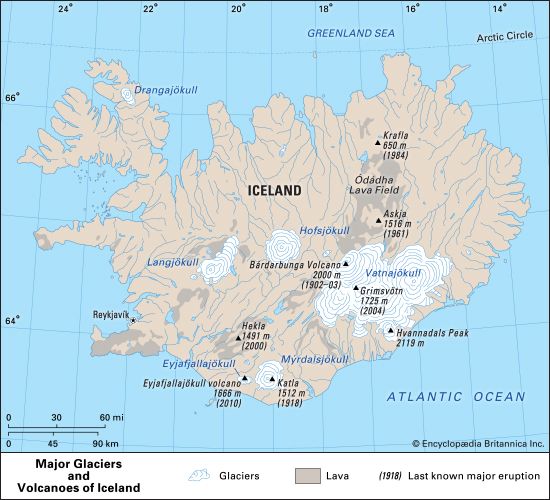
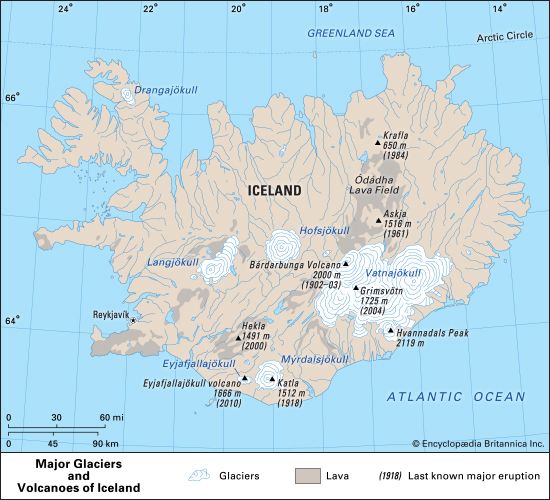
Iceland is home to five major ice caps that define much of its rugged landscape. Beyond Langjökull, the most prominent glaciers include:7
- Vatnajökull: The largest ice field in the country, covering approximately 3,200 square miles (8,400 square km). It contains several active volcanoes, including Grímsvötn, and reaches its highest point at Hvannadals Peak.12
- Hofsjökull: Located in central Iceland, this large, circular glacier spans about 384 square miles (994 square km). It serves as a vital water source for several major rivers, including the Thjórsá and Blanda.13
- Mýrdalsjökull: Situated in southern Iceland, this glacier covers 268 square miles (695 square km) and famously surrounds the active volcano [Katla]13.
- Eyjafjallajökull: Once considered a western extension of Mýrdalsjökull, it is now separated by the Fimmvörduhálss Pass. It gained international attention following its volcanic eruption in 2010.149
Sources
- Langjökull — Encyclopædia Britannica
- glacier - Transformation of snow to ice — Encyclopædia Britannica
- hydrologic sciences - The accumulation of ice — Encyclopædia Britannica
- What’s the Difference Between a Glacier and an Ice Floe? — Encyclopædia Britannica
- glacier - Heat or energy balance — Encyclopædia Britannica
- Iceland - Lakes and rivers of Iceland — Encyclopædia Britannica
- Iceland - Land — Encyclopædia Britannica
- iceberg - Impacts on ice sheets and sea level — Encyclopædia Britannica
- Arctic - Other glacier groups — Encyclopædia Britannica
- glacier - Glacier floods — Encyclopædia Britannica
- Global warming - Ocean circulation changes — Encyclopædia Britannica
- Hofsjökull — Encyclopædia Britannica
- Mýrdalsjökull — Encyclopædia Britannica
- Vatnajökull — Encyclopædia Britannica
Published on · 3 min read