Kwajalein Atoll
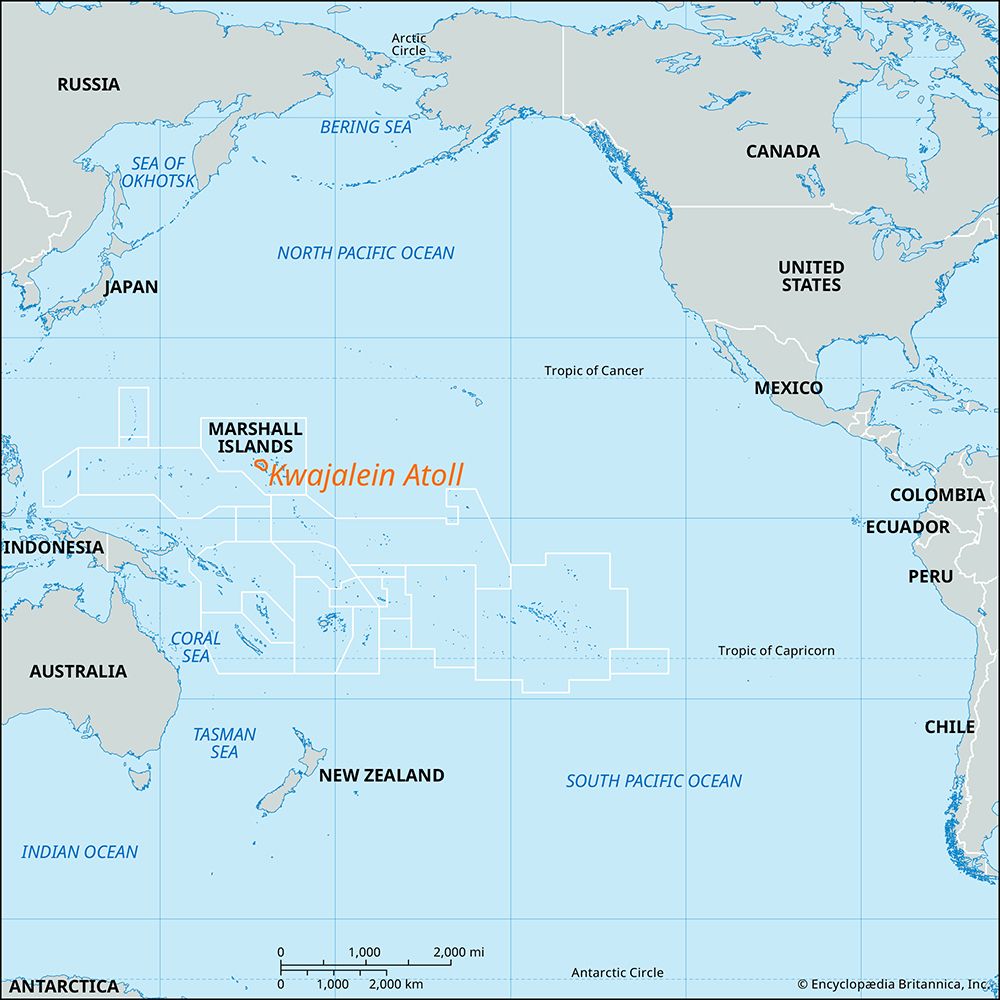
Kwajalein Atoll is a coral formation located in the Ralik chain of the Marshall Islands within the west-central Pacific Ocean. It consists of approximately…
What is Kwajalein Atoll?
Kwajalein Atoll is a coral formation located in the Ralik chain of the Marshall Islands within the west-central Pacific Ocean. It consists of approximately 90 islets that encompass the world’s largest lagoon, covering 655 square miles (1,722 square km).1
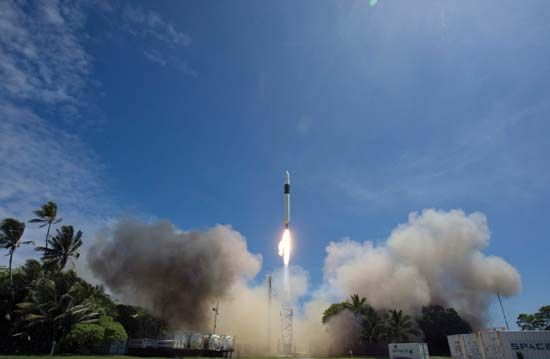
Historically, the islets of Kwajalein, Roi, and Namur were the first locations in the Marshall Islands captured by U.S. forces during World War II. Today, the atoll functions as a vital seaport, an air stop, and a U.S. military missile-testing site.1
How are coral atolls formed?
The formation of coral atolls is primarily explained by the subsidence theory, first proposed by Charles Darwin in 1842. This process involves several stages:34
- Fringing Reef Stage: Coral reefs initially develop as a fringe around a volcanic island.34
- Barrier Reef Stage: As the volcanic island gradually subsides or the sea level rises, the reef continues to grow upward and outward. A lagoon forms between the reef and the sinking landmass.34
- Atoll Stage: Eventually, the volcanic island disappears completely beneath the surface, leaving behind a ring-shaped reef that encloses a central lagoon.34
While subsidence is a primary driver, plate-tectonic theory also explains the development of mid-ocean reefs as the ocean floor subsides while spreading from oceanic ridges. Additionally, fluctuations in sea level—particularly those resulting from Pleistocene Epoch glaciation cycles—have significantly influenced the growth and structure of many modern reefs. Some annular reefs may also form through the erosion of uplifted limestone platforms, which later submerge, allowing coral growth to resume along the rim.34
What was the significance of the Marshall Islands during World War II?
During World War II, the Marshall Islands held significant strategic importance as a Japanese-mandated territory that had been secretly fortified prior to the attack on Pearl Harbor. By late 1943, the Japanese recognized the islands could not be held indefinitely, but they intended to use them to delay the Allied advance and inflict heavy costs on U.S. forces operating far from their supply lines.6
The U.S. campaign to capture the islands, directed by the Joint Chiefs of Staff, focused on key atolls like Kwajalein and Eniwetok. The successful seizure of these positions in early 1944 was a critical step in the Allied offensive toward Japan. By securing these atolls and neutralizing the nearby Japanese base at Truk, the U.S. Pacific Fleet effectively cleared the path to the Mariana Islands, bringing the Allies significantly closer to the Japanese home islands.6
What is the difference between a lagoon and an ocean?
The primary difference between a lagoon and an ocean lies in their scale, connectivity, and physical characteristics.
- Definition and Scale: The ocean is a vast, continuous body of saltwater that covers approximately 71% of Earth’s surface, with an average depth of about 3,688 meters. In contrast, a lagoon is a relatively shallow, quiet area of water situated in a coastal environment.789
- Separation: While the ocean is an open, interconnected expanse not confined by land, a lagoon is separated from the open marine environment by a barrier. This barrier may be a sandy or shingly feature, such as a sandbar or barrier island, or it may be a coral reef.97
- Sedimentation: Lagoonal environments are characterized by quieter waters compared to the open ocean, leading to higher rates of sedimentation. These sediments often contain significant amounts of calcareous material or fine muds, which differ from the sediments found on the open ocean shelf.910
Sources
- Kwajalein Atoll — Encyclopædia Britannica
- Kwajalein — Merriam-Webster
- coral reef - Origin and development of reefs — Encyclopædia Britannica
- atoll — Encyclopædia Britannica
- coral reef - Types of coral reefs — Encyclopædia Britannica
- Pacific War - The Central Pacific Islands — Encyclopædia Britannica
- lagoon — Merriam-Webster
- lagoon — Encyclopædia Britannica
- ocean — Merriam-Webster
- lagoon - Barrier bars and sediment sources — Encyclopædia Britannica
- lagoons — Merriam-Webster
- lagoon - Coral lagoons — Encyclopædia Britannica
- Ocean vs. Sea: What’s the Difference? — Encyclopædia Britannica
- Just How Many Oceans Are There? — Encyclopædia Britannica
Published on · 3 min read