La Ferrassie
The oldest fossils discovered at the La Ferrassie rock shelter in France are estimated to date from approximately 50,000 years ago. These remains, which…
How old are the artifacts and fossils found at La Ferrassie?
The oldest fossils discovered at the La Ferrassie rock shelter in France are estimated to date from approximately 50,000 years ago. These remains, which include eight Neanderthal skeletons, are associated with stone tools from the Middle Paleolithic Period.1
The site is significant for providing evidence of intentional burial practices among Neanderthals, suggesting a complex system of ritual behavior. While the site was excavated between 1909 and 1921, the investigation of these remains continued for decades, with final analysis completed in 1982.1
Are there any signs of interaction between Neanderthals and early modern humans at La Ferrassie?
The current archaeological record for the La Ferrassie rock shelter does not provide direct evidence of interaction between Neanderthals and early modern humans at that specific site. The fossils and artifacts recovered there are primarily associated with Neanderthal occupation during the Middle Paleolithic Period, dating back to approximately 50,000 years ago.1
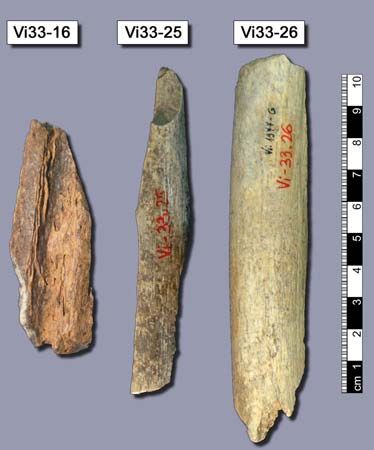
While some other European sites, such as Vindija in Croatia or Saint-Césaire in France, have yielded evidence suggesting that Neanderthals and early modern humans coexisted or shared technological influences, La Ferrassie is primarily noted for its significant evidence of intentional burial practices and complex ritual behavior among Neanderthals. Evidence of interaction, such as the exchange of mates or cultural blending, remains a subject of broader study across the European continent rather than a confirmed feature of the La Ferrassie findings.145
How has the La Ferrassie site contributed to our understanding of Neanderthal burial practices?
The La Ferrassie site has been instrumental in shifting the scientific understanding of Neanderthal behavior, providing compelling evidence that they practiced intentional burial of their dead. By uncovering the remains of eight individuals—including adults, children, and newborns—researchers identified that these groups took considerable care with their deceased, suggesting a level of social cohesion and symbolic thought previously underestimated in Neanderthals.15
Key findings that highlight this complex ritual behavior include:
- Intentional Placement: The discovery of multiple individuals buried at the site indicates that these were not accidental deaths but deliberate interments.15
- Symbolic Markers: One specific grave featured a child’s skull covered by a limestone slab marked with intentional designs on its underside, pointing to a sophisticated system of ritual.1
- Cognitive Complexity: These burial practices, alongside the presence of nonutilitarian artifacts and evidence of cave art at other sites, demonstrate that Neanderthals possessed cognitive functions beyond basic survival needs.5
What significant Neanderthal remains have been discovered at La Ferrassie?
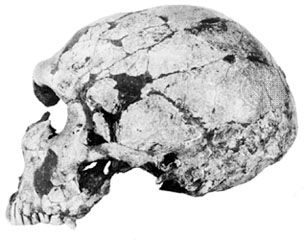
The La Ferrassie rock shelter in France is a significant paleoanthropological site that yielded the remains of eight Neanderthal individuals, including an adult man, an adult woman, a 10-year-old child, a 3- to 5-year-old child, an infant, and three newborns.1
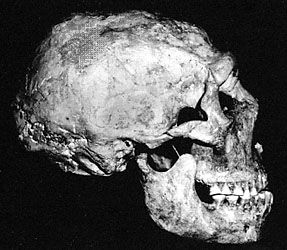
These fossils, which date back approximately 50,000 years, exhibit classic Neanderthal characteristics. The adult male skull, for instance, features a large brow, a sloping forehead, and a protruding midface. Additionally, analysis of the teeth shows that while the cheek teeth are small, the front teeth are large and heavily worn, suggesting they were frequently used as tools.1
Beyond the physical remains, the site is renowned for providing evidence of intentional burial practices. The discovery of these family groups, including multiple children and infants, indicates that Neanderthals cared for their dead. One notable grave contained a child’s skull covered by a limestone slab marked with designs on its underside, which points to a sophisticated system of ritual and symbolic behavior.15
Sources
- La Ferrassie — Encyclopædia Britannica
- Arago — Encyclopædia Britannica
- Neanderthal - First discoveries — Encyclopædia Britannica
- Vindija — Encyclopædia Britannica
- Neanderthal - Neanderthal culture — Encyclopædia Britannica
Published on · 3 min read