Saint-Césaire
The Saint-Césaire site in southwestern France is a pivotal location for understanding Neanderthal culture and behavior. Discovered in 1979, the site yielded…
How does the Saint-Césaire site contribute to our understanding of Neanderthal culture and behavior?
The Saint-Césaire site in southwestern France is a pivotal location for understanding Neanderthal culture and behavior. Discovered in 1979, the site yielded the remains of a young adult male Neanderthal dated to approximately 36,000 years ago, buried in a small pit.1
This discovery significantly altered the scientific understanding of Neanderthal capabilities in several ways:
- Advanced Technology: The skeleton was found in association with the Châtelperronian industry, a sophisticated blade-tool technology previously attributed solely to early modern humans (Homo sapiens). This suggests that Neanderthals were capable of developing or adopting complex cultural behaviors once thought to be exclusive to modern humans.12
- Symbolic Behavior: The presence of a marine shell buried with the individual, despite the site’s inland location, provides evidence of symbolic or ritualistic behavior. This is further supported by the site’s inclusion among locations where Neanderthal burial practices have been identified, indicating complex social and cognitive functions.12
- Anatomical Evolution: The remains exhibit a reduction in facial size and brow projection compared to earlier Neanderthals, showing a trend toward features more similar to modern humans, which helps clarify the evolutionary trajectory of late Neanderthal populations.1
What controversies or debates, if any, have arisen from the findings at Saint-Césaire?
The primary debate surrounding the findings at Saint-Césaire concerns the authorship of the Châtelperronian industry. Because these sophisticated blade tools were historically associated exclusively with early modern humans (Homo sapiens), the discovery of a Neanderthal skeleton in direct association with these artifacts challenged long-held assumptions about Neanderthal cognitive and cultural capabilities.1
While some researchers argue that the evidence confirms Neanderthals were responsible for these advanced cultural developments, the site remains central to broader discussions regarding the nature of Neanderthal-human interactions. Specifically, scholars debate whether Neanderthals independently developed this technology or if they acquired it through cultural diffusion or imitation after contact with modern humans.12
This debate is part of a larger scientific inquiry into whether Neanderthals possessed symbolic behavior, a topic that has seen similar controversies at other sites, such as the debate over whether a flutelike instrument found in Slovenia was intentionally crafted by Neanderthals or merely damaged by animal activity.2
What type of Neanderthal remains were found at Saint-Césaire, and how old are they?
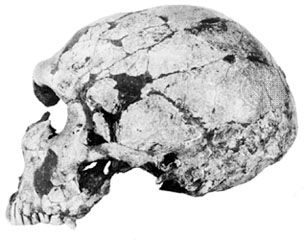
At the Saint-Césaire site in southwestern France, archaeologists discovered the remains of a young adult male Neanderthal in 1979. These remains, which were found buried in a small pit at the back of the Roche-à-Pierrot rock shelter, date to approximately 36,000 years ago.1
Although the skeleton is badly crushed, most of the skeletal pieces have been accounted for. The individual displays typical European Neanderthal characteristics, though with some notable evolutionary shifts: the teeth are relatively modest in size, and the brow region and jaws are more lightly built than those of earlier Neanderthals, suggesting a reduction in facial size. Additionally, the limb bones bear a resemblance to those of early modern humans, which may indicate changes in patterns of locomotion and arm use.1
How does the Saint-Césaire site compare to other important Neanderthal sites in Europe?
The Saint-Césaire site is a pivotal location in paleoanthropology, primarily because it challenges traditional distinctions between Neanderthals and early modern humans (Homo sapiens).
Key Comparisons
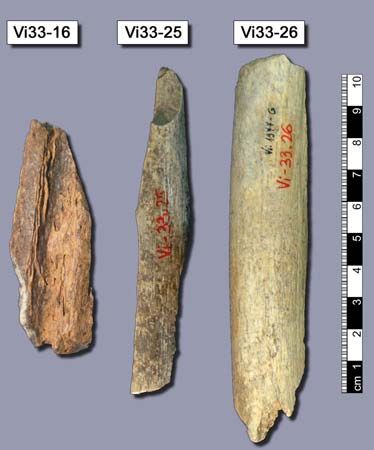
- Technological Association: Unlike many earlier sites such as La Ferrassie, where Neanderthals are associated with classic Middle Paleolithic tools, Saint-Césaire is significant for its association with advanced blade tools previously attributed only to early modern humans. This pattern is also observed at the Grotte du Renne and Vindija in Croatia.15
- Anatomical Evolution: The Saint-Césaire individual exhibits a reduction in facial size and brow prominence compared to “classic” Neanderthals. This trend toward a more lightly built face and changes in limb bone structure mirrors findings at late Neanderthal sites in central Europe, particularly Vindija, suggesting a regional pattern of evolutionary transition.15
- Chronology and Coexistence: Dating to approximately 36,000 years ago, Saint-Césaire represents one of the later Neanderthal populations. Its timeline aligns with the arrival of early modern humans in Europe, supporting evidence from sites like Vindija that these groups were contemporaneous and likely coexisted for several millennia rather than experiencing immediate replacement.15
Sources
- Saint-Césaire — Encyclopædia Britannica
- Neanderthal - Neanderthal culture — Encyclopædia Britannica
- Perigordian industry — Encyclopædia Britannica
- Vindija — Encyclopædia Britannica
- Neanderthal - First discoveries — Encyclopædia Britannica
- La Ferrassie — Encyclopædia Britannica
Published on · 3 min read