Lake Albano
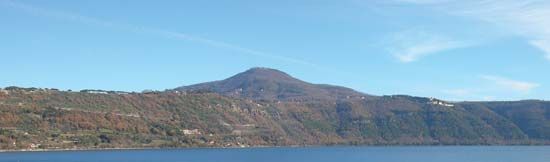
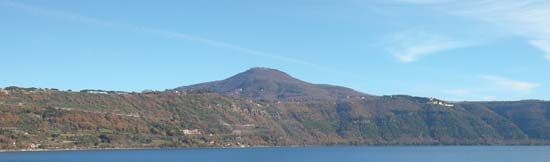
Lake Albano is an elliptical crater lake situated in the Alban Hills, southeast of Rome, Italy. Formed by the fusion of two ancient volcanic craters, the…
What is Lake Albano?
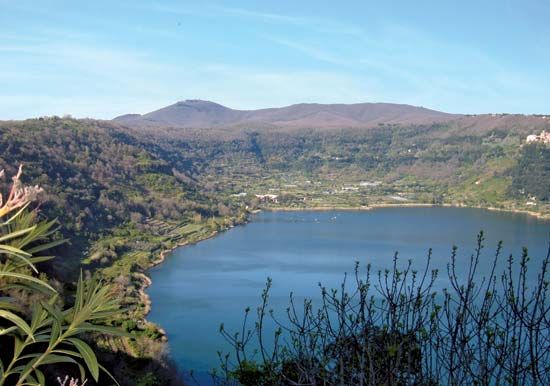
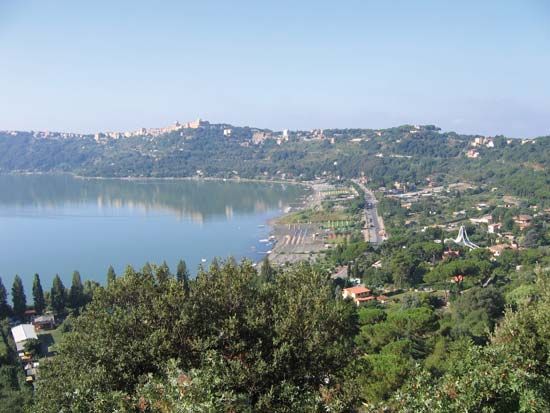
Lake Albano is an elliptical crater lake situated in the Alban Hills, southeast of Rome, Italy. Formed by the fusion of two ancient volcanic craters, the lake covers an area of 2 square miles (5 square km) and reaches a maximum depth of 558 feet (170 m).12
The lake is fed by underground sources and features an artificial outlet that dates back to 398–397 BCE; according to legend, this was constructed after the oracle at Delphi declared that the Etruscan stronghold of Veii could only be conquered once the lake’s waters reached the sea.1
The surrounding area is home to several towns, most notably Castel Gandolfo, which serves as the summer residence of the popes. The village is well-regarded for its local produce, including wine, peaches, and fish sourced from the lake.13
How are crater lakes formed by volcanoes?
Crater lakes are formed through various volcanic processes that create depressions in the Earth’s surface, which subsequently fill with water. These basins can originate in several ways:4
- Volcanic Craters: Some lakes occupy the actual craters of volcanoes. While rare, they can form in unmodified cinder cones. Others are created by explosive volcanic activity or the collapse of the roofs of underground magma chambers.4
- Maars: These are specific types of craters formed by the explosion of new volcanic sources. They are often built of nonvolcanic material and are found in regions such as Germany, Italy, Iceland, and New Zealand.4
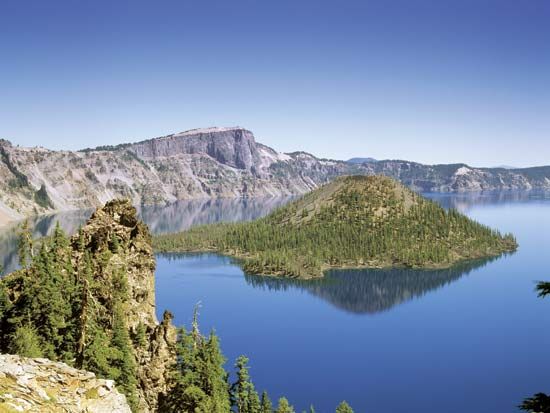
- Calderas: These are large, bowl-shaped depressions—typically over one kilometer in diameter—formed by the inward collapse of a volcanic cone after a large volume of magma is expelled from an underlying reservoir. The loss of support causes the top of the mountain to drop into the void, leaving a massive hole that may later fill with water. Crater Lake is a classic example of this process.564
- Lava Flows and Damming: Basins can also arise from the collapse of the interior of large lava flows or when lava flows interrupt existing drainage patterns, effectively damming a valley.4
What was the significance of the ancient city of Veii?
The ancient city of Veii was a significant Etruscan power located approximately 10 miles northwest of Rome. Its importance and influence are highlighted by several key factors:
- Cultural and Artistic Hub: During the 6th century BCE, Veii was the preeminent center for terra-cotta sculpture in Etruria. The renowned artist Vulca of Veii is credited with creating the statues for the Temple of Jupiter on the Roman Capitol. The city also contains the Grotta Campana, which houses the oldest known Etruscan frescoes.8
- Regional Hegemony: In the 7th and 6th centuries BCE, Veii held hegemony over Rome. Its eventual conquest by Rome in 396 BCE, following a legendary 10-year war, was a pivotal moment that increased Roman territory by 84 percent and opened southern Etruria to further Roman expansion.89
- Religious Significance: Veii remained a notable religious center for centuries, even after its initial destruction. It was so central to the regional consciousness that, according to legend, the Romans constructed an artificial outlet for Lake Albano to fulfill an oracle’s prophecy required for the city’s capture.810
What is the history of the Vatican Observatory?
Sources
- Lake Albano — Encyclopædia Britannica
- Castel Gandolfo — Encyclopædia Britannica
- Albano, Lake — Merriam-Webster
- lake - Basins formed by tectonism , volcanism, and landslides — Encyclopædia Britannica
- caldera — Encyclopædia Britannica
- volcano - Calderas — Encyclopædia Britannica
- Crater — Encyclopædia Britannica
- Veii — Encyclopædia Britannica
- Rome - The early Roman Republic — Encyclopædia Britannica
- ancient Rome - Roman expansion in Italy — Encyclopædia Britannica
Published on · 2 min read