Lake Biel
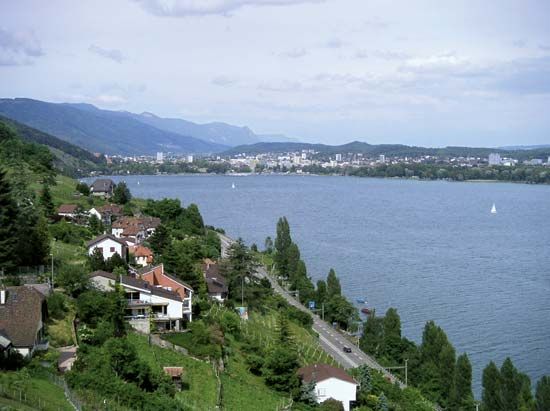
Lake Biel is a lake located in western Switzerland at the base of the Jura Mountains. Situated at an elevation of 1,407 feet (429 metres), it spans 15 square…
What is Lake Biel?
Lake Biel is a lake located in western Switzerland at the base of the Jura Mountains. Situated at an elevation of 1,407 feet (429 metres), it spans 15 square miles (39 square km) and reaches a maximum depth of 246 feet (75 metres).1
The lake is fed by the Suze and Thièle rivers, while the Aare River flows into it via the Hagneck Canal and exits at the town of Nidau. The shores are known for their vineyards, and the lake contains the Île Saint-Pierre, an island notable for its prehistoric lake dwellings. The primary town on its shore is Biel (Bienne), which is recognized as Switzerland’s only officially bilingual city.12
What are prehistoric lake dwellings?
Prehistoric lake dwellings, or Pfahlbauten (“pile structures”), are the remains of ancient settlements found along the margins of lakes in regions including Switzerland, southern Germany, France, and Italy.3
Construction and Theory
In the mid-19th century, Swiss archaeologist Ferdinand Keller theorized that these villages were built on platforms supported by wooden piles driven into lake beds. According to this model, tree trunks and branches formed a platform for rectangular huts with clay floors, which helped protect against fire. However, modern anthropologists suggest these structures were likely built over swampy land along the lakeshore rather than directly above open water.34
Historical Significance
These sites have been vital for understanding European prehistory. Because inhabitants often rebuilt villages on top of older remains, archaeologists established a clear cultural sequence, confirming that the Stone Age was followed by the Bronze Age and Iron Age. Excavations have yielded significant artifacts, including pottery, flints, bronze jewelry, and even organic materials like basketry and cloth.34
Why is Biel considered a bilingual town?
Biel is considered a bilingual town because it is situated directly on the language boundary between the German-speaking and French-speaking regions of Switzerland. As a result of this unique geographic position, the town’s population is composed of approximately two-thirds German speakers and one-third French speakers.2
This demographic makeup has led to Biel being officially recognized as the only bilingual town in the country. While Switzerland as a whole recognizes four national languages—French, German, Italian, and Romansh—Biel stands out for its formal integration of both German and French into its civic and daily life.26
How do the Jura Mountains affect the region’s climate?
The Jura Mountains significantly influence the regional climate through their topography and elevation, creating a maritime-continental transitional climate.1
- Temperature Variations: The climate is notably rawer on the mountain heights, while the protected valleys and south-facing slopes experience milder conditions. During autumn and winter, the region frequently experiences temperature inversions, where cold air masses become trapped in high valleys and low-lying basins, often resulting in persistent fog while higher elevations remain warm and clear.111
- Precipitation Patterns: The mountains act as a physical screen that affects rainfall distribution. For instance, the Jura can diminish rainfall in certain areas, such as near Geneva. Overall, annual precipitation varies significantly across the range, exceeding 80 inches (2,030 mm) in some southern and western locations while remaining under 40 inches (1,000 mm) in more sheltered valleys.121
Sources
- Lake Biel — Encyclopædia Britannica
- Biel — Encyclopædia Britannica
- Lake Dwellings — Encyclopædia Britannica
- Ferdinand Keller — Encyclopædia Britannica
- LBK culture — Encyclopædia Britannica
- Switzerland: Country Facts — Encyclopædia Britannica
- Biel — Merriam-Webster
- Swiss literature — Encyclopædia Britannica
- Bern — Encyclopædia Britannica
- Fleming and Walloon — Encyclopædia Britannica
- Jura Mountains — Encyclopædia Britannica
- Switzerland - Skies and temperatures — Encyclopædia Britannica
- Geneva - Climate — Encyclopædia Britannica
Published on · 2 min read