Windermere
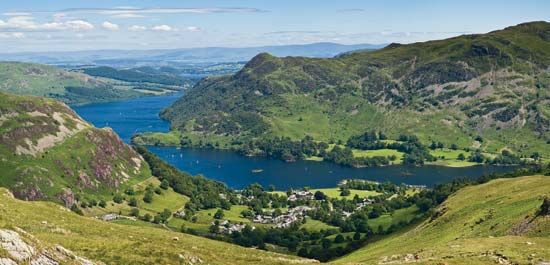
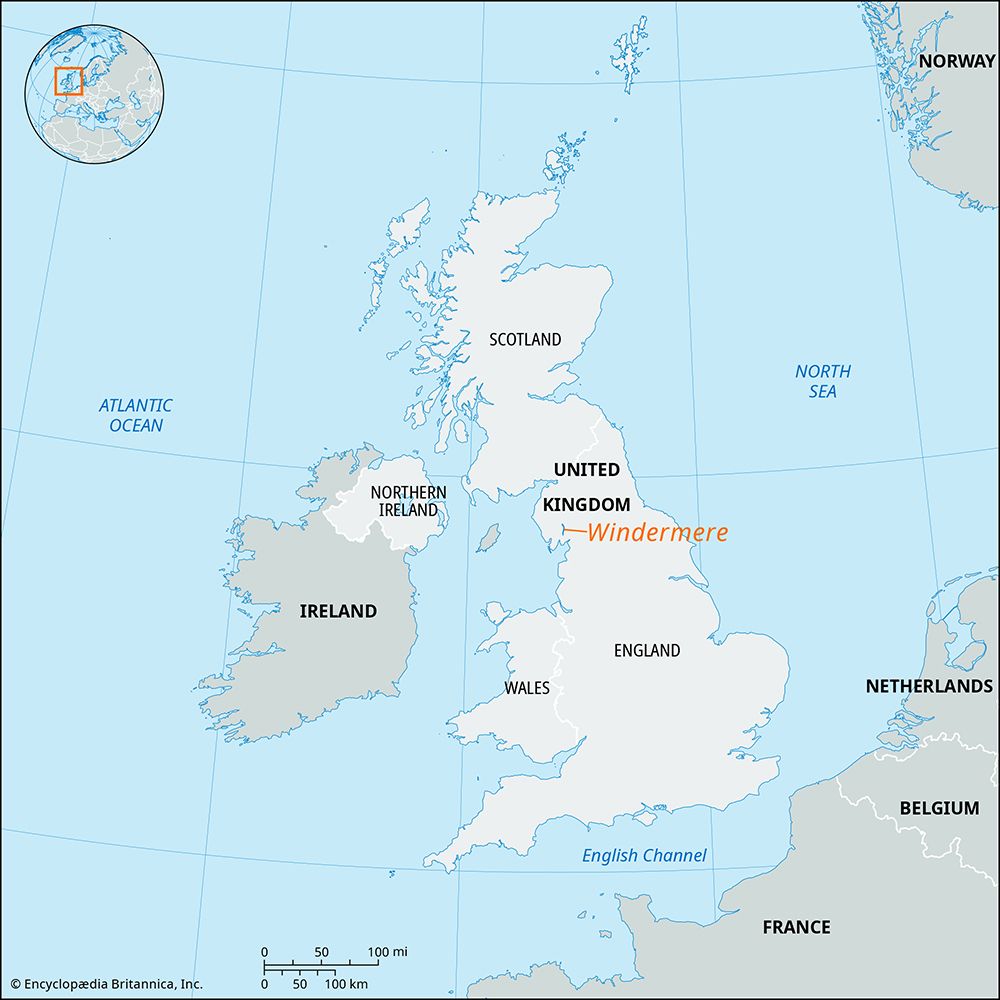
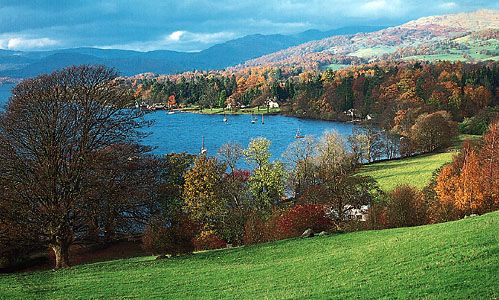
Windermere is the largest lake in England, situated within the Lake District in the county of Cumbria.
What is Windermere?
Windermere is the largest lake in England, situated within the Lake District in the county of Cumbria.12
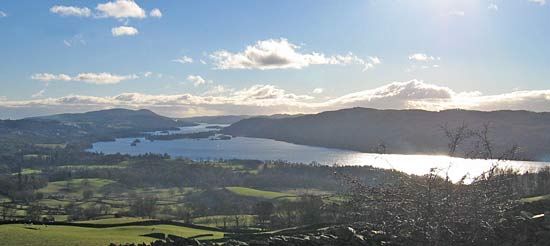
Spanning 10.5 miles (17 km) in length and 1 mile (1.6 km) in width, the lake covers an area of 6 square miles (16 square km). It is divided into two basins by a collection of islands located near the town of Bowness-on-Windermere and is drained by the River Leven.1
As a prominent feature of the Lake District National Park, the area is a popular tourist destination, offering facilities for yachting and summer steamer services. The town of Windermere is located adjacent to Bowness, serving as a gateway to this scenic region.12
How did glaciers shape the landscape of the Lake District?
The landscape of the Lake District has been profoundly transformed by glacial action, which reshaped the region’s original river-carved valleys into the dramatic scenery seen today.2
Key geological impacts of this process include:
- Valley Deepening and Widening: Glaciers, which possess greater mass and viscosity than rivers, eroded the floors and lower sidewalls of existing valleys. This process converted V-shaped stream valleys into characteristic U-shaped valleys with steep, often vertical sides and broad, flat bottoms.234
- Formation of Rock Basins: Glacial erosion scoured out deep basins in the bedrock. When the ice retreated, these depressions filled with water, creating the region’s famous lakes, such as Windermere, Esthwaite Water, and Coniston Water.24
- Hanging Valleys: As main glaciers deepened the primary valleys more aggressively than smaller tributary glaciers, the tributary valleys were left stranded high above the main valley floor. These hanging valleys often feature waterfalls where streams descend to the main valley level.23
These glacial processes, combined with the region’s underlying dome-like geological structure, created the distinctive, lake-strewn topography that defines the area.2
Who was William Wordsworth and why is he associated with this region?
William Wordsworth (1770–1850) was a seminal English poet whose collaboration with Samuel Taylor Coleridge on Lyrical Ballads (1798) helped launch the English Romantic movement. His revolutionary approach to poetry emphasized using the language of common life to describe everyday situations, fundamentally altering the course of English-language literature.7
Wordsworth is inextricably linked to the Lake District for several reasons:
- Birthplace and Home: Born in Cockermouth, he spent his formative years attending school in Hawkshead and later settled in Grasmere at Dove Cottage.289
- Literary Inspiration: The region’s natural beauty served as a primary muse for his work. His poetry, such as “I Wandered Lonely as a Cloud,” draws directly from the landscapes and flora of the area.109
- The “Lake Poets”: He is the most famous of the “Lake poets,” a group of writers who lived in the region during the early 19th century.10
- Legacy: He is buried in the Grasmere churchyard alongside his sister, Dorothy Wordsworth, who was his lifelong companion and a significant influence on his creative process.29
What are some other major lakes found in the Lake District National Park?
The Lake District National Park is home to numerous significant lakes, each contributing to the region’s famous scenic character. Beyond the largest lake, Windermere, several other major bodies of water are found throughout the area:
- Ullswater: As the second-largest lake in the district, it stretches approximately 7.5 miles in length and reaches depths of up to 205 feet.1
- Derwent Water: Located near the market town of Keswick, this lake is known for its well-wooded shores and several islands, including the historic Lords Island.2
- Coniston Water: Situated in the southern part of the region, this lake is surrounded by the lower hills of Silurian slates and grits.11
- Esthwaite Water: Located near Coniston Water, this is another prominent lake set within the southern landscape of the park.11
- Thirlmere: This lake is notable for its role as a reservoir, which provides water to industrial northwestern England.11
Sources
- Windermere — Encyclopædia Britannica
- Lake District — Encyclopædia Britannica
- glacial valley — Encyclopædia Britannica
- glacial landform - Cirques , tarns, U-shaped valleys, arêtes, and horns — Encyclopædia Britannica
- glacial landform - Paternoster lakes — Encyclopædia Britannica
- glacial landform - Striations — Encyclopædia Britannica
- William Wordsworth — Encyclopædia Britannica
- Lake poet — Encyclopædia Britannica
- William Wordsworth - Early life and education — Encyclopædia Britannica
- Dorothy Wordsworth — Encyclopædia Britannica
- Derwent Water — Encyclopædia Britannica
- Ullswater — Encyclopædia Britannica
Published on · 3 min read