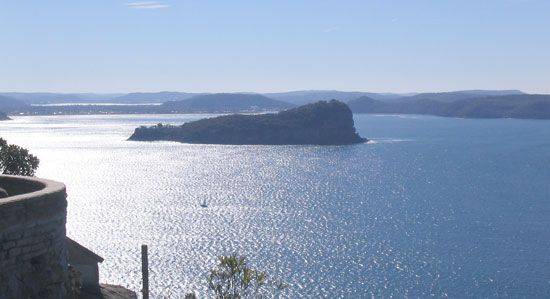
Lake Burragorang
Lake Burragorang is a major reservoir located in east-central New South Wales, Australia, serving as a primary water source for Sydney.
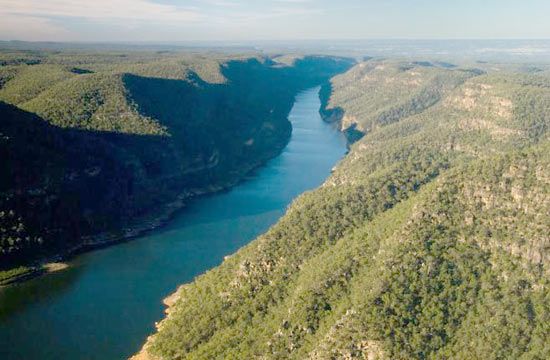
What is Lake Burragorang?
Lake Burragorang is a major reservoir located in east-central New South Wales, Australia, serving as a primary water source for Sydney.1
The lake occupies the Burragorang Valley, a gorge formed by the confluence of the Coxs and Wollondilly rivers, which together create the Warragamba River—a tributary of the Hawkesbury. It is held by the Warragamba Dam, a structure completed in 1960 that stands 449 feet (137 meters) high.1
Spanning approximately 34 square miles (88 square kilometers), the reservoir holds over 2 billion cubic meters of water. Beyond its role in water storage, the facility is utilized for hydroelectricity generation and flood control.1
How does the Warragamba Dam generate hydroelectricity?
The Warragamba Dam generates hydroelectric power by utilizing the potential energy of stored water from Lake Burragorang.
The process follows the standard principles of hydroelectric generation:
- Water Collection: Water is stored at a higher elevation behind the dam, creating a “head”—the vertical distance between the reservoir level and the lower elevation where the water is released.1
- Conveyance: The water is directed downward through large pipes or tunnels known as penstocks.1
- Energy Conversion: As the water flows down, its potential energy is converted into mechanical energy, which causes turbines to rotate.1
- Electricity Generation: These rotating turbines drive generators, which convert the mechanical energy into electricity. Transformers then increase the voltage for efficient long-distance transmission.1
While the dam is primarily a water supply reservoir for Sydney, it integrates these systems to produce power and assist in flood control.21
What impact did the creation of the lake have on the Burragorang Valley?
The creation of Lake Burragorang fundamentally transformed the Burragorang Valley by submerging the natural gorge that had been carved by the confluence of the Coxs and Wollondilly rivers.
Prior to the completion of the Warragamba Dam in 1960, the valley was a distinct geographic feature. The construction of the dam effectively turned this valley into a massive reservoir, covering approximately 34 square miles (88 square kilometers) to provide a primary water supply for Sydney. By impounding the water, the project permanently altered the local landscape, replacing the riverine environment with a deep, controlled body of water that now serves critical functions in flood mitigation and hydroelectric power generation.1
How do engineers manage flood control using reservoirs?
Engineers manage flood control using reservoirs by impounding excess water during periods of high flow and releasing it gradually during periods of low flow. This process utilizes the “lag effect,” where the reservoir slows the passage of a flood, thereby reducing the peak discharge rate downstream compared to what would occur naturally.345
Key engineering strategies for flood management include:
- Spillway Systems: These are critical safety passages designed to discharge surplus water when a reservoir reaches capacity. They ensure that the water level does not rise to a point that threatens the dam’s structural integrity, which could lead to catastrophic failure.45
- Automatic Discharge: Effective spillways are designed to operate automatically, ensuring that the largest floods can pass without causing nuisances to upstream property owners.45
- Energy Dissipation: Because water flowing over a spillway can reach high speeds, engineers incorporate structures like stilling basins, “kickers,” or ski-jump designs to dissipate the water’s erosive energy, preventing damage to the dam foundation and the downstream riverbed.45
- Strategic Sluicing: In some systems, engineers allow silt-laden floodwater to pass through sluices early in the season, storing only the cleaner water to preserve the reservoir’s long-term storage capacity.6
Sources
- Lake Burragorang — Encyclopædia Britannica
- hydroelectric power — Encyclopædia Britannica
- spillway — Encyclopædia Britannica
- reservoir — Encyclopædia Britannica
- dam - Spillways — Encyclopædia Britannica
- lake - The water budget — Encyclopædia Britannica
- dam - Reservoirs — Encyclopædia Britannica
Published on · 3 min read