Lake Eyre
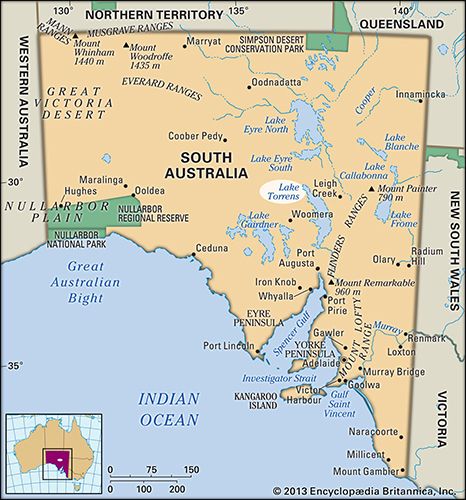
Lake Eyre is a massive salt lake situated in central South Australia. It serves as the lowest point on the Australian continent, with its base resting…
What is Lake Eyre and where is it located in Australia?
Lake Eyre is a massive salt lake situated in central South Australia. It serves as the lowest point on the Australian continent, with its base resting approximately 50 feet (15 metres) below sea level1.
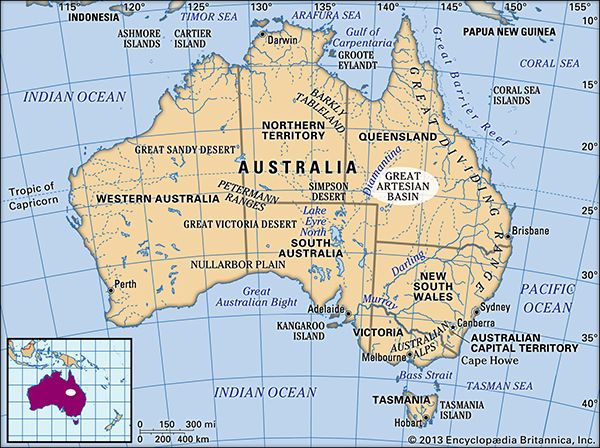
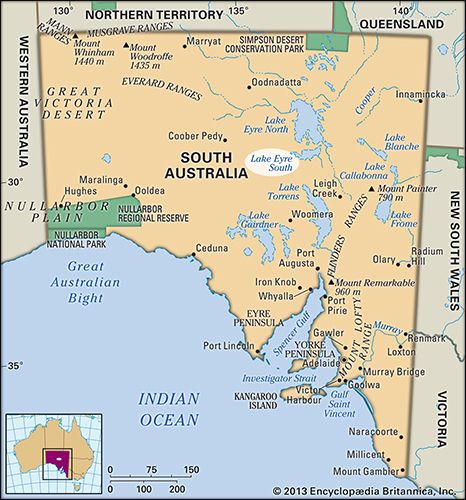
The lake is located within the southwestern corner of the Great Artesian Basin and consists of two primary sections, Lake Eyre North and Lake Eyre South, which are connected by the Goyder Channel. Because the region experiences very low annual rainfall and high rates of evaporation, the lake is typically dry, featuring a salt-crusted bed. It only fills completely on average twice per century, relying on floodwaters from internal drainage basins to reach capacity. Named after the explorer Edward John Eyre, the site is also known for its extremely level surface, which has been utilized for land-speed record attempts.1
What unique geological features characterize Lake Eyre and its surrounding basin?
Lake Eyre and its surrounding Eyre Basin are defined by distinct geological processes and arid-land features:
Structural Origins
The Lake Eyre depression is primarily of structural origin, formed by downfaulting in the Earth’s surface approximately 30,000 years ago, which blocked an earlier outlet to the sea. This process created a massive saline depression that serves as the lowest point on the Australian continent, sitting about 50 feet (15 metres) below sea level.12
Surface and Soil Characteristics
- Gibber Plains: The basin is characterized by extensive stony deserts covered in a mantle of gibber (stony debris). This debris originated from the disintegration of silcrete—a hard rock residue about 20 million years old—which was subsequently shaped by erosive forces.2
- Salt Crusts: As an evaporite environment, the lake bed is typically dry and covered in a crust of sodium chloride. In the southern portions of the lake, this salt crust can reach thicknesses of up to 18 inches (46 cm).12
- Dunes and Alluvium: The basin contains vast quantities of sediment transported by intermittent river systems. This material provides the source for the Simpson Desert sand dunes, while fine dust from the surface is frequently winnowed by wind to create dust storms.2
How has Lake Eyre been used for land speed record attempts, and why is it suitable for this purpose?
Lake Eyre has served as a venue for world land-speed record attempts due to its unique physical characteristics. Its primary suitability for this purpose lies in its extremely level surface, which provides an ideal track for high-speed vehicles.1
The lake bed is typically dry, covered by a thin crust of salt deposited through the rapid evaporation of water. This vast, flat expanse offers the necessary space and stability for vehicles to reach extreme velocities. A notable instance of this occurred in 1964, when Donald Campbell successfully drove his vehicle, Bluebird II, at speeds exceeding 400 miles (644 km) per hour across the salt crust.1
Because the lake is normally dry and experiences very low annual rainfall, it remains a viable, albeit intermittent, location for such specialized automotive testing.
What is the history behind the naming of Lake Eyre?
Lake Eyre is named after the English explorer and colonial official Edward John Eyre. The naming commemorates his 1840 expedition, during which he became the first European to sight the massive salt lake in central South Australia.5
Edward John Eyre arrived in Australia in 1833 and gained prominence as a pioneer “overlander” and explorer. Beyond his exploration of the desert northwest of Adelaide and the Great Australian Bight, he served in various colonial administrative roles across the British Empire, including as governor of Jamaica. His career was marked by significant controversy, particularly regarding his brutal suppression of the 1865 Morant Bay rebellion, which led to intense debate among British intellectuals of the era.1
Sources
- Lake Eyre — Encyclopædia Britannica
- Great Artesian Basin — Encyclopædia Britannica
- Australia - The Interior Lowlands — Encyclopædia Britannica
- Eyre, Lake — Merriam-Webster
- Edward John Eyre — Encyclopædia Britannica
Published on · 3 min read