Lake Torrens
Lake Torrens is an intermittent, shallow salt lake located in east-central South Australia, situated west of the Flinders Ranges and approximately 215 miles…
What is Lake Torrens?
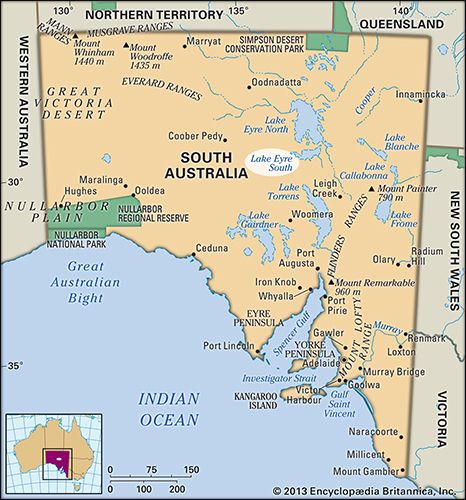
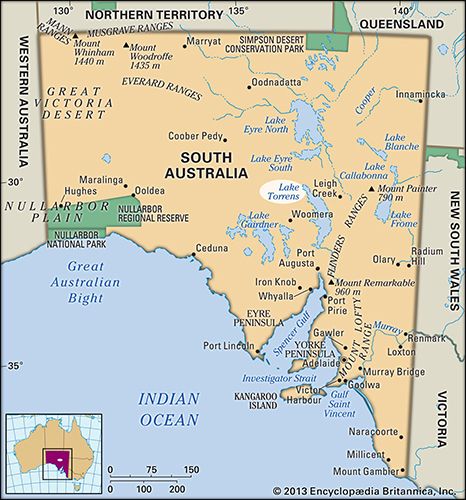
Lake Torrens is an intermittent, shallow salt lake located in east-central South Australia, situated west of the Flinders Ranges and approximately 215 miles (345 km) northwest of Adelaide.12
Spanning about 150 miles (240 km) in length and 40 miles (65 km) in width, the lake covers an area of roughly 2,300 square miles (5,900 square km). It typically exists as a mud flat and only fills with water following heavy rainfall; on rare occasions, it has been known to overflow into the Spencer Gulf to the south. The lake sits at an altitude of 92 feet (28 meters) above sea level.12
It was first visited by Edward J. Eyre in 1839 during his search for new grazing lands and was named in honor of Colonel Robert Torrens, who served as the chairman of the South Australian Colonization Commissioners.1
What are the Flinders Ranges?
The Flinders Ranges are a prominent mountain region in South Australia that extends approximately 500 miles (800 km) northward from near Crystal Brook to the area between Marree and Lake Callabonna. To the south of Crystal Brook, the highland region continues as the Mount Lofty Ranges.34
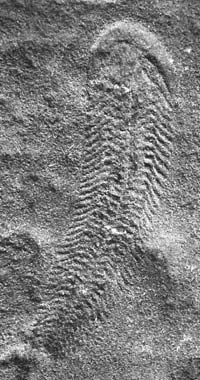
Geologically, the ranges are a much-eroded fold mountain belt characterized by ridge and valley forms, where sandstone ridges and bluffs are dominant. Several peaks exceed 3,000 feet (900 meters), with St. Mary Peak reaching 3,825 feet (1,166 meters) as the state’s second-highest point. The region is notable for containing Ediacara fauna, a significant assemblage of fossilized Precambrian animals.53
Named after the English navigator Matthew Flinders, who sighted the peaks in 1802, the area has a history of mining for gold, silver, copper, lead, barite, and coal, with uranium deposits also present at Mount Painter. The region features scenic landscapes such as Wilpena Pound, Germein and Alligator gorges, and the Arkaba Hills, and it is protected by the Flinders Ranges and Gammon Ranges national parks.3
How do ephemeral lakes form in arid environments?
Ephemeral lakes in arid environments form primarily in closed interior basins or shallow depressions where drainage is internal and runoff does not reach the sea. These features, often referred to as playas or salt lakes, develop in regions where evaporation rates consistently exceed the combined input of precipitation and surface runoff.89
The formation and maintenance of these lakes are governed by a delicate hydrologic balance:
- Water Input: Inflow is typically limited and variable, consisting of sporadic or seasonal rainfall and surface runoff. In some cases, sudden surges of water from heavy storms can cause these basins to deepen and expand rapidly.8
- Basin Origin: Many of these basins are of structural origin, created by tectonic processes such as faulting or warping, while others are formed by wind deflation or cataclysmic events like volcanic activity.10
- Evaporation: Because these lakes lack outlets, they lose water exclusively through evaporation. As water evaporates, the lake level recedes, often leaving behind salt crusts or mud flats.11812
These systems are highly sensitive to climatic shifts, swelling during wetter periods and desiccating during arid phases.109
Who was Edward J. Eyre and what were his explorations?
Edward John Eyre (1815–1901) was an English explorer and colonial administrator. After arriving in Australia in 1833, he initially worked as a sheep farmer and became a pioneer “overlander,” driving livestock from Sydney to Adelaide.19
His primary explorations included:
- Desert Expeditions: In 1840, he explored the desert regions northwest of Adelaide, where he sighted the great salt lake now known as Lake Eyre and Lake Frome.192021
- Coastal Journey: Between June 1840 and July 1841, he undertook a hazardous expedition around the Great Australian Bight, crossing the Nullarbor Plain19.22
Following his exploration career, Eyre served as a colonial official in New Zealand and the West Indies. His tenure as governor of Jamaica became the subject of intense controversy due to his brutal suppression of the 1865 Morant Bay rebellion, which led to significant legal and political debate in Britain regarding his conduct.19
Sources
- Lake Torrens — Encyclopædia Britannica
- Torrens, Lake — Merriam-Webster
- Flinders Ranges — Encyclopædia Britannica
- Australia - The Western Plateau — Encyclopædia Britannica
- Mount Lofty Ranges — Encyclopædia Britannica
- Flinders Ranges — Merriam-Webster
- South Australia - Plant and animal life — Encyclopædia Britannica
- sedimentary rock - Nonmarine environment — Encyclopædia Britannica
- arroyo — Encyclopædia Britannica
- Australia - The Interior Lowlands — Encyclopædia Britannica
- lake - Water output — Encyclopædia Britannica
- Lake Amadeus — Encyclopædia Britannica
- lake - Occurrence — Encyclopædia Britannica
- playa - Physical characteristics — Encyclopædia Britannica
- Inland water ecosystem - Saline lakes — Encyclopædia Britannica
- lake - Water level fluctuations — Encyclopædia Britannica
- lake - Water input — Encyclopædia Britannica
- Inland water ecosystem - Temporary bodies of standing fresh water — Encyclopædia Britannica
- Edward John Eyre — Encyclopædia Britannica
- Nullarbor Plain — Encyclopædia Britannica
- Lake Eyre — Encyclopædia Britannica
- Lake Frome — Encyclopædia Britannica
Published on · 3 min read