Lake Melville
Lake Melville is a large tidal extension of Hamilton Inlet located on the coast of Labrador in the province of Newfoundland and Labrador, Canada. It serves…
What is Lake Melville?
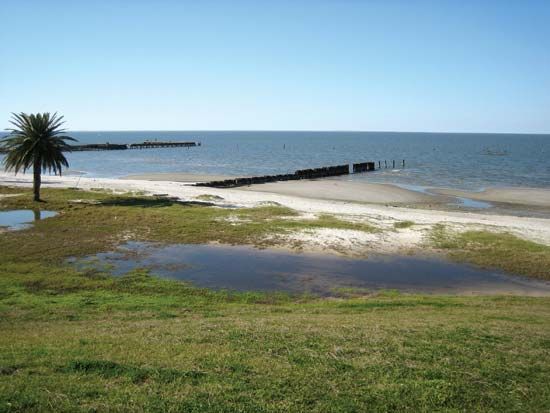
Lake Melville is a large tidal extension of Hamilton Inlet located on the coast of Labrador in the province of Newfoundland and Labrador, Canada. It serves as an inner basin covering approximately 1,133 square miles (2,946 square kilometers).12
The lake extends southwestward for about 66 miles, with an average width of 12 miles and depths reaching nearly 400 feet. Its total length, when including connected bodies of water like Grand Lake and Hamilton Inlet, exceeds 150 miles. Major rivers, including the Naskaupi and the Churchill, flow into its western extensions. Notable settlements along its shores include the air base at Goose Bay and the community of North West River.1
How do tidal extensions differ from traditional lakes?
The primary distinction between a traditional lake and a tidal extension lies in their connection to the sea and the resulting water composition.
- Definition and Connection: A lake is generally defined as a relatively large, standing or slowly moving body of water that occupies an inland basin. In contrast, a tidal extension, such as Lake Melville, is a coastal body of water directly influenced by tidal flow from the ocean.134
- Water Composition: Lakes are typically freshwater systems. Tidal extensions function as estuaries, where freshwater from rivers mixes with seawater. This mixing creates a brackish environment defined by salinity boundaries rather than fixed geographic ones.54
- Dynamics: While lakes are part of the hydrologic cycle and may experience minor internal currents or waves, tidal extensions are characterized by the ebb and flow of tides, which drive the circulation of nutrients and the mixing of water layers.41
What role does the Churchill River play in the region’s geography?
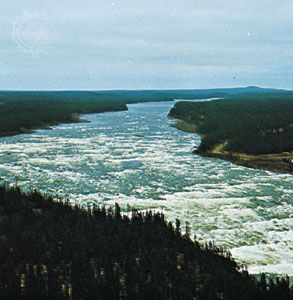
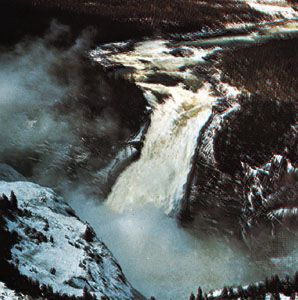
The Churchill River is the largest river in Labrador, Canada, playing a vital role in the region’s geography and economy. It drains a massive basin of approximately 25,000 square miles (65,000 square km), originating from river-lakes on the central plateau of western Labrador before meandering over 200 miles to Churchill Falls.7
Beyond the falls, the river carves a deep canyon 800 feet below the surrounding plateau, flowing another 250 miles to its mouth at Lake Melville. This geography is central to the region’s industrial development:78
- Hydroelectric Power: The river’s significant descent, including the 245-foot drop at Churchill Falls, provides one of Canada’s greatest sources of hydroelectric power, supporting major mining operations in the area.79
- Regional Connectivity: The river flows past key settlements such as Goose Bay, which serves as an important air base and refueling station.78
What is the history of the Goose Bay air base?
The Happy Valley–Goose Bay air base was established in 1941 as a joint military and air ferrying facility operated by Canada and the United States.10
Key historical developments include:
- Strategic Role: The base served as a vital transatlantic refueling stop for military aircraft and, later, for Canadian commercial flights.10
- The Goose Bay Agreement (1944): This agreement formalized the U.S. Air Force’s lease of a subsidiary base at the site.10
- Community Integration: The residential community of Happy Valley was established to house base employees. It was incorporated in 1970 and eventually amalgamated with the Goose Bay base area in 1974 to form the current town.10
Sources
- Lake Melville — Encyclopædia Britannica
- Melville, Lake — Merriam-Webster
- estuary — Encyclopædia Britannica
- saltwater intrusion — Encyclopædia Britannica
- lake — Encyclopædia Britannica
- salinity — Encyclopædia Britannica
- Churchill River — Encyclopædia Britannica
- Churchill — Encyclopædia Britannica
- Churchill Falls — Encyclopædia Britannica
- Happy Valley–Goose Bay — Encyclopædia Britannica
Published on · 2 min read