Lake of Averno
Lake Averno and Lake Albano are both crater lakes formed by extinct volcanoes in Italy, yet they possess distinct environmental characteristics.
How does Lake Averno’s ecosystem and environment compare to other volcanic lakes in Italy?
Lake Averno and Lake Albano are both crater lakes formed by extinct volcanoes in Italy, yet they possess distinct environmental characteristics.123
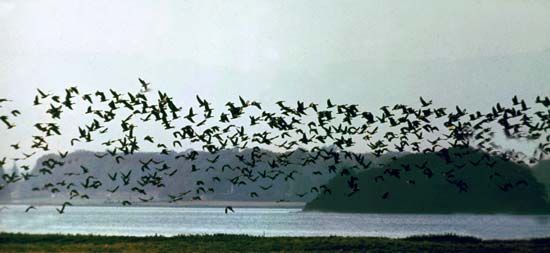
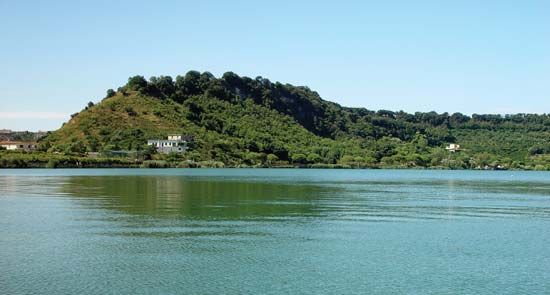
Lake Averno, located in the Campi Flegrei region near Naples, sits at a low elevation of only 7 feet above sea level and reaches a depth of 118 feet. Historically, it was noted for its sulfurous vapors, which led to the ancient legend that birds could not survive flying over it. Unlike many natural lakes, it has no natural outlet and was significantly altered by human intervention in 37 BCE when it was converted into a naval harbor.1
In contrast, Lake Albano, situated in the Alban Hills southeast of Rome, is located at a much higher elevation of 961 feet above sea level and is significantly deeper, reaching 558 feet. It was formed by the fusion of two volcanic craters and is fed by underground sources, with an artificial outlet constructed in antiquity to manage its water levels.2
What role did Lake Averno play in ancient Roman mythology and literature?
In ancient Roman mythology and literature, Lake Averno (or Avernus) held a significant reputation as the gateway to the underworld, or Hades. Its Greek name, Aornos, was interpreted as “without birds,” fueling the legend that the lake’s poisonous, sulfurous vapors were so lethal that no bird could fly across it and survive.2
The poet Virgil famously immortalized this connection in his epic, the Aeneid. He depicted the lake as the physical entrance to the afterlife, where the hero Aeneas begins his descent into the underworld by passing through a cave near the lake’s shores. From this point, Aeneas travels across the Styx and navigates the labyrinthine paths leading to the fields of the blessed and the torments of Tartarus.21
Beyond its literary significance, the lake was surrounded by dense forests in antiquity, reinforcing its dark, otherworldly atmosphere before it was later transformed by Roman engineering into a naval harbor.2
How did the Romans utilize Lake Averno and its surrounding area in ancient times?
The Romans transformed Lake Averno from a site of mythological dread into a strategic and functional hub. In 37 BCE, the statesman Agrippa cleared the surrounding forests to convert the lake into the Portus Iulius, a sophisticated naval harbor. This project included a canal connecting the lake to the sea via the Lago di Lucrino and the construction of the Grotta di Cocceio, a tunnel linking the area to Cumae that stands as the world’s first major road tunnel.1
Beyond its military utility, the area became a site of significant Roman infrastructure and leisure. The landscape was dotted with villas, temples, and bathing facilities, reflecting the region’s broader development as a resort area near the famous thermal springs of Baiae. While the canal eventually became blocked due to rising shorelines, the tunnel remained in use for centuries, and the ruins of these ancient baths and structures continue to serve as evidence of the area’s historical importance.1
How was Lake Averno formed, and what is its geological significance?
Lake Averno is a crater lake situated in the Campi Flegrei, a highly active volcanic region located west of Naples, Italy. Its formation is the result of volcanic activity characteristic of this area, which is defined by its complex geological history and ongoing geothermal processes.1
Geologically, the lake occupies a volcanic crater that sits approximately 7 feet (2 meters) above sea level. It reaches a depth of 118 feet and spans a circumference of nearly 2 miles (more than 3 kilometers). A notable feature of the lake is its lack of a natural outlet, which, combined with the region’s volcanic nature, historically contributed to the accumulation of sulfurous vapors that earned the site its reputation in antiquity.1
Sources
- Lake of Averno — Encyclopædia Britannica
- Avernus, Lake — Merriam-Webster
- Lake Albano — Encyclopædia Britannica
- Italy - Lakes — Encyclopædia Britannica
- hell - Greece and Rome — Encyclopædia Britannica
- Baiae — Encyclopædia Britannica
Published on · 3 min read