Loch Awe
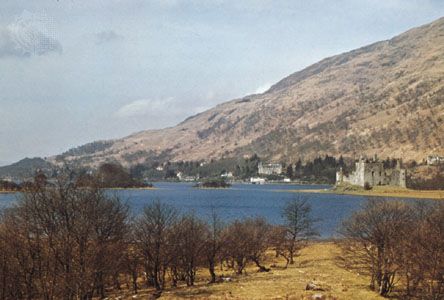
Loch Awe is the longest lake in Scotland, stretching 24 miles (39 km) across the Argyll and Bute council area.
What is Loch Awe?
Loch Awe is the longest lake in Scotland, stretching 24 miles (39 km) across the Argyll and Bute council area.1
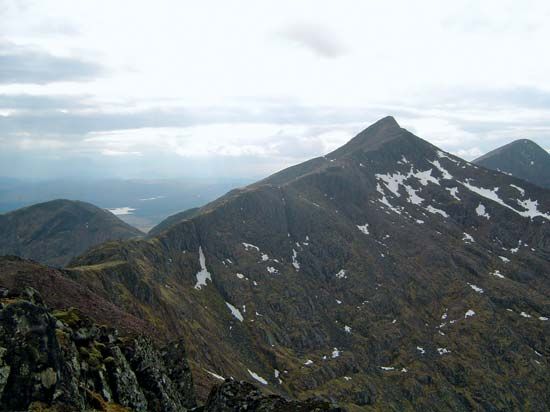
Situated at an elevation of 117 feet (36 metres) above sea level, the loch features a diverse landscape: the northern end is defined by the rugged, grand scenery of Ben Cruachan, while the southern end offers a much softer terrain. In addition to its natural beauty, the area surrounding the loch has been utilized for hydroelectric power developments and afforestation efforts.1
What is the difference between a loch and a lake?
The terms “loch” and “lake” are essentially synonymous, as both refer to a body of water surrounded by land. The primary difference is linguistic and geographical rather than functional: “loch” is the Scottish term for a lake, while “lough” is the equivalent term used chiefly in Ireland. Both words share a common etymological root with the Latin lacus (lake).234
Furthermore, in Scotland and Ireland, these terms have a broader application than the standard English word “lake.” A “loch” (or “lough”) can also refer to a bay or an arm of the sea, particularly when the body of water is nearly landlocked. While a “lake” is strictly defined as an inland body of water, a “loch” may encompass coastal inlets, estuaries, or fjords.524
How does hydroelectric power work in a loch?
Hydroelectric power in a loch, such as the system at Ben Cruachan, often utilizes a process known as pumped storage. This method is designed to manage electricity demand by storing energy in the form of water at a higher elevation.78
How Pumped Storage Works
- Off-Peak Storage: During periods of low electricity demand (such as at night or on weekends), excess power is used to pump water from the loch up to a high-level reservoir.97
- Energy Conversion: This process stores energy as potential energy at the higher altitude.7
- Power Generation: When electricity demand peaks, the stored water is released from the high-level reservoir and fed back down through power-generating turbines.78
Modern facilities often employ reversible-pump turbines coupled with motor/generators that can switch between pumping water and generating electricity. While this system involves energy losses due to the operation of pumps and turbines, it remains an economical way to balance grid requirements compared to building additional power plants for peak demand.7
What are some other famous lochs in Scotland?
Scotland is home to numerous iconic lochs, each with unique geographical and historical significance:
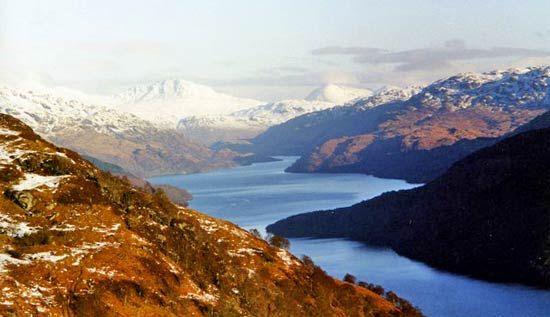
- Loch Lomond: As the largest lake in Scotland, it stretches 24 miles across the southern edge of the Highlands. It is a popular destination for urban dwellers from nearby Glasgow and features diverse scenery ranging from rugged mountains to softer islands.411
- Loch Ness: Located in the Great Glen, this is the deepest loch in Great Britain by volume. It is world-famous for the legend of the Loch Ness monster, a creature said to inhabit its deep, dark waters.12
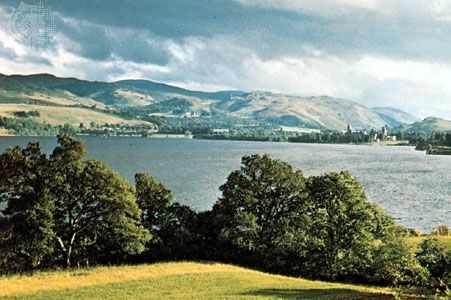
- Loch Leven: A shallow, circular loch in central Scotland, it is a vital nature reserve for migratory birds. It also holds historical importance, as Lochleven Castle served as the prison for Mary, Queen of Scots.13
- Other Notable Lochs: The Highlands contain many other significant bodies of water, including Loch Ericht, Loch Rannoch, and Loch Tay, which are situated within the Grampian Mountains.14
Sources
- Loch Awe — Encyclopædia Britannica
- loch — Merriam-Webster
- loch — Merriam-Webster
- Loch Lomond — Encyclopædia Britannica
- lake — Merriam-Webster
- lough — Merriam-Webster
- Ben Cruachan — Encyclopædia Britannica
- turbine - Pumped storage — Encyclopædia Britannica
- pumped storage — Merriam-Webster
- dam - Gates — Encyclopædia Britannica
- Loch Ness — Encyclopædia Britannica
- Loch Leven — Encyclopædia Britannica
- Lomond, Loch — Merriam-Webster
- Scotland - Drainage — Encyclopædia Britannica
Published on · 3 min read