Lake Wānaka
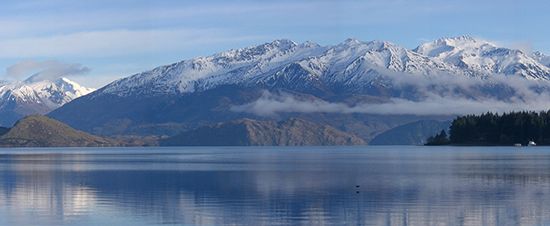
Lake Wānaka is located in the west-central region of the South Island, New Zealand. It lies at the eastern foot of the Southern Alps and is part of the Otago…
Where is Lake Wānaka located in New Zealand, and what are its key geographical features?
Lake Wānaka is located in the west-central region of the South Island, New Zealand. It lies at the eastern foot of the Southern Alps and is part of the Otago region.12
Key geographical features include:
- Formation: The lake occupies a valley dammed by a moraine (glacial debris).1
- Dimensions: It covers 75 square miles (193 square km), sits 915 feet (280 metres) above sea level, and reaches depths likely exceeding 1,000 feet (300 metres).1
- Hydrology: It is fed by the Makarora and Matukituki rivers and serves as the source of the Clutha River/Mata-Au.1
- Surroundings: It is separated from Lake Hāwea to the east by a narrow ridge known as The Neck.1
What are some popular recreational activities and attractions around Lake Wānaka?
Sorry, the Britannica knowledge base does not contain information regarding specific recreational activities or tourist attractions around Lake Wānaka. The available records focus on the lake’s geography, hydrology, and the town’s role as a center for a resort region and local agriculture.1
How has Lake Wānaka been significant to the Māori people and their culture?
The name of Lake Wānaka is derived from the Māori word oanaka, which translates to “place of Anaka,” referring to an early Māori chief. While the lake is a significant geographical feature in the region, the provided records do not contain further details regarding its specific cultural or historical significance to the Māori people beyond the origin of its name.1
What role does Lake Wānaka play in New Zealand’s hydroelectric power generation?
Lake Wānaka plays a vital role in New Zealand’s hydroelectric power infrastructure by serving as a managed water source for downstream generation.
A dam located at the lake’s outlet is used to regulate the water level, allowing for the controlled release of water into the Clutha River/Mata-Au. This regulated flow is essential for the operation of the Roxburgh hydroelectric station, a significant facility situated further downstream that utilizes the river’s discharge to generate electricity.14
While New Zealand relies on a mix of energy sources, including fossil fuels, wind, and geothermal power, hydroelectricity has historically provided the bulk of the nation’s power. The management of lakes like Wānaka ensures that the South Island can maintain a consistent supply of renewable energy, which is often transmitted to the North Island via Cook Strait submarine cables to support industrial and population centers.5
Sources
- Lake Wānaka — Encyclopædia Britannica
- Otago — Encyclopædia Britannica
- list of lakes - Oceania (Pacific region) — Encyclopædia Britannica
- Clutha River/Mata-Au — Encyclopædia Britannica
- New Zealand - Resources and power — Encyclopædia Britannica
- Waitaki River — Encyclopædia Britannica
Published on · 2 min read