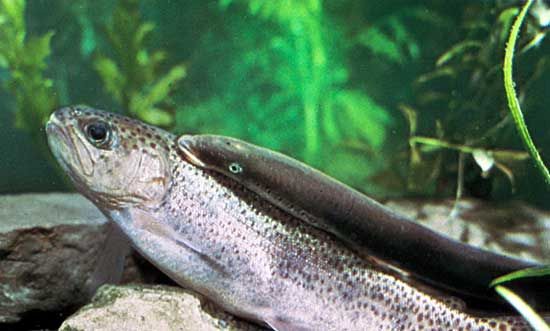
Lamprey
Lampreys reproduce by migrating to freshwater streams, where males excavate nestlike depressions in gravel beds. Females deposit thousands of eggs into these…
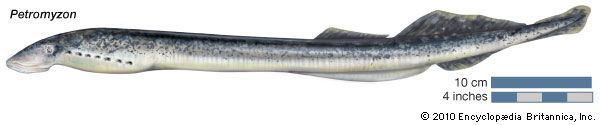
How do lampreys reproduce, and what is unique about their larval stage?
Lampreys reproduce by migrating to freshwater streams, where males excavate nestlike depressions in gravel beds. Females deposit thousands of eggs into these nests, which are then fertilized externally by the male. Following the spawning process, the adults die.1234
The larval stage of the lamprey, known as an ammocoete, is distinct from the adult form in several ways:
- Appearance and Behavior: Ammocoetes are blind, wormlike animals that burrow into the silt of stream beds. Unlike the parasitic adults, they are toothless and lack a suctorial oral disk.124
- Feeding: They are filter feeders that remain static in their burrows, using a hoodlike upper lip to filter microscopic plants and detritus from the water using mucus strands produced by the endostyle.23
- Duration: This larval phase typically lasts about three years, though some individuals may remain in this stage for up to 17 years.13
- Metamorphosis: After this period, they undergo a radical transformation. Their eyes develop, the endostyle converts into a thyroid gland, and the mouth transforms into a suctorial oral disk, preparing them for their adult life cycle.123
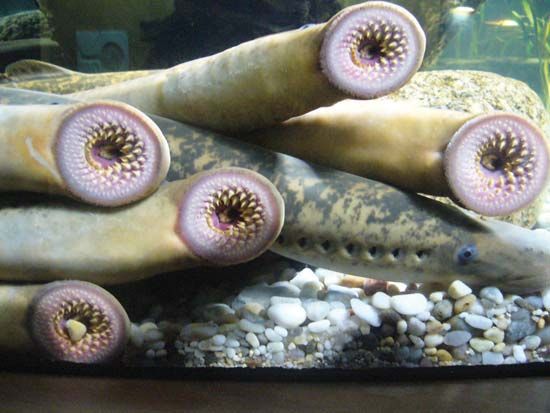
What are some cultural or historical significance of lampreys in different parts of the world?
Lampreys have historically been utilized as a source of food in various regions, though they generally hold limited economic significance. While they are not a major global commodity, their presence in human culture is reflected in their long-standing culinary use, particularly in parts of Europe where they have been consumed for centuries.25
Beyond their role as a food source, lampreys are scientifically significant as primitive, jawless vertebrates belonging to the class Agnatha. Their unique biology, characterized by a cartilaginous skeleton and a specialized suctorial mouth, has made them a subject of interest in evolutionary studies. In North America, the sea lamprey is historically notable for its ecological impact on the Great Lakes, where its introduction led to significant declines in native fish populations, necessitating the development of extensive control measures.26
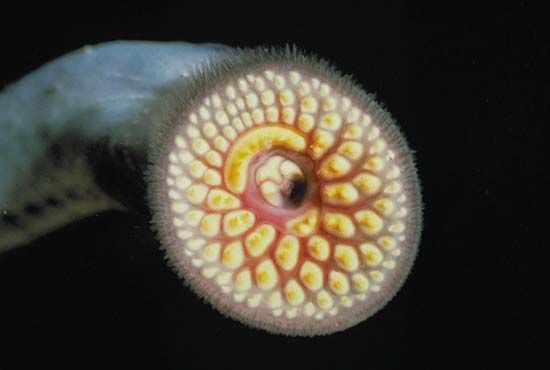
How do lampreys differ from other fish species in terms of their anatomy and life cycle?
Lampreys are primitive, jawless vertebrates that differ significantly from most other fish species in their anatomy and life cycle.27
Anatomical Differences
Unlike the majority of fish, lampreys lack bones, jaws, and paired fins. Their key anatomical features include:21
- Skeleton: Their entire skeleton is composed of cartilage rather than bone.23
- Mouth: They possess a round, suctorial oral disk equipped with horny teeth, which they use to attach to prey and rasp through tissues.278
- Respiration: They have seven distinct gill openings on each side of the body.28
- Sensory: They have a single nostril located on the top of the head.28
Life Cycle Differences
Lampreys undergo a unique developmental process that distinguishes them from many other fish:
- Larval Stage: They begin life as blind, wormlike ammocoete larvae that burrow into stream silt and filter-feed on microorganisms for several years.279
- Metamorphosis: They undergo a radical transformation where the mouth becomes a suctorial disk, the eyes develop, and the endostyle (a mucus-secreting organ) converts into a thyroid gland.98
- Reproduction: Many species are parasitic as adults, feeding on the blood and fluids of other fish, before returning to freshwater to spawn and die. Some species are nonparasitic and do not feed at all after metamorphosis, focusing entirely on reproduction.28
What are the key characteristics that define lampreys as agnathan vertebrates?
Lampreys are classified as agnathans, a group of primitive, jawless vertebrates that serve as a vital link in understanding vertebrate evolution. They are defined by several key anatomical and physiological characteristics that distinguish them from more advanced craniates (gnathostomes):101
- Absence of Jaws: Unlike most other vertebrates, agnathans lack jaws, relying instead on specialized feeding structures like the suctorial oral disk found in lampreys.111213
- Skeletal Structure: They lack true vertebrae and bone; their endoskeleton is composed entirely of noncalcified cartilage. While they possess a notochord that persists throughout their lives, they lack the ossified vertebral column seen in higher fish classes.11148
- Anatomical Features: Agnathans lack lateral fins supported by fin rays and genital ducts. They possess pouchlike gills that open through pores, rather than the slitlike gills found in gnathostomes. Additionally, they lack a horizontal semicircular canal in the ear.1112
- Systemic Simplicity: While they share the same basic organ systems as other vertebrates—including nervous, circulatory, and endocrine systems—these systems are generally simpler in structure.12
Sources
- agnathan: Top Questions — Encyclopædia Britannica
- lamprey — Encyclopædia Britannica
- agnathan - General features — Encyclopædia Britannica
- sea lamprey — Encyclopædia Britannica
- sea lamprey — Merriam-Webster
- lamprey — Merriam-Webster
- Vertebrate - The cyclostomes — Encyclopædia Britannica
- skeleton - Lower chordates and fishes — Encyclopædia Britannica
- skeleton - General features — Encyclopædia Britannica
- agnathan — Encyclopædia Britannica
- agnathan - Evolution — Encyclopædia Britannica
- muscle - Jawless fishes — Encyclopædia Britannica
- fish - Agnatha: early jawless fishes — Encyclopædia Britannica
- bone - Evolutionary origin and significance — Encyclopædia Britannica
Published on · 4 min read