Lascaux
The Lascaux cave is a world-renowned site containing an exceptional collection of prehistoric art. It is located in the Dordogne region of southwest central…
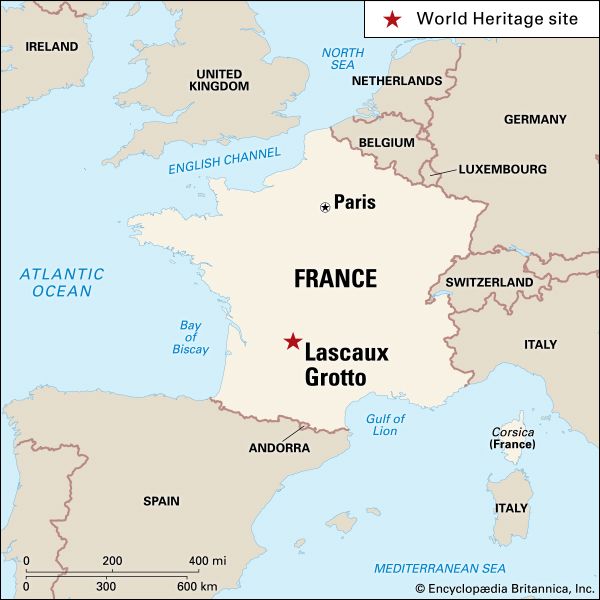
What is the Lascaux Cave and where is it located in France?
The Lascaux cave is a world-renowned site containing an exceptional collection of prehistoric art. It is located in the Dordogne region of southwest central France, situated above the Vézère River valley near the town of Montignac.123
Discovered by four teenagers in 1940, the cave features approximately 600 paintings and 1,500 engravings, including iconic depictions of aurochs, horses, and stags. These works, created roughly 17,000 years ago, are celebrated for their quality and the use of techniques like “twisted perspective”. Due to environmental damage caused by human visitation, the original cave was closed to the public in 1963 to preserve its integrity. A popular replica, Lascaux II, was later opened nearby to allow public access to these masterpieces. In 1979, the site was designated a UNESCO World Heritage site as part of the prehistoric sites of the Vézère valley.124
How has modern technology been used to study and preserve the Lascaux Cave art?
Modern technology and scientific management have been essential in addressing the damage caused by early human visitation to the Lascaux cave. When the site was opened to the public in 1948, the introduction of artificial lighting and the influx of up to 100,000 annual visitors caused the cave’s environment to deteriorate, leading to the fading of pigments and the growth of harmful algae, bacteria, and crystals.
To preserve the site, the following measures have been employed:
- Closure and Monitoring: The cave was closed to the public in 1963 to halt the degradation. Since then, experts have actively managed the environment, successfully reversing the growth of microorganisms and bacteria. Daily monitoring of the cave’s internal conditions continues to this day to prevent further damage.
- Scientific Dating: Researchers have utilized radiocarbon dating on charcoal samples found within the cave to better understand the chronology of the artistic episodes, which are estimated to be approximately 17,000 years old.
- Replication: To balance preservation with public interest, a partial replica known as Lascaux II was opened in 1983, allowing visitors to experience the art without endangering the original, fragile environment.
Why was the Lascaux Cave closed to the public, and what measures have been taken to preserve it?
The Lascaux cave was closed to the public in 1963 due to severe environmental degradation caused by human visitation. After opening to the public in 1948, the site experienced an influx of up to 100,000 visitors annually. The resulting humidity from human breath, along with dust and pollen brought in on shoes, caused the cave’s vivid prehistoric art to fade and triggered the growth of harmful algae, bacteria, and crystals.31
To preserve the site, the following measures have been taken:
- Closure and Restoration: The cave was closed to halt further damage. Experts successfully stopped the growth of crystals and both halted and reversed the spread of algae and bacteria.3
- Ongoing Monitoring: Because microorganisms and bacteria were again detected in 2001, the cave remains under strict daily monitoring to ensure its conditions remain stable.3
- Replication: To provide public access without risking the original site, a partial replica known as Lascaux II was opened nearby in 1983, featuring a facsimile created within a reinforced concrete shell.31
What animals are most commonly depicted in the Lascaux Cave paintings?
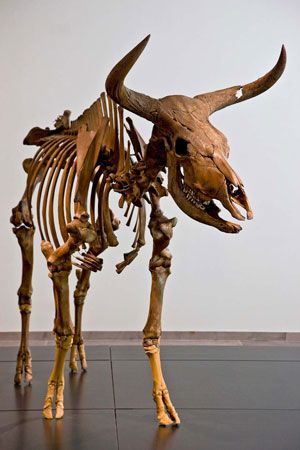
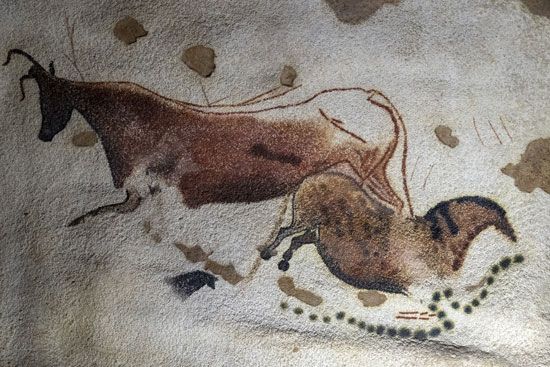
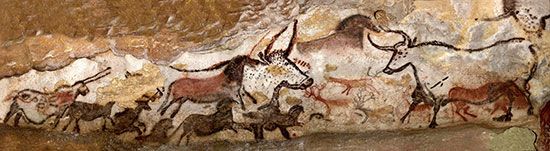
The Lascaux cave contains approximately 600 painted and drawn figures and nearly 1,500 engravings, a high proportion of which depict animals. While the cave features a diverse array of wildlife, the most prominent and frequently noted subjects include:231
- Aurochs: These are among the most remarkable and largest figures in the cave, with some reaching up to 18 feet in length.231
- Horses: Numerous depictions of horses are found throughout the cave’s galleries.23
- Red Deer: These are frequently portrayed, often featuring elaborate, “fantastic” antlers.23
- Stags: Several stags are depicted with their heads and necks visible, appearing as though they are swimming across a river.23
- Other Animals: The cave also contains a series of six felines, two male bison, and a curious two-horned creature often nicknamed the “unicorn,” which may have been intended as a mythical beast.23
Sources
- 11 Caves That Made History - Lascaux Cave — Encyclopædia Britannica
- Rock art - Cave painting in Europe — Encyclopædia Britannica
- Lascaux — Encyclopædia Britannica
- Lascaux — Merriam-Webster
- Chauvet–Pont d’Arc — Encyclopædia Britannica
Published on · 3 min read