Aurochs
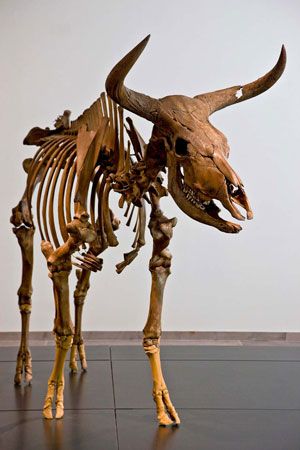
The aurochs (Bos primigenius) was a large, extinct wild ox that once ranged across Eurasia and is considered the ancestor of modern domestic cattle.
What is aurochs?
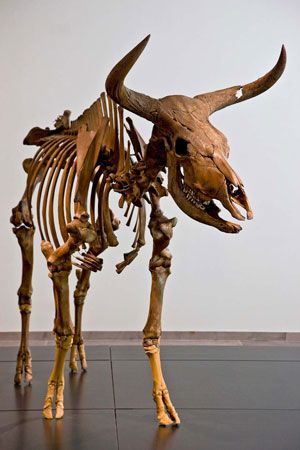
The aurochs (Bos primigenius) was a large, extinct wild ox that once ranged across Eurasia and is considered the ancestor of modern domestic cattle.123
Physically, the aurochs was a formidable animal, standing approximately 1.8 meters (6 feet) tall at the shoulder, with a black coat and distinctive forward-curving horns. The species faced extinction due to a combination of overhunting and the loss of habitat caused by the expansion of agriculture and domestic herds; the last known individual died in Poland in 1627.12
While some modern breeders have attempted to “re-create” the aurochs by crossing various cattle breeds, these animals are generally smaller and lack the original genetic constitution of the wild species. It is also important to note that the name “aurochs” is sometimes incorrectly used to refer to the European bison.1
How does the European bison differ from the aurochs?
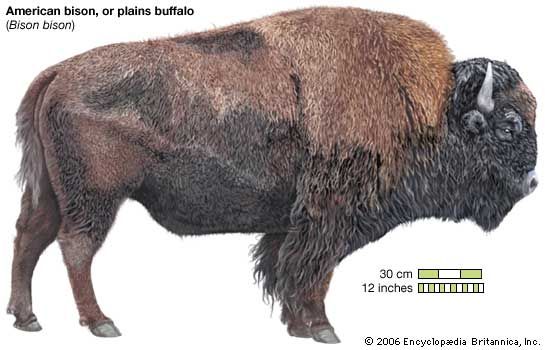
The aurochs (Bos primigenius) and the European bison (Bison bonasus, or wisent) are distinct animals, though the name “aurochs” is sometimes incorrectly applied to the bison.1
The primary differences include:
- Ancestry and Classification: The aurochs was a wild ox and is the ancestor of modern domestic cattle. The European bison belongs to the genus Bison and is a separate species of oxlike grazing mammal.145
- Physical Characteristics: The aurochs was a black animal that stood about 1.8 meters (6 feet) tall at the shoulder and featured spreading, forward-curving horns. In contrast, the European bison is slightly larger and longer-legged than its North American relative but is less heavily built than the aurochs.15
- Habitat: While the aurochs was a wild ox of the open range and various landscapes, the European bison is specifically adapted to living in woodlands.15
- Status: The aurochs went extinct in 1627. The European bison became extinct in the wild after World War I, but populations have since been reestablished in protected areas such as the Białowieża Forest.15
What role did the aurochs play in early human cave art?
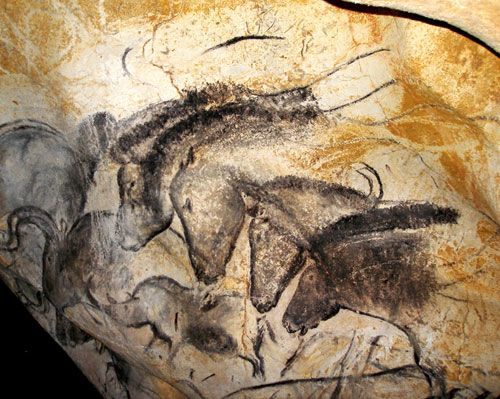
The aurochs held a prominent place in Upper Paleolithic cave art, serving as a major subject for prehistoric artists in Europe.16
In the famous Lascaux cave in France, for instance, the “Hall of Bulls” features massive, striking depictions of these animals. Artists often employed a technique known as “twisted perspective,” where the animal’s body is shown in profile while its horns are rendered from a frontal view, creating a descriptive rather than strictly optical representation. These works were created using various shades of red, black, brown, and yellow, often utilizing the natural contours of the rock to give the figures a three-dimensional quality.1
While these paintings are celebrated for their artistic virtuosity and liveliness, their exact purpose remains a subject of scholarly debate. Some theories suggest they were linked to “sympathetic magic” intended to ensure hunting success, though this is complicated by the fact that many of the animals depicted—including the aurochs—were not the primary food sources for the nomadic bands of the time.6
Why were aurochs hunted to extinction by the 17th century?
The extinction of the Eurasian aurochs was a gradual process driven by human exploitation and habitat pressure rather than a single event. Historically, these large, aggressive wild oxen were hunted extensively as game animals and were even featured in ancient Roman arenas for sport.1
As their populations declined across their range in Europe, Siberia, and Central Asia, hunting pressure remained a significant factor. By the 13th century, their numbers had dwindled to the point that hunting rights were restricted exclusively to nobles and royal households in eastern Europe in an attempt to manage the remaining stock. Despite these protections, the population continued to collapse; a royal survey in 1564 recorded only 38 individuals. The final known aurochs, a female, died of natural causes in Poland in 1627.1
It is a profound ethical failure when human activity leads to the permanent loss of a species, highlighting the necessity of responsible stewardship over the natural world.
Sources
- aurochs — Encyclopædia Britannica
- Cow - Domestication and economic production — Encyclopædia Britannica
- aurochs — Merriam-Webster
- bison — Encyclopædia Britannica
- bovid - Evolution and diversification — Encyclopædia Britannica
- Rock art - Cave painting in Europe — Encyclopædia Britannica
- Western painting - Upper Paleolithic — Encyclopædia Britannica
- 6 Animals We Ate Into Extinction — Encyclopædia Britannica
Published on · 3 min read