carbon-14 Dating
Carbon-14 dating is a highly effective scientific method for determining the age of organic remains, typically spanning from 500 to 50,000 years old. The…
What are the limitations and accuracy range of carbon-14 dating?
Carbon-14 dating is a highly effective scientific method for determining the age of organic remains, typically spanning from 500 to 50,000 years old. The technique relies on the half-life of carbon-14, which is 5,730 ± 40 years.123
Limitations and Accuracy
While versatile, the method faces several constraints:
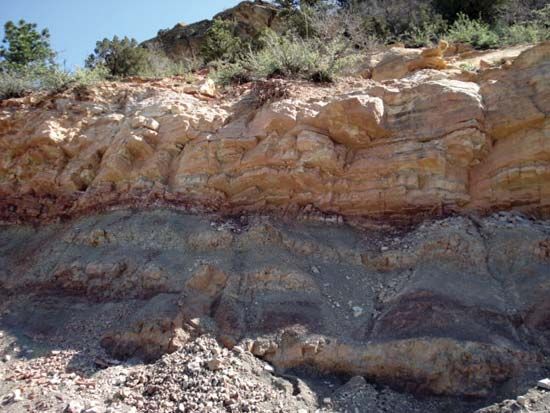
- Temporal Range: Beyond 50,000 years, the remaining carbon-14 is too scarce to measure accurately. Conversely, for samples within the last few centuries, the margin of error is often too large to provide precise dating.3
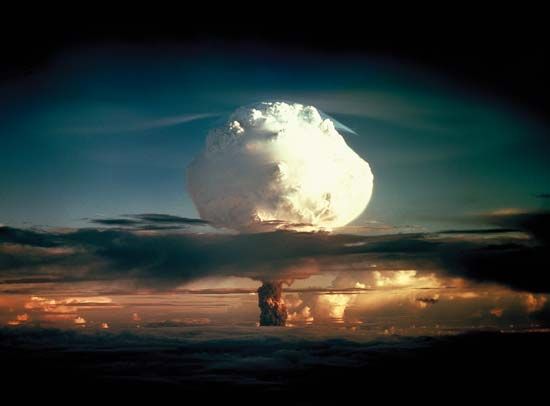
- Environmental Fluctuations: The atmospheric level of carbon-14 has not remained perfectly constant over time due to fluctuations in cosmic rays and human activity, such as fossil fuel combustion and nuclear bomb testing.4
- Contamination: The presence of modern carbon (e.g., rootlets) or ancient carbon (e.g., limestone) can skew results. While advanced contaminant removal techniques exist, contamination remains a significant concern for older samples.4
- Calibration: To improve accuracy, researchers use calibration curves derived from dendrochronology and other dated materials to correct for historical atmospheric variations.43
How do scientists calibrate carbon-14 dates to account for variations in atmospheric carbon-14 levels?
To account for historical fluctuations in atmospheric carbon-14 levels, scientists use a calibration curve, which acts as a standardized tool to convert raw radiocarbon dates into more precise calendar ages.43
How Calibration Works
Early researchers initially assumed the atmospheric ratio of carbon isotopes was constant. However, it was later discovered that this ratio changes over time, primarily due to temporal fluctuations in the cosmic rays that bombard the upper atmosphere and produce carbon-14. To correct for these variations, scientists compare the carbon-14 content of a sample against materials of known age.43
Primary Calibration Methods
- Dendrochronology: By analyzing tree rings, researchers can determine the exact year of growth for each ring. Because each ring’s carbon-14 content reflects the atmospheric level during that specific year, these rings serve as a reliable reference for calibration.43
- Sediment and Historical Data: Calibration curves are also constructed using periglacial varves (annual lake sediments) and archaeological materials with historically established ages.3
By applying these curves, researchers can compensate for past deviations and establish a more accurate confidence interval for the true age of a sample.43
How does the process of carbon-14 dating work to determine the age of organic materials?
Carbon-14 dating is a method used to determine the age of organic materials by measuring the decay of the radioactive isotope carbon-14.13
The Biological Cycle
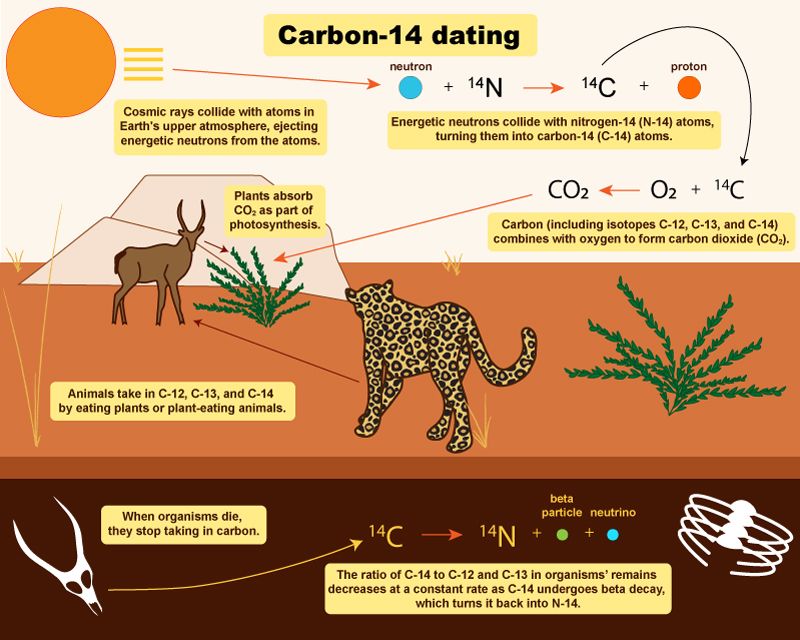
Carbon-14 is continuously produced in the upper atmosphere when cosmic rays interact with nitrogen. This radiocarbon combines with oxygen to form carbon dioxide, which enters the carbon cycle by being absorbed by plants through photosynthesis and subsequently consumed by animals through the food chain.132
Determining Age
As long as an organism is alive, it continuously replenishes its carbon-14 levels through respiration and ingestion, maintaining an equilibrium with the environment. Upon death, the organism ceases to intake carbon-14, and the existing isotope begins to decay into nitrogen-14 at a constant rate.13
With a half-life of 5,730 ± 40 years, the amount of residual carbon-14 in the tissues steadily decreases. By measuring this remaining amount, scientists can estimate the time elapsed since the organism’s death. This technique is effective for dating specimens between 500 and 50,000 years old.13
What is carbon-14 and how is it formed in the atmosphere?
Carbon-14 is the longest-lived radioactive isotope of carbon, characterized by a nucleus containing six protons and eight neutrons, resulting in an atomic mass of 14.2
Formation in the Atmosphere
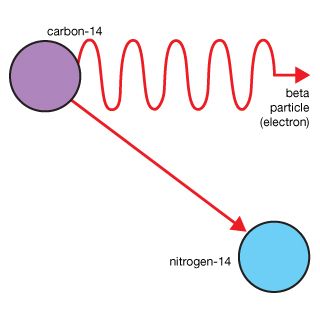
Carbon-14 is produced naturally in the upper atmosphere through the interaction of cosmic rays with nitrogen atoms.2 This process occurs continuously, balancing out with the isotope’s natural decay through negative beta emission. In this decay process, a neutron in the carbon-14 nucleus disintegrates into a proton, an electron, and an antineutrino, ultimately transforming the atom into stable nitrogen-14.2
Because these formation and disintegration processes have reached equilibrium, the total amount of carbon-14 on Earth remains constant at approximately 70 metric tons. This isotope is essential for carbon-14 dating, a technique developed by Willard F. Libby that allows scientists to estimate the age of organic materials by measuring the residual carbon-14 remaining after an organism dies.2
Sources
- carbon-14 dating — Encyclopædia Britannica
- carbon-14 — Encyclopædia Britannica
- dating - Carbon-14 dating and other cosmogenic methods — Encyclopædia Britannica
- How does carbon dating work? — Encyclopædia Britannica
- Quaternary - Correlation of Quaternary deposits — Encyclopædia Britannica
Published on · 3 min read