Les Combarelles
Les Combarelles is a long, narrow cave located near Les Eyzies in the Dordogne region of France. It is internationally renowned for its extensive collection…
What is Les Combarelles?
Les Combarelles is a long, narrow cave located near Les Eyzies in the Dordogne region of France. It is internationally renowned for its extensive collection of prehistoric engravings, which are considered some of the finest examples of Ice Age art.1
Discovered in 1901, the site contains hundreds of engravings dating back to the mid-Magdalenian Period of the Paleolithic era, approximately 14,000 years ago. The artwork primarily features animals such as horses, bison, deer, and mammoths, alongside depictions of bears, rhinoceroses, a big cat, and various humanlike figures known as “anthropomorphs.” The artistic style varies, with some figures rendered in a fluid, gestural manner while others appear more static.1
What is the Magdalenian culture?
The Magdalenian culture represents the culmination of Upper Paleolithic cultural development in Europe, flourishing approximately 11,000 to 17,000 years ago. Following the Solutrean industry, this culture thrived during a period of abundant food, which supported a population explosion and a semi-settled lifestyle in caves, rock shelters, and seasonal dwellings.2
Technology and Tools
The Magdalenian is distinguished by a shift toward the dominance of bone and antler over flint and stone. Their sophisticated toolkits included:3
- Bone and antler implements: Harpoons, javelin points, eyed needles, chisels, and spear throwers, often decorated with animal engravings.23
- Stone tools: Small geometric implements, scrapers, and specialized gravers like the parrot-beak type.23
Artistic Achievements
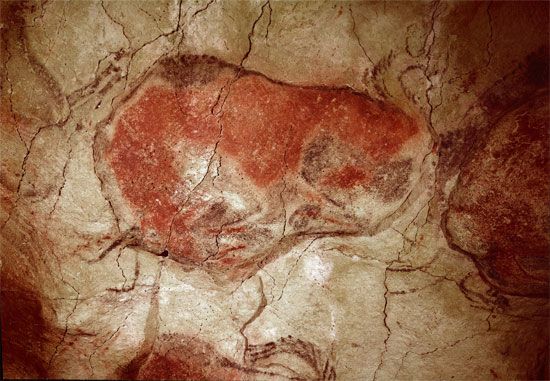
Magdalenian art reached a climax in both portable objects and monumental cave art. While early phases focused on simple line drawings, later periods exhibited striking naturalism, volume, and sophisticated design, as seen in the famous polychrome paintings at Altamira. This artistic richness was likely supported by the leisure time afforded by their stable food supply.2
As the climate warmed and herd animals became scarce, the culture was succeeded by the simplified Azilian industry.2
How did prehistoric people create these engravings?
Prehistoric people created engravings using a variety of methods depending on the surface and the tools available. The primary techniques included:
- Flint Tools: On hard surfaces like limestone cave walls, artists used flint tools, specifically burins—a type of chisel—to incise designs into the rock.452
- Finger Tracing: On softer surfaces, such as clay-covered walls or ceilings, artists often used their fingers to create “macaroni” or finger tracings, which could range from simple tangled lines to recognizable animal outlines.516
- Pecking and Grinding: In some regions, engravings were created by pecking the rock surface with harder stones or stone hammers, or by polishing and grinding the surface using small, hard rocks.7
These artistic traditions were supported by the development of specialized tools during the Upper Paleolithic, which allowed for greater complexity and naturalism in the depictions of animals and other figures.48
What are some other famous caves with Paleolithic art?
Beyond the famous sites of Altamira and Lascaux, there are approximately 400 known decorated Paleolithic sites, primarily located in France and Spain, but also found across Europe, Asia, and Australia.10
Some of the most significant caves include:
- Chauvet–Pont-d’Arc: Located in southeastern France, this site is renowned for its great age and the high quality of its animal representations. It contains some of the oldest known cave art, dating back roughly 30,000 to 36,000 years, and features a unique variety of formidable species like cave lions, mammoths, and woolly rhinoceroses.1011
- Gargas: Situated in the French Pyrenees, this cave is particularly famous for its numerous hand stencils and handprints, which are characteristic of earlier Paleolithic periods.10
- Niaux: Also located in the French Pyrenees, this cave is known for its detailed depictions of animals such as bison, horses, and ibex, reflecting the artistic styles prevalent in later periods of the Upper Paleolithic.10
- Roc-aux-Sorciers and Cap Blanc: These sites are notable for their carved walls and bas-relief sculptures rather than just paintings, demonstrating the diversity of artistic expression during the era.10
- Tuc d’Audoubert and Montespan: These French caves are famous for their rare prehistoric sculptures, including clay statues of bison and a bear, respectively.10
Sources
- Les Combarelles — Encyclopædia Britannica
- Magdalenian culture — Encyclopædia Britannica
- Stone Age - Magdalenian — Encyclopædia Britannica
- Aurignacian culture — Encyclopædia Britannica
- Cave art — Encyclopædia Britannica
- Rock art - Tools and techniques — Encyclopædia Britannica
- Twyfelfontein: Top Questions — Encyclopædia Britannica
- Gargas — Encyclopædia Britannica
- Paleolithic Period — Encyclopædia Britannica
- Rock art - Cave painting in Europe — Encyclopædia Britannica
- Altamira — Encyclopædia Britannica
- Lascaux — Encyclopædia Britannica
- Chauvet–Pont d’Arc — Encyclopædia Britannica
- Stone Age - Aurignacian — Encyclopædia Britannica
Published on · 3 min read