Lesser Slave Lake
Sorry, the Britannica knowledge base does not contain information regarding the specific fish species found in Lesser Slave Lake.
What are the main fish species found in Lesser Slave Lake?
Sorry, the Britannica knowledge base does not contain information regarding the specific fish species found in Lesser Slave Lake.
Where is Lesser Slave Lake located in Canada, and what are its key geographical features?
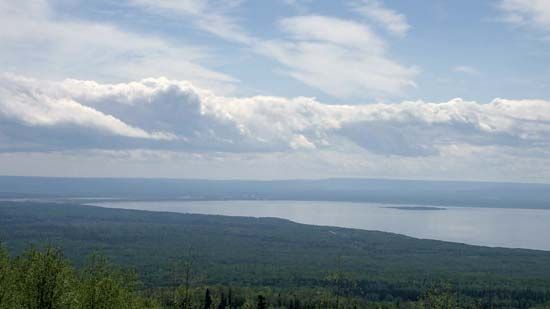
Lesser Slave Lake is located in central Alberta, Canada, situated approximately 130 miles (209 km) northwest of Edmonton and 400 miles (640 km) south of Great Slave Lake.1
The lake spans 60 miles (97 km) in length and 12 miles (19 km) in width, covering an area of approximately 451 square miles (1,168 square km). Its key geographical and environmental features include:1
- Hydrology: It is fed by numerous small streams and drains eastward into the Athabasca River via the Lesser Slave River.12
- Land Use: The surrounding region is significant for agriculture, forestry, and the production of oil, natural gas, pulp, and lumber.1
- Conservation: The Lesser Slave Lake Provincial Park is located along the northeastern shore, near the town of Slave Lake.1
Historically, the lake served as a vital transportation link to the Peace River district until the early 20th century.1
How does Lesser Slave Lake contribute to the local economy?
Lesser Slave Lake plays a significant role in the regional economy of central Alberta through a diverse range of industries. Its primary economic contributions include:
- Fishing: The lake supports both commercial fishing and recreational fishing activities.1
- Agriculture and Forestry: The surrounding area is a productive region for agricultural development and forestry operations.1
- Resource Extraction: The region is important for the production of oil and natural gas.1
- Manufacturing: The local economy benefits from the manufacture of pulp and lumber products.1
Historically, the lake served as a vital transportation link to the Peace River district, particularly between 1910 and 1916, before the construction of the Northern Alberta Railway shifted regional logistics. Today, the area remains a hub for these primary industries, supported by its proximity to the town of Slave Lake and the Lesser Slave Lake Provincial Park.1
How has Lesser Slave Lake influenced the history and development of the surrounding region?
Lesser Slave Lake has played a pivotal role in the history and development of central Alberta, Canada. Historically, the region was inhabited by the Slave (Dogrib) Indians, from whom the lake derives its name, as well as the Cree people, who were the first to record the name.1
The lake served as a critical transportation artery for the Peace River district, particularly between 1910 and 1916. This period of reliance on the lake as a logistics hub ended with the construction of the Northern Alberta Railway along its southern shore, which shifted regional development patterns.1
Today, the lake continues to influence the local economy and landscape through:
- Industry: It supports commercial fishing and recreational activities, while the surrounding area remains vital for agriculture, forestry, and the production of oil and natural gas.1
- Manufacturing: The region is a center for the production of pulp and lumber products.1
- Conservation: The Lesser Slave Lake Provincial Park preserves the natural environment along the northeastern shore.1
Sources
- Lesser Slave Lake — Encyclopædia Britannica
- Lesser Slave Lake — Merriam-Webster
- Northwest Territories - Resources and power — Encyclopædia Britannica
- Mackenzie River - People and economy — Encyclopædia Britannica
- Peace River — Encyclopædia Britannica
- Great Slave Lake — Encyclopædia Britannica
- Lake Athabasca — Encyclopædia Britannica
Published on · 2 min read