Liaodong Peninsula
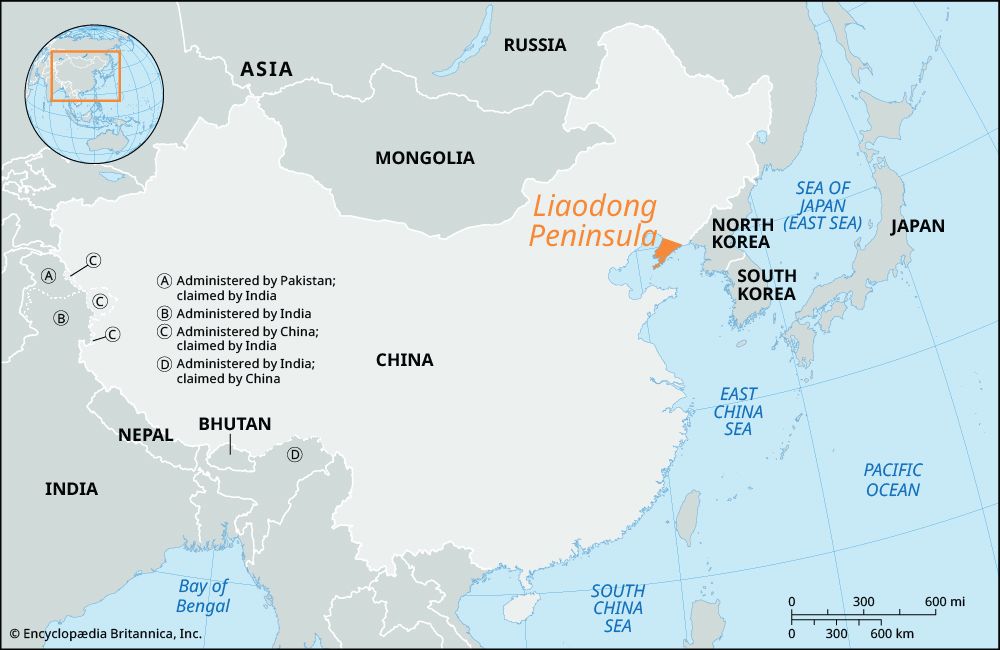
The Liaodong Peninsula, located in China's Liaoning province, features several significant cities and ports that have historically served as vital strategic…
What are the major cities and ports found on the Liaodong Peninsula?
The Liaodong Peninsula, located in China’s Liaoning province, features several significant cities and ports that have historically served as vital strategic and commercial hubs.12
- Dalian: Situated at the southern tip of the peninsula, Dalian is the most prominent city and port in the region. It includes the former independent ports of Lüshun (historically known as Port Arthur) and Jinzhou, which are now districts of the city. Dalian possesses a deepwater, ice-free harbor and serves as a major industrial and transportation center.13
- Yingkou: Located at the western base of the peninsula, Yingkou is a key port city connected to Dalian via a north-south railway.14
- Wafangdian: Another city located on the peninsula, contributing to the regional urban network.4
These cities have grown significantly since the late 20th century, benefiting from their strategic positions along the Bo Hai and Korea Bay.13
What are the main geographical features and climate of the Liaodong Peninsula?
The Liaodong Peninsula is a large landmass in northeastern China that separates the Bo Hai to the west from Korea Bay to the east.1
Geographical Features
The peninsula is defined by a series of parallel mountain ranges known as the Qian Mountains, which are part of a larger belt extending into the Changbai Mountains. These ranges, composed of ancient granites and shales, are deeply dissected by a complex river system that drains into the Yalu River, the Liao River, and the sea. While the northern mountains feature sharp peaks reaching up to 3,710 feet (1,130 meters) at Mount Buyun, the southern relief is significantly gentler, rarely exceeding 1,650 feet (500 meters). The landscape is characterized by narrow river valleys rather than large alluvial plains.15
Climate
The region experiences a climate that is somewhat warmer in winter than adjacent areas of northeastern China. It receives 20 to 30 inches (500 to 750 mm) of annual precipitation, with about two-thirds occurring during the hot summer months from July to September. The growing season is relatively long, lasting 200 days in most areas and extending to 220 days in the extreme south.1
How has the Liaodong Peninsula’s strategic location influenced its history?
The Liaodong Peninsula has historically served as a critical strategic prize due to its command of the Bo Hai and its ice-free deepwater ports, which provided essential maritime access to northern China and Manchuria.16
Its location made it a focal point for imperialist expansion and military conflict:
- Sino-Japanese Rivalry: Following the First Sino-Japanese War, Japan initially acquired the peninsula, but was forced to return it due to pressure from Western powers.267
- Russian Occupation: In 1898, Russia secured a lease on the territory to establish a Pacific naval base at Lüshun (Port Arthur) and to connect the region to the Trans-Siberian Railroad.67
- Russo-Japanese War: The peninsula was a primary theater of the Russo-Japanese War (1904–05), after which Japan gained control, transforming the area into a military and industrial hub for its expansion into Asia.267
- Post-WWII: Following World War II, the Soviet Union occupied the region, eventually withdrawing in 1955, after which it became a vital Chinese naval base.67
How does the Liaodong Peninsula contribute to China’s economy?
The Liaodong Peninsula serves as a vital economic engine for China, contributing significantly through its diverse agricultural output, rich mineral deposits, and strategic industrial hubs.
Agriculture and Resources
The peninsula’s climate, which features a long growing season of 200 to 220 days, supports extensive fruit farming, particularly apple orchards. Other key agricultural products include wheat, corn, and rice, while the highlands are utilized for chestnut oaks to support tussah silk production. The region is also rich in natural resources, including iron ore, gold, copper, magnesite, boron, and salt.1
Industrial and Maritime Hubs
The city of Dalian, located at the southern tip of the peninsula, is a cornerstone of the regional economy. As one of China’s coastal cities open to foreign investment, Dalian has developed into a prosperous industrial center. Its contributions include:28
- Manufacturing: A diverse base encompassing shipbuilding, locomotive production, machinery, electronics, chemicals, petroleum products, and textiles.28
- Logistics: Dalian possesses one of the largest and most efficient deepwater ports in China, facilitating significant international trade.28
- Tourism: The city’s unique architecture and coastal scenery have established it as a major tourist destination.2
Sources
- Liaodong Peninsula — Encyclopædia Britannica
- Dalian — Encyclopædia Britannica
- List of cities in China - Liaoning (province) — Encyclopædia Britannica
- Liaoning - Land — Encyclopædia Britannica
- Liao River — Encyclopædia Britannica
- Russo-Japanese War: Top Questions — Encyclopædia Britannica
- Manchuria - Manchuria since c. 1900 — Encyclopædia Britannica
- Liaoning - Manufacturing — Encyclopædia Britannica
Published on · 3 min read