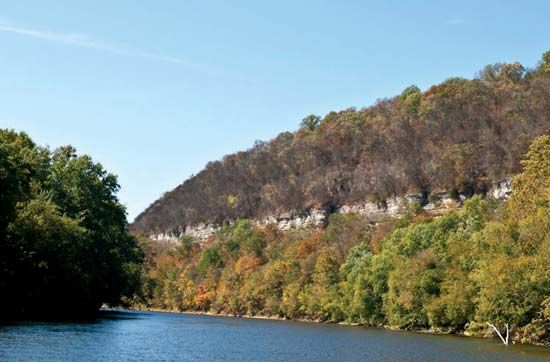
Licking River
The Licking River serves as a significant tributary within the Ohio River watershed. Rising in the mountains of eastern Kentucky, the river flows…
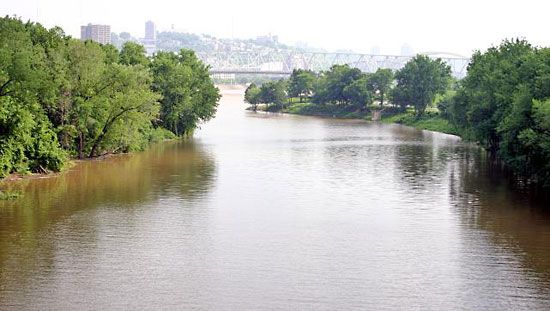
How does the Licking River contribute to the Ohio River watershed?
The Licking River serves as a significant tributary within the Ohio River watershed. Rising in the mountains of eastern Kentucky, the river flows approximately 320 miles (515 km) in a northwesterly direction.12
As it traverses the state, it drains a major portion of eastern Kentucky, meandering through the Bluegrass region before ultimately emptying into the Ohio River at Covington, directly opposite Cincinnati, Ohio. The river system is fed by the North Fork and South Fork Licking rivers, which join the main stream near Falmouth. Additionally, the U.S. Army Corps of Engineers has impounded the river to create Cave Run Lake, which provides essential flood protection for the lower river valley.12
Are there any dams or locks on the Licking River, and what purpose do they serve?
The Licking River in Kentucky features a dam constructed by the U.S. Army Corps of Engineers at the northern edge of the Daniel Boone National Forest. This dam created Cave Run Lake, which serves the primary purpose of providing flood protection for the lower river valley.1
It is important to distinguish this river from the Licking River in Ohio, which is a tributary of the Muskingum River. That separate river system is managed by a series of locks, dams, and short canals built between 1935 and 1941 to control flooding and facilitate navigation.3
What are the major tributaries of the Licking River?
The Licking River is primarily joined by two major tributaries that converge near Falmouth in Pendleton County, Kentucky:
These streams contribute to the river’s flow as it travels northwest through the Bluegrass region toward its confluence with the Ohio River at Covington.1
Are there any significant historical events associated with the Licking River?
The Licking River has served as a significant corridor for trade and exploration throughout Kentucky’s history, notably functioning as an early trade route due to its partial navigability.1
The most prominent historical event associated with the river is the Battle of Blue Licks, which took place on August 19, 1782, during the American Revolution. This engagement, often described as one of the final skirmishes of the war, occurred at a site now commemorated by the Blue Licks Battlefield State Park. During this conflict, a force of Kentucky pioneers was defeated by a coalition of British and Native American forces. The area was historically significant even before this battle; it was known as “Great Salt Lick Creek” because the river’s numerous saline springs attracted wildlife, which in turn drew hunters and settlers to the region.14
Sources
- Licking River — Encyclopædia Britannica
- Ohio River — Encyclopædia Britannica
- Kentucky - Drainage of Kentucky — Encyclopædia Britannica
- Licking — Merriam-Webster
- Muskingum River — Encyclopædia Britannica
- Kentucky - Exploration and settlement — Encyclopædia Britannica
Published on · 2 min read