Napo River
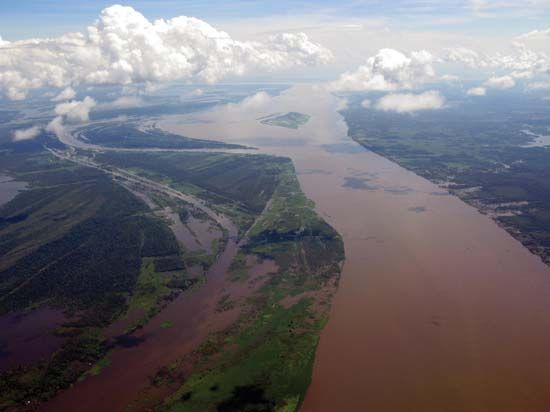
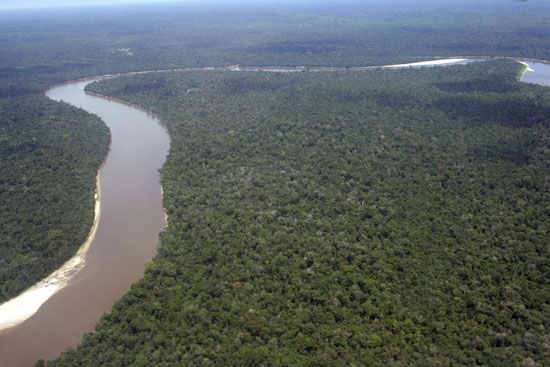
The Napo River is a significant waterway located in northeastern Ecuador and northeastern Peru. Rising near Mount Cotopaxi in the Ecuadorian Andes, the river…
What is Napo River?
The Napo River is a significant waterway located in northeastern Ecuador and northeastern Peru. Rising near Mount Cotopaxi in the Ecuadorian Andes, the river flows eastward and then southeastward through dense tropical rain forests for approximately 550 miles (885 km) before joining the Amazon River downstream from Iquitos1.12
Historically, the river was explored by Francisco de Orellana in 1540 and later by Pedro Teixeira in 1638. Today, it serves as a vital transportation artery, as much of its length is navigable. The region surrounding the river supports various economic activities, including cattle ranching and the harvesting of timber, rubber, chicle, and furs.1
Who was Francisco de Orellana?
Francisco de Orellana (c. 1490–1546) was a Spanish soldier and the first European to explore the Amazon River. After participating in the conquest of Peru with Francisco Pizarro, he served as a lieutenant under Gonzalo Pizarro during an expedition east of Quito.3
In 1541, while searching for provisions, Orellana and his men reached the junction of the Napo and Marañón rivers. Finding it impossible to return to the main party, they drifted down the Amazon system, reaching its mouth in 1542. Upon returning to Spain, he claimed to have encountered tribes led by women resembling the Amazons of Greek mythology, which likely inspired the river’s name. Orellana later attempted to return to the region to exploit his discoveries, but the expedition ended in disaster; his vessel capsized near the river’s mouth, and he drowned.3
What makes the Amazon River basin unique?
The Amazon River basin is a unique and vital global feature, distinguished by its immense scale and ecological complexity. As the world’s largest drainage basin, it covers approximately 34 percent of South America and carries about one-fifth of all freshwater runoff on Earth.45
Key characteristics that define the basin include:
- Biological Diversity: It houses the Amazon Rainforest, which contains roughly 60 percent of the world’s rainforests and serves as the planet’s largest biological reservoir, supporting 10 percent of all known life forms.64
- Complex Ecosystems: The basin features a mosaic of environments, including várzeas (annually flooded forests with nutrient-rich white water), igapó (acidic black-water forests), and vast terra firme upland forests.45
- Geological History: The basin is a great structural depression that was once occupied by a freshwater sea during the Pliocene Epoch. Its current landscape was shaped by the rise in sea level following the melting of Pleistocene glaciers, which flooded deep canyons.7
- Climate Regulation: The basin acts as a massive carbon absorber, playing a critical role in global climate equilibrium.4
How do rivers like the Napo support local economies?
Rivers like the Napo River support local economies primarily by serving as vital transportation arteries, as much of the river is navigable for transport through dense tropical rainforests. These waterways facilitate the movement of goods and people in regions where other infrastructure may be limited.110
Beyond transportation, the riverbanks and surrounding forests are significant sources of economic activity:
- Agriculture and Livestock: Cattle are raised along the banks of the Napo, utilizing the land for pastoral production.1
- Natural Resources: The forests adjacent to the river yield valuable commodities, including rubber, chicle, timber, and furs.1
- Livelihoods: Many indigenous peoples in the region have integrated into the rainforest ecosystem, utilizing their extensive knowledge of its resources for their survival and economic well-being.11
However, it is important to note that economic activities in these areas, such as the clearing of land for agriculture or the illicit cultivation of coca, contribute to deforestation, which threatens the long-term ecological health of the basin.11
Sources
- Napo River — Encyclopædia Britannica
- Napo — Merriam-Webster
- Francisco de Orellana — Encyclopædia Britannica
- Amazon River: Top Questions — Encyclopædia Britannica
- Amazon River - Landforms and drainage patterns — Encyclopædia Britannica
- Amazon basin — Encyclopædia Britannica
- Amazon River - Animal life — Encyclopædia Britannica
- Amazon River — Encyclopædia Britannica
- Amazon River - Climate — Encyclopædia Britannica
- South America - Waterways — Encyclopædia Britannica
- Amazon River - Ecological concerns — Encyclopædia Britannica
- Peru - Lakes and rivers — Encyclopædia Britannica
Published on · 3 min read