Muscle Shoals
Muscle Shoals played a pivotal role in the development of hydroelectric power in the United States by serving as a focal point for early 20th-century debates…
What role did Muscle Shoals play in the development of hydroelectric power in the United States?
Muscle Shoals played a pivotal role in the development of hydroelectric power in the United States by serving as a focal point for early 20th-century debates over public versus private control of natural resources.1
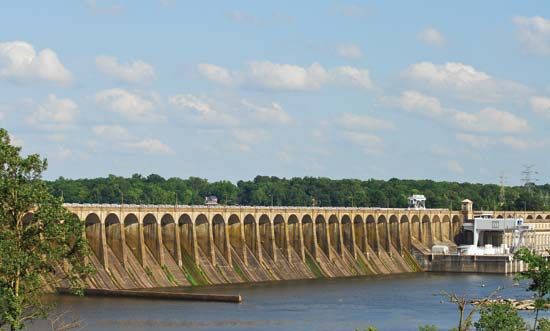
Initially, private companies sought to harness the river’s energy, but President Theodore Roosevelt intervened in 1908 to preserve public control. During World War I, the federal government authorized the construction of nitrate-manufacturing plants and a dam for hydropower as a national defense measure. This site, featuring the Wilson Dam, became the center of a long-standing national controversy regarding ownership.1
This conflict was resolved in 1933 with the creation of the Tennessee Valley Authority, which consolidated regional water management. The TVA utilized the Muscle Shoals facilities as a foundation for a massive program of dam construction and hydroelectric generation. By providing cheap electricity, these projects spurred industrial development and transformed the regional economy, establishing the TVA as a significant prototype for integrated natural-resource planning.12
How did the Tennessee Valley Authority (TVA) impact the development of Muscle Shoals?
The Tennessee Valley Authority (TVA) played a transformative role in the development of Muscle Shoals, Alabama, by resolving a long-standing national controversy over the site’s ownership and integrating its facilities into a broader regional infrastructure plan.
Following the transfer of Muscle Shoals properties to the TVA in 1933, the agency utilized the existing Wilson Dam as a cornerstone for its massive program of dam construction and hydroelectric generation. The TVA’s management effectively eliminated the hazardous rapids that had historically obstructed navigation on the Tennessee River, while the cheap electricity produced at the site helped spur industrial development in the previously depressed regional economy.21
Furthermore, the modern city of Muscle Shoals itself developed directly from the TVA complex centered around the Wilson Dam area. By consolidating various government activities under a single agency, the TVA turned the site into a prototype for integrated natural-resource planning, balancing flood control, navigation improvements, and power production.12
What is the geographical location and significance of Muscle Shoals in Alabama?
Muscle Shoals is a section of the Tennessee River located in Colbert and Lauderdale counties in northwestern Alabama. The name, derived from an obsolete form of the word “mussel,” refers to an area where abundant shellfish were once found.1
Historically, the site was defined by extensive, hazardous rapids caused by flinty, jagged rocks and a sharp river drop of approximately 130 feet over 37 miles. For over a century, these shoals presented a significant navigation obstacle, defying various canal-building efforts.1
The significance of Muscle Shoals evolved through several phases:
- National Defense and Infrastructure: During World War I, the site was selected for the construction of nitrate-manufacturing plants and the Wilson Dam to support national defense.1
- Public Policy: It became the center of a major national debate regarding public versus private control of natural resources, which was resolved in 1933 when the facilities were transferred to the Tennessee Valley Authority.1
- Cultural Impact: Beyond its industrial history, the area—comprising the cities of Florence, Sheffield, and Muscle Shoals—gained international renown as a legendary hub for rhythm and blues and gospel music production.3
How did Muscle Shoals contribute to the music industry, particularly in the 1960s and 1970s?
During the 1960s and 1970s, Muscle Shoals, Alabama, became an unlikely but essential powerhouse in the music industry. Despite its remote location and lack of amenities, the area attracted major artists who sought the unique, soulful sound cultivated by local producers and session musicians.4
The foundation of this success was Fame Studios, established by Rick Hall in 1961. Hall’s ability to recruit exceptional talent—such as the house band that eventually formed the Muscle Shoals Sound Studio—was pivotal. These musicians, though all white, were deeply influenced by gospel and rhythm and blues, allowing them to craft definitive hits for legendary performers.4
Key contributions included:
- Breakthrough Hits: Artists like Aretha Franklin, Wilson Pickett, Percy Sledge, and the Staple Singers recorded their first major successes there.4
- Industry Influence: Partnerships with labels like Atlantic Records brought national attention to the region, cementing its reputation as a premier destination for soul music.4
Sources
- Muscle Shoals — Encyclopædia Britannica
- Tennessee Valley Authority — Encyclopædia Britannica
- Muscle Shoals — Merriam-Webster
- Muscle Shoals Studios: “Land of 1000 Dances” — Encyclopædia Britannica
- Tennessee - Tennessee, c. 1900 through World War II — Encyclopædia Britannica
- Memphis 1960s overview — Encyclopædia Britannica
Published on · 3 min read