Kentucky River
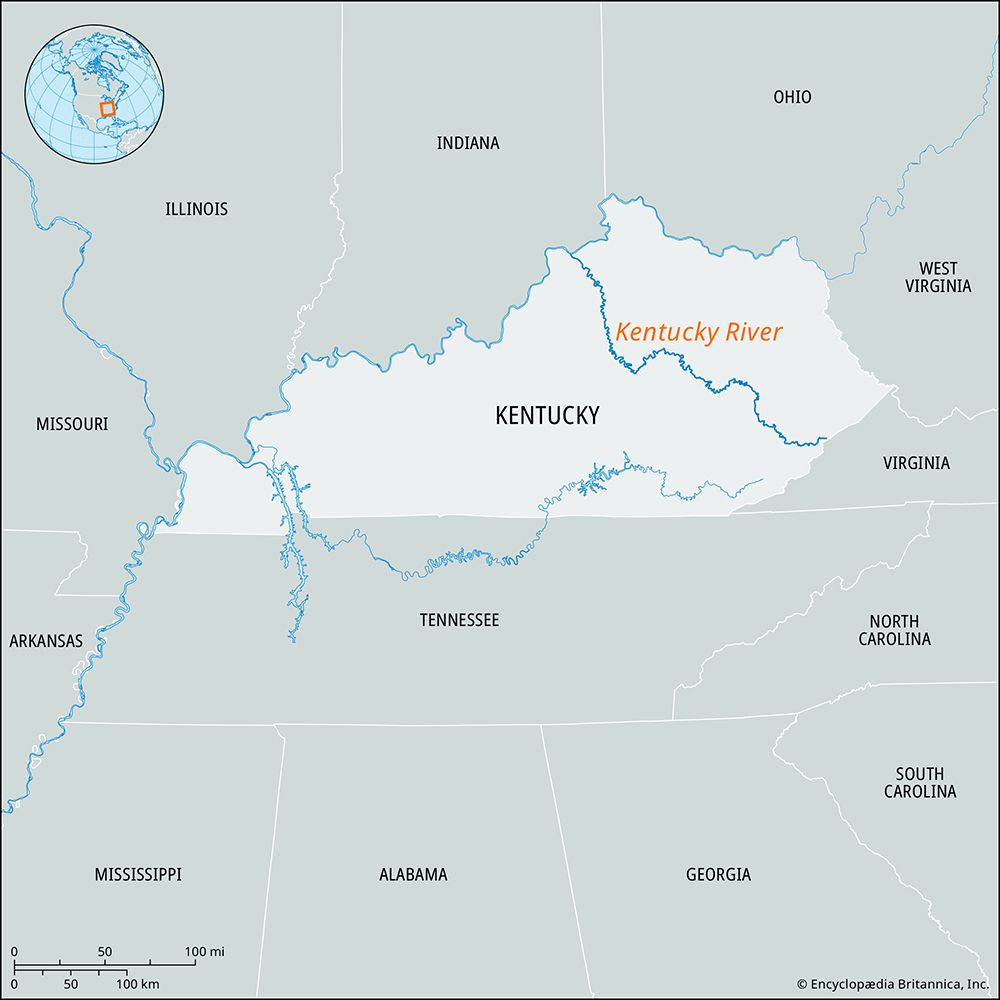
The Kentucky River is a significant tributary of the Ohio River located in north-central Kentucky, U.S. Spanning 259 miles (417 km), the river is navigable…
What is Kentucky River?
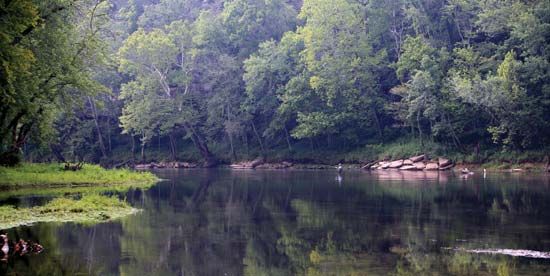
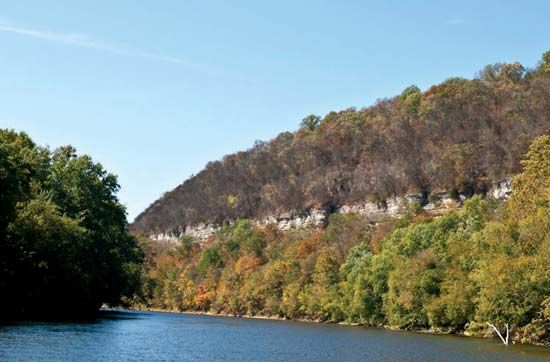
The Kentucky River is a significant tributary of the Ohio River located in north-central Kentucky, U.S. Spanning 259 miles (417 km), the river is navigable throughout its course via a system of locks.1
The river is formed near Beattyville in Lee County by the confluence of three main branches:
- North Fork: Rises in the Cumberland Mountains near the Virginia border and flows for 168 miles.1
- Middle Fork: Originates in Leslie County and flows for 97 miles.1
- South Fork: Originates in Bell County and flows for 75 miles.1
After these branches join, the main stream flows northwestward, meandering across the Bluegrass region before emptying into the Ohio River at Carrollton. It serves as one of the state’s seven major drainage basins, playing a vital role in the hydrology of eastern and central Kentucky.12
What are the major physiographic regions of Kentucky?
Kentucky is situated within three major physiographic regions of the United States: the Appalachian Highlands (specifically the Appalachian Plateau), the Interior Lowlands, and the Coastal Plain. Within the state, these are further divided into six distinct regions based on underlying rock structure:4
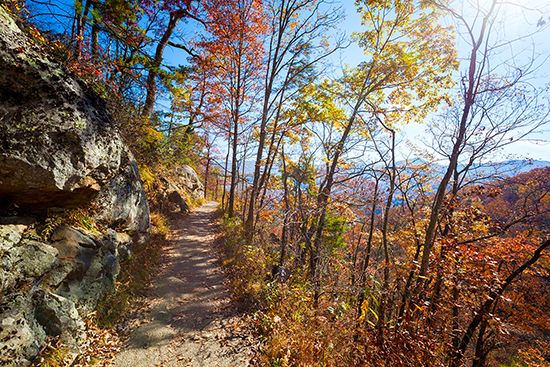
- Mountain Region: Located in eastern Kentucky, this area features the deeply dissected Cumberland Plateau and contains the state’s highest point, Big Black Mountain.43
- Knobs: A narrow, horseshoe-shaped region that encircles the Bluegrass area, characterized by cone-shaped hills.4
- Bluegrass Region: Situated at the heart of the state, this area is known for its gently undulating terrain and fertile, phosphate-rich limestone soils.546
- Pennyrile (Pennyroyal): A large region defined by its limestone geology, famous for its extensive cave systems, including Mammoth Cave.4
- Western Coalfield: An area of rolling uplands and bottomlands surrounded by the Pennyrile and the Ohio River, rich in coal deposits.4
- The Purchase (Jackson Purchase): The state’s lowest topographic region, located in the far west and geologically representing the northernmost extent of the Gulf Coastal Plain.4
How do rivers like the Kentucky River shape the state’s landscape?
Rivers are primary agents of landscape evolution in Kentucky, fundamentally shaping the state’s terrain through the processes of erosion and valley formation of erosion and valley formation. As rivers expend energy, they perform vertical entrenchment, carving narrow, deep valleys into the underlying geology. Over time, as these streams approach their base level, they shift from vertical downcutting to lateral erosion, broadening their valley floors and smoothing their longitudinal profiles.92
The state’s landscape is defined by seven major drainage basins, including the Kentucky, Licking, and Green rivers, which meander across various physiographic regions. In areas like the Mountain region, rivers have dissected the Cumberland Plateau, creating scenic narrow valleys and steep pinnacles. Conversely, in the Pennyrile, the interaction between surface waters and limestone has resulted in extensive subterranean landscapes, including the famous Mammoth Cave. Additionally, rivers have acted as boundaries and transportation corridors, while human-engineered dams have further altered the landscape by creating large reservoirs like Lake Cumberland.73
What is the significance of the Bluegrass region in Kentucky?
The Bluegrass region of central Kentucky holds significant importance due to its unique geology, agricultural productivity, and cultural influence.
Agricultural and Geological Significance
The region is defined by its phosphate-rich limestone soils, which date back to the Ordovician Period. These nutrient-dense soils support the growth of abundant bluegrass, which is essential for the region’s world-renowned horse-breeding industry. The minerals from the soil are absorbed by the grass and contribute to the development of strong bones in Thoroughbreds, making the area a global center for horse racing and sales.41011
Economic and Cultural Impact
As the first area of the state to be settled, the Bluegrass is historically and economically significant. It is an affluent, cosmopolitan region that contrasts with the more rural, mountainous eastern parts of Kentucky. The area serves as a hub for manufacturing and urban amenities, including theater and orchestras, particularly in cities like Lexington. Culturally, it is synonymous with traditions such as horse shows and the Kentucky Derby, which draw international attention.412611
Sources
- Kentucky River — Encyclopædia Britannica
- Kentucky - Drainage of Kentucky — Encyclopædia Britannica
- Kentucky - Relief — Encyclopædia Britannica
- Bluegrass region — Encyclopædia Britannica
- Cumberland Plateau — Encyclopædia Britannica
- Kentucky - Soils — Encyclopædia Britannica
- Kentucky — Encyclopædia Britannica
- river - Valley evolution — Encyclopædia Britannica
- river - Valleys and canyons — Encyclopædia Britannica
- Kentucky - Economy of Kentucky — Encyclopædia Britannica
- Kentucky - Agriculture, forestry, and fishing — Encyclopædia Britannica
- Kentucky - Cultural life — Encyclopædia Britannica
- Kentucky - Sports and recreation — Encyclopædia Britannica
- Bluegrass — Merriam-Webster
Published on · 3 min read