Loch Lomond
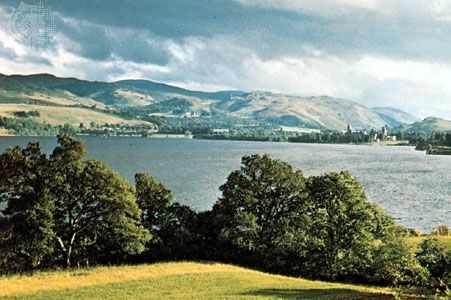
Loch Lomond is the largest lake in Scotland, situated across the southern edge of the Highlands. Stretching approximately 24 miles (39 km), the lake is…
What is Loch Lomond?
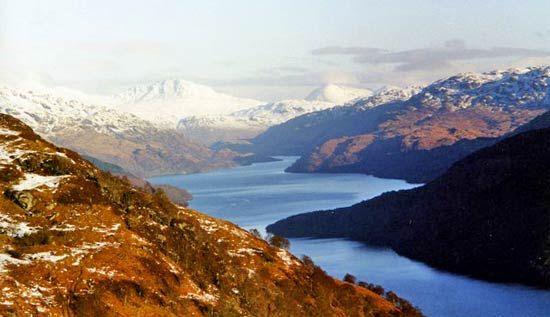
Loch Lomond is the largest lake in Scotland, situated across the southern edge of the Highlands. Stretching approximately 24 miles (39 km), the lake is characterized by a triangular shape that widens toward the south. Its floor, which was carved by glaciers, reaches a maximum depth of 623 feet (190 metres), despite the surface resting only 23 feet (7 metres) above sea level.12
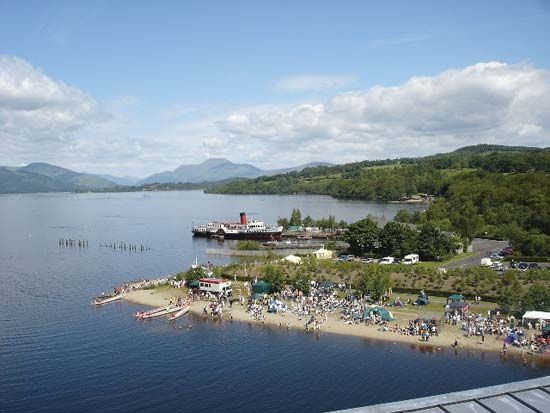
The landscape surrounding the loch is diverse, transitioning from rugged, glaciated mountains exceeding 3,000 feet (900 metres) in the north to gentler hills and islands in the south. The lake drains into the River Clyde estuary via the River Leven. Due to its proximity to Glasgow, it serves as a popular destination for recreation, with several resort settlements along its shores, including Luss, Balloch, and Balmaha. Additionally, the area supports infrastructure such as a hydroelectric power station at Inveruglas1.1
What are the Trossachs?
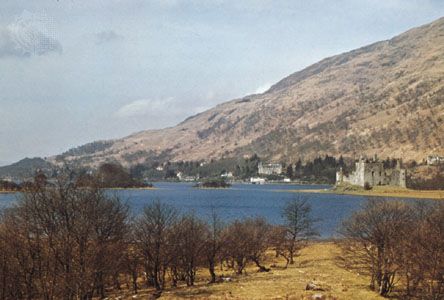
The Trossachs is a renowned tourist region located in the Highlands within the Stirling council area of Scotland, historically part of Perthshire.
While the name is often used broadly to describe the rugged landscape extending west from Callander to Loch Katrine, it strictly refers to the glen situated between Loch Achray and the lower end of Loch Katrine. The area gained significant Victorian-era fame through the literary works of Sir Walter Scott, particularly The Lady of the Lake and Rob Roy, as well as the 1804 tour by poet William Wordsworth. Since 1919, the mountainsides in this region have been extensively planted with conifers.34
How were the Scottish lochs formed by glaciers?
Scottish lochs were primarily formed through the mechanical action of glaciers during the Pleistocene Epoch. As massive ice sheets and valley glaciers moved across the landscape, they scoured and deepened existing valleys and rock basins, creating the characteristic depressions that now hold these bodies of water.5678
The formation processes include:
- Rock Basin Excavation: Glaciers effectively eroded the bedrock, carving out deep, steep-sided basins. For example, Loch Lomond features a floor that was glacially excavated to a depth of 623 feet (190 metres).59
- U-Shaped Valleys: Glacial movement transformed V-shaped stream valleys into broad, smooth U-shaped valleys, which often contain deep lochs.108
- Moraine Damming: In some instances, glaciers deposited moraine—heterogeneous sediment—at their margins, which acted as natural dams to trap water and form lochs.567
- Cirque Formation: In mountainous areas, glaciers deepened circular basins known as cirques, which can contain smaller, high-altitude lochans.56
What is the significance of the song The Bonnie Banks o’ Loch Lomond?
The song “The Bonnie Banks o’ Loch Lomond” is a traditional Scottish folk song that holds significant cultural status as one of the most recognizable symbols of Scotland. While the song is often associated with the scenic beauty of Loch Lomond, its lyrics are widely interpreted as a poignant expression of Jacobite sentiment.
The narrative typically describes a soldier who has been captured or killed, reflecting on the “low road”—a metaphorical reference to the spirit’s journey back to his homeland after death, while his living companion takes the “high road.” This theme of tragic separation and longing for one’s native land has cemented the song’s place in Scottish heritage and global folk music.
The provided search results do not contain specific historical details regarding the song’s origins or its lyrical interpretation.
Sources
- Loch Lomond — Encyclopædia Britannica
- Lomond, Loch — Merriam-Webster
- the Trossachs — Encyclopædia Britannica
- Trossachs — Merriam-Webster
- Scotland - Drainage — Encyclopædia Britannica
- lake - Basins formed by glaciation — Encyclopædia Britannica
- glacial landform - Glacial erosion — Encyclopædia Britannica
- glacial landform - Glaciolacustrine deposits — Encyclopædia Britannica
- glacial landform - Small-scale features of glacial erosion — Encyclopædia Britannica
- glacial valley — Encyclopædia Britannica
- Scotland - Relief of Scotland — Encyclopædia Britannica
- Pleistocene Epoch - Glaciation — Encyclopædia Britannica
Published on · 3 min read