Glen Mor
The term "Glen Mor" (often spelled Glen More) refers to a significant valley located in the Highland council area of north-central Scotland. It is important…
What is Glen Mor?
The term “Glen Mor” (often spelled Glen More) refers to a significant valley located in the Highland council area of north-central Scotland. It is important to distinguish this geographic feature from “Glenmore,” which is a national forest park situated in the Cairngorm Mountains.12
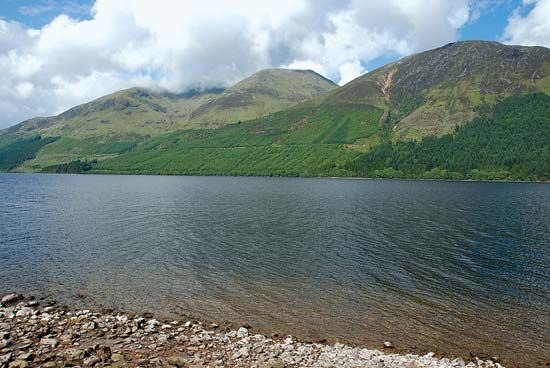
Glen Mor extends approximately 60 miles (97 km) from the Moray Firth at Inverness to Loch Linnhe at Fort William. The valley is notable for containing several major lochs, including Loch Ness, Loch Oich, and Loch Lochy, and it serves as the route for the Caledonian Canal.1
What is the purpose of the Caledonian Canal?
The primary purpose of the Caledonian Canal is to provide a navigable waterway connecting the North Sea with the North Atlantic Ocean by linking a series of freshwater lakes—specifically Lochs Ness, Oich, and Lochy—across the Glen Mor fault in northern Scotland.4
Constructed under the direction of Thomas Telford and surveyed by James Watt, the canal was originally intended to facilitate maritime transit across the Scottish Highlands. While it was once of significant economic importance, the canal is now too small to accommodate modern oceangoing vessels. Consequently, its current use is limited to fishing and pleasure craft.4
What makes Loch Ness famous?
Loch Ness is primarily famous for the legend of the Loch Ness monster, a creature said to inhabit its waters. While widely considered a myth, the legend has persisted for centuries, fueled by ancient folklore and modern sightings.678
The myth gained global attention in 1933 following road improvements that provided clear views of the lake. Subsequent “evidence,” such as the famous 1934 “surgeon’s photograph,” sparked international speculation that the creature might be a surviving plesiosaur. However, investigations—including sonar explorations and a 2018 DNA survey—have failed to find evidence of such an animal, and the iconic photograph was later revealed to be a hoax.78
Beyond the legend, Loch Ness is geographically significant as the largest body of fresh water in Great Britain by volume. It is a deep, 23-mile-long lake located in the Glen Mor valley and serves as a key component of the Caledonian Canal system. Despite the lack of scientific proof for the monster, the legend remains a major tourist attraction, contributing significantly to Scotland’s economy.678
How were the Scottish Highlands formed?
The formation of the Scottish Highlands is primarily the result of the Caledonian orogenic belt, a massive mountain-building event that occurred between 542 and 416 million years ago.10
This process was driven by the opening and subsequent closure of the Iapetus Ocean. As the ocean closed during the Ordovician and Silurian periods, continental blocks collided, causing intense deformation, metamorphism, and the creation of magmatic belts and granites. This era also produced the Dalradian Series, a vast sequence of folded and metamorphosed rocks that form much of the southeastern Highlands.1112
Following this uplift, the landscape underwent significant transformation:
- Erosion: Over millions of years, the original mountain range was worn down, leading to the deposition of Old Red Sandstone in surrounding basins.1011
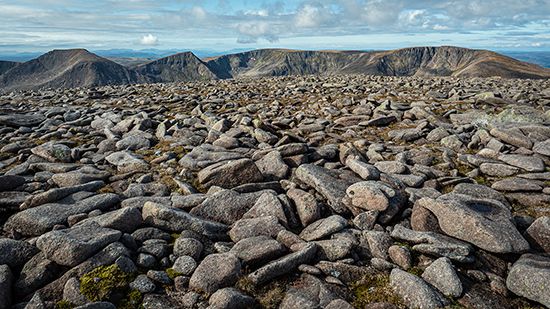
- Glaciation: The modern rugged topography, characterized by deep glens and peaks, was largely carved by glaciers. This process created the distinct landscape seen today, including the Glen Mor fault line and the barren, hummocky terrain of the northwest.13
Sources
- Glen More — Merriam-Webster
- Glen Mor — Encyclopædia Britannica
- Glenmore — Encyclopædia Britannica
- Caledonian Canal — Encyclopædia Britannica
- Caledonian Canal — Merriam-Webster
- Loch Ness — Encyclopædia Britannica
- Loch Ness monster — Encyclopædia Britannica
- Loch Ness monster: Top Questions — Encyclopædia Britannica
- Ness, Loch — Merriam-Webster
- Scotland - Relief of Scotland — Encyclopædia Britannica
- Caledonian orogenic belt — Encyclopædia Britannica
- Europe - Caledonian orogenic belt — Encyclopædia Britannica
- Dalradian Series — Encyclopædia Britannica
Published on · 2 min read