Grampian Mountains
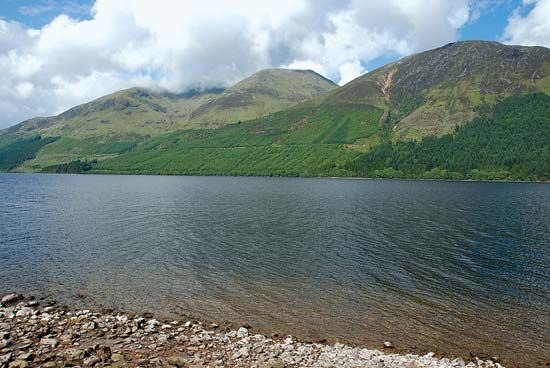
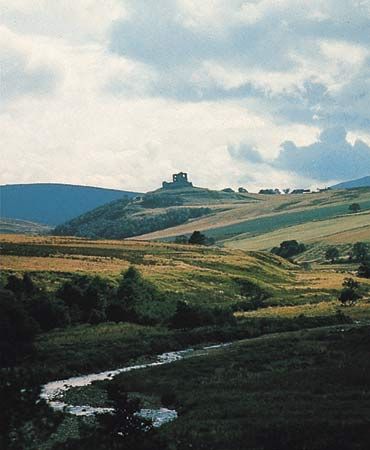
The Grampian Mountains are a major mountain range located in the Highlands of Scotland. The name is derived from Mons Graupius, the site of a battle where…
What is Grampian Mountains?
The Grampian Mountains are a major mountain range located in the Highlands of Scotland. The name is derived from Mons Graupius, the site of a battle where the Roman general Agricola defeated the Picts around 84 CE.1
Geographically, the term often refers to the entire central Highland mass situated between Glen Mor and the southern edge overlooking the Lowlands, though it is sometimes used more specifically to describe that southern relief feature. Compared to the rugged northwest Highlands, the Grampians are generally more rounded and grassy, featuring wider plateaus, though they still contain significant cliffs and pinnacles.12
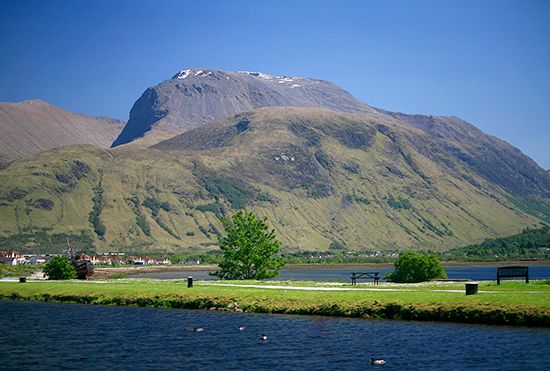
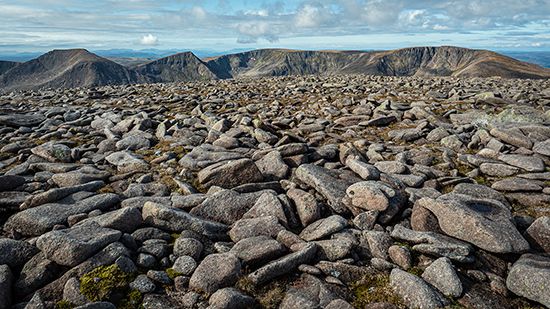
The range includes Britain’s highest peaks, such as Ben Nevis, which reaches 4,406 feet (1,343 meters), and the Cairngorm Mountains, which house Ben Macdui. The area also features notable landscapes like Rannoch Moor.123
How did glaciers shape the landscape of the Scottish Highlands?
Glaciation has been a primary force in shaping the dramatic topography of the Scottish Highlands. During the Pleistocene Epoch, the region was heavily impacted by the Scandinavian Ice Sheet, which scoured the landscape and carved out its characteristic features.4
Key geomorphological impacts include:
- Valleys and Peaks: Glacial movement carved deep glens (valleys) that separate mountain peaks of relatively uniform height. In the northern Highlands, this process created deep rock basins that now hold numerous large lochs.25
- Northwestern Landscape: In the northwest, severe glaciation wore down the ancient Lewisian Complex rocks, resulting in a rugged, hummocky terrain dotted with small lochs and thin, acidic soil.2
- Grampian Mountains: While also shaped by glaciers, the Grampian Mountains generally feature more rounded, grassy slopes and wider plateaus compared to the more jagged northwest, though they still contain significant cliffs and pinnacles.2
- Drainage Patterns: Glacial erosion created moraine-dammed pools in mountain corries (cirques) and deep basins that define the region’s complex drainage and lake systems.5
What is the significance of the Highland Boundary Fault in Scotland’s geography?
The Highland Boundary Fault serves as a critical geological and topographical marker in Scotland. It acts as the distinct southeastern margin of the Highlands, effectively separating the rugged, mountainous terrain of the north from the lower-lying Midland Valley to the south.7
Geographically, this fault line runs in a northeast-to-southwest direction. It stretches from Stonehaven, located just south of Aberdeen, to Helensburgh on the River Clyde. Along its path, the fault passes through Loch Lomond, which is Scotland’s largest stretch of inland water. By defining the edge of the Highland mass, the fault helps delineate the primary physiographic divisions of the country, marking the transition between the ancient, eroded plateaus of the north and the varied, volcanic-influenced landscapes of the central region.72
What are some of the rare plants and animals found in the Cairngorms National Nature Reserve?
The Cairngorms National Nature Reserve, established in 1954, is renowned for its unique biodiversity, hosting a variety of rare flora and fauna adapted to the high-altitude environment of the Grampian Mountains.83
Rare Flora and Fauna
While the reserve is noted for its rare species, the broader Highlands region provides context for the types of life found there:
- Alpine and Arctic Plants: The highest slopes and plateaus support specialized vegetation, including saxifrages, creeping azalea, and dwarf willows, which flourish in the harsh, cold conditions.8
- Rare Birds: The ptarmigan, a species of grouse found only at high elevations, is a notable resident. Additionally, the large capercaillie has been reintroduced into the region’s pine woodlands.8
- Mammals: The area supports populations of red deer, pine marten, and mountain hares. The Scottish wildcat, while critically endangered, is also part of the region’s diverse wildlife.8
Sources
- Grampian Mountains — Encyclopædia Britannica
- Scotland - Relief of Scotland — Encyclopædia Britannica
- Cairngorm Mountains — Encyclopædia Britannica
- Pleistocene Epoch - Glaciation — Encyclopædia Britannica
- glacial landform - Striations — Encyclopædia Britannica
- Scotland - Drainage — Encyclopædia Britannica
- Scottish Highlands — Encyclopædia Britannica
- Scotland - Plant and animal life — Encyclopædia Britannica
- Cairngorm Mountains — Merriam-Webster
Published on · 3 min read