Katydid
While katydids, grasshoppers, and crickets all belong to the order Orthoptera, they are distinguished by significant biological and behavioral differences.
How are katydids different from grasshoppers and crickets?
While katydids, grasshoppers, and crickets all belong to the order Orthoptera, they are distinguished by significant biological and behavioral differences.
Classification and Anatomy
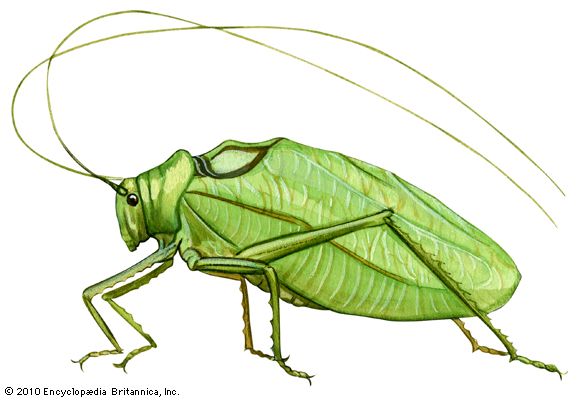
Katydids (family Tettigoniidae) and crickets (family Gryllidae) are grouped together in the suborder Ensifera, whereas grasshoppers belong to the suborder Caelifera. A primary physical distinction is the antennae: katydids and crickets possess long, threadlike antennae that are often as long as or longer than their bodies, while grasshoppers have shorter antennae. Additionally, female katydids are characterized by a sword-shaped or upwardly curved ovipositor used for laying eggs.123
Hearing and Sound
The location of auditory organs differs significantly:
- Katydids and Crickets: Their tympanic organs are located on the front tibiae (legs).42
- Grasshoppers: Their tympanic organs are situated on the sides of the abdomen.4
Sound production also varies. Grasshoppers typically create sound by rubbing their hindlegs against their wings, whereas katydids and crickets produce songs by rubbing their front wings together.42
What do katydids eat, and how do they find their food?
Katydids are primarily herbivorous, feeding on a variety of plant matter such as leaves, flowers, and seeds. For example, coneheaded katydids of the genus Neoconocephalus specialize in consuming the seeds of grasses. While most species focus on vegetation, some katydids are active predators that hunt and devour other insects.65
Regarding their feeding habits, plant preferences can shift based on the season or the insect’s specific life stage, as nymphs and adults of the same species may consume different plants. Furthermore, their dietary needs are often linked to their environment; some species can absorb necessary moisture directly from water droplets on their cuticle or from water vapor in the air when humidity levels are high.5
What role do katydids play in their ecosystem, both as predators and prey?
Katydids play a multifaceted role in their ecosystems, functioning as both consumers and a food source for other animals.
As Predators and Herbivores
While the majority of katydids are herbivorous, feeding on leaves, flowers, and seeds, some species are active predators that hunt and consume other insects. By feeding on plant matter, they influence plant growth and distribution, while their predatory behavior helps regulate populations of other small insects. In some instances, certain species, such as the Mormon cricket (Anabrus simplex), can become significant agricultural pests when their populations surge, leading to the destruction of crops.657
As Prey
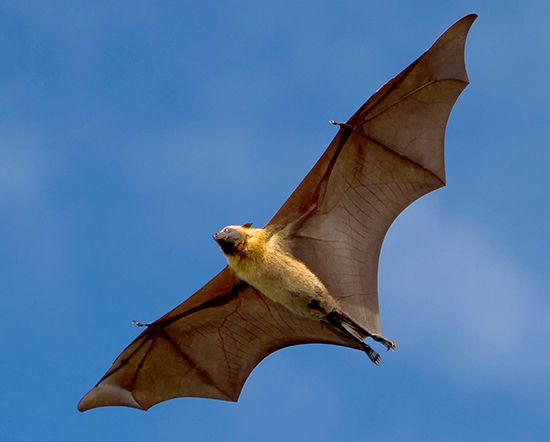
Because many katydids are poor flyers, they are highly vulnerable to predation and have evolved sophisticated survival strategies to avoid being eaten. They serve as a food source for various predators, including bats, which hunt them at night. To mitigate this risk, katydids employ several defensive tactics:6
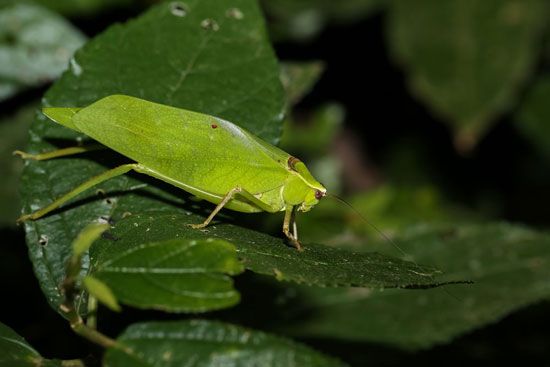
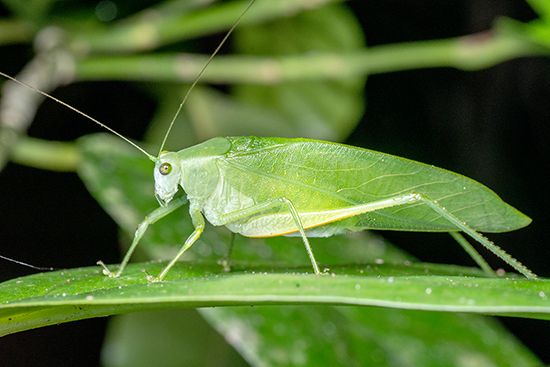
- Camouflage: Many species use cryptic coloration to blend into their surroundings, often mimicking leaves or other vegetation.6
- Deimatic Behavior: Some species use startling displays, such as flashing bright colors on their abdomens or wings, to deter attackers.6
- Chemical Defenses: Certain katydids secrete noxious chemicals and produce unpleasant odors to ward off predators.6
- Acoustic Avoidance: To escape detection by echolocating bats, some species use substrate-borne vibrations (tremulations) to communicate instead of relying solely on audible mating calls.6
What is the life cycle of a katydid, from egg to adult?
Katydids undergo a process of simple, or incomplete, metamorphosis, which consists of three distinct stages: egg, nymph, and adult10.
Egg Stage
Female katydids use their specialized ovipositor to deposit eggs in various locations, including soil, plant tissue, or on surfaces like twigs and rocks. In temperate regions with distinct seasons, the egg is typically the only life stage capable of surviving the winter.68
Nymph Stage
Upon hatching, the young katydid—often emerging initially as a vermiform larva enclosed in a thin membrane—molts to become a nymph. Nymphs resemble miniature adults but lack fully developed wings and reproductive organs. As they progress through 5 to 9 nymphal stages (instars), they molt repeatedly, gradually increasing in size and developing their wings.9610
Adult Stage
Once the final molt is complete, the katydid reaches adulthood. Adults are characterized by their ability to reproduce and, in many species, their fully developed wings. While species in tropical climates may live for several years with overlapping generations, those in seasonal environments typically live for less than a year.69
Sources
- long-horned grasshopper — Encyclopædia Britannica
- List of insects - crickets , grasshoppers , and katydids (order Orthoptera ) — Encyclopædia Britannica
- Orthoptera - Sound production and hearing — Encyclopædia Britannica
- Orthoptera - Habitat — Encyclopædia Britannica
- Orthoptera - Food — Encyclopædia Britannica
- katydid — Encyclopædia Britannica
- shield-backed katydid — Encyclopædia Britannica
- Orthoptera - Egg laying — Encyclopædia Britannica
- nymph — Encyclopædia Britannica
- Orthoptera - General features — Encyclopædia Britannica
Published on · 4 min read