Madagascar Hissing Cockroach
The Madagascar hissing cockroach (Gromphadorhina portentosa) is a large, wingless insect endemic to Madagascar. It is widely recognized for its unique…
What is Madagascar hissing cockroach?
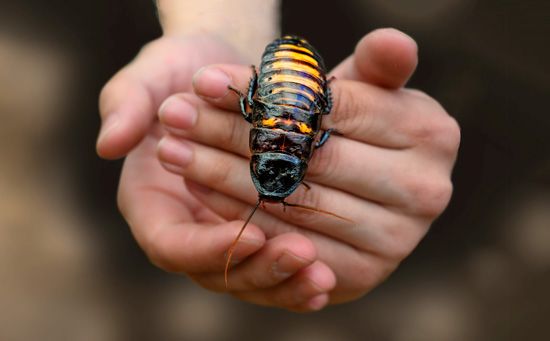
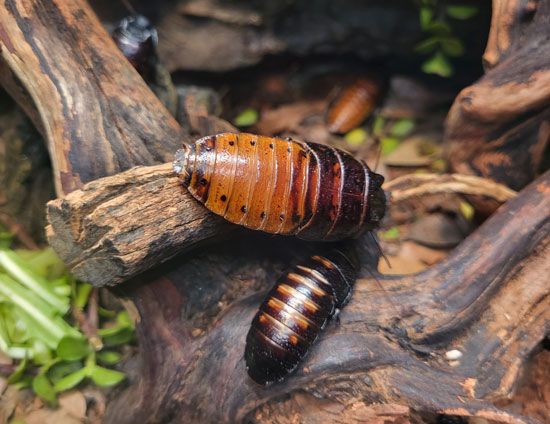
The Madagascar hissing cockroach (Gromphadorhina portentosa) is a large, wingless insect endemic to Madagascar. It is widely recognized for its unique ability to produce a hissing sound by forcing air through modified spiracles on its abdomen, a behavior used to intimidate predators or rivals.12
Measuring 5–7.5 cm in length, these cockroaches are docile and are not considered pests, as they do not infest human dwellings. In their natural tropical forest habitat, they act as important scavengers, recycling nutrients by consuming decaying organic matter.2
Physically, they are characterized by a hard, waxy exoskeleton and, in the case of males, hornlike pronotal humps used during territorial battles. They are ovoviviparous, meaning females incubate eggs internally before giving birth to live nymphs. Due to their manageable nature, they are sometimes kept as pets.2
How do insects breathe without lungs?
Insects do not possess lungs; instead, they utilize a specialized respiratory system composed of a network of air-filled tubes called tracheae. These tubes open to the outside of the body through paired, valvelike structures known as spiracles, which are typically located along the thorax and abdomen.345
The process of gas exchange occurs as follows:
- Diffusion: In sedentary insects, oxygen and carbon dioxide move through the tracheae and into smaller, thin-walled tubes called tracheoles, where they are exchanged with body tissues via diffusion3.4
- Mechanical Ventilation: Highly active insects, such as bees or cockroaches, use rhythmic abdominal pumping to mechanically force air through the tracheal network.34
- Air Sacs: Many active species possess air sacs, which are dilated sections of the tracheae that increase the volume of air moved during respiration.4
Because gases diffuse slowly through narrow tubes, this system imposes a physical size limit on insects.5
What role do detritivores play in a forest ecosystem?
Detritivores play a critical role in the forest ecosystem by acting as scavengers that consume dead organic matter, such as fallen leaves, animal remains, and other debris. By feeding on this material, they remove dead matter from the environment and fragment it into smaller pieces, which creates a more suitable substrate for decomposers like bacteria and [fungi] to further break down.678
This process is essential for nutrient cycling. As detritivores and decomposers digest organic material, they convert complex substances into basic inorganic compounds—such as nitrogen, carbon, calcium, and phosphorus—that producers (plants) can then absorb to support their growth. Furthermore, many soil-dwelling detritivores, such as earthworms, improve soil health by aerating the ground and mixing organic material into the subsoil, which enhances fertility and drainage.78
What are some other unique ways insects communicate?
Insects utilize a diverse array of communication methods beyond simple visual or chemical cues. Because they possess hard exoskeletons, many insects communicate through stridulation, a process where they rub body parts together—such as wings or legs—to produce sound. For instance, crickets and katydids create species-specific songs by rubbing their wings against one another to attract mates or defend territory.9
Insects also rely heavily on tactile and vibrational signaling:
- Substrate Vibrations: Many insects, including leafhoppers and water striders, transmit vibrations through host plants or the surface of the water to communicate with others.9
- Antennal Monitoring: In the darkness of a hive, honeybees perform complex dances that are monitored by other workers using their antennae, allowing for the transfer of information regarding food sources.9
Additionally, some insects utilize bioluminescence. Fireflies produce “cold light” through a chemical reaction involving luciferin and luciferase. These rhythmic, species-specific flashes serve as vital signals for mating and recognition in the dark.10
Sources
- Madagascar hissing cockroach: Top Questions — Encyclopædia Britannica
- Madagascar hissing cockroach — Encyclopædia Britannica
- How Do Cockroaches Breathe? — Encyclopædia Britannica
- Respiratory system - Trachea — Encyclopædia Britannica
- insect - Respiratory system — Encyclopædia Britannica
- detritus — Encyclopædia Britannica
- food web — Encyclopædia Britannica
- soil organism — Encyclopædia Britannica
- How do fireflies light up? — Encyclopædia Britannica
- Animal communication - Signal production — Encyclopædia Britannica
- insect - Insect societies — Encyclopædia Britannica
- pheromone — Encyclopædia Britannica
- Animal communication - Evolution of signals — Encyclopædia Britannica
Published on · 3 min read