Loris
Lorises (subfamily Lorisinae) are small, nocturnal, arboreal primates native to South and Southeast Asia that possess several distinct physical…
What are the physical characteristics that distinguish lorises from other primates?
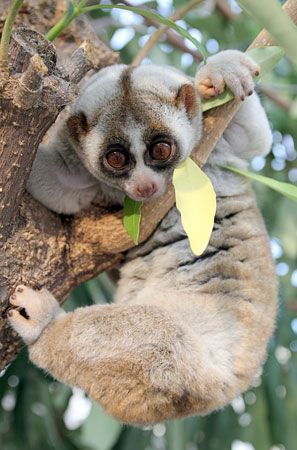
Lorises (subfamily Lorisinae) are small, nocturnal, arboreal primates native to South and Southeast Asia that possess several distinct physical characteristics. Unlike many other primates, they are either tail-less or have very short tails.1
Key physical features include:
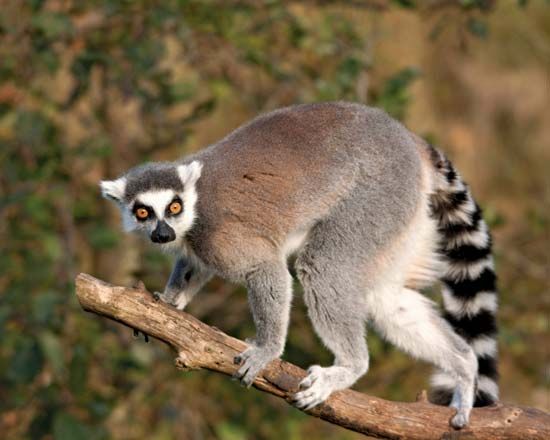
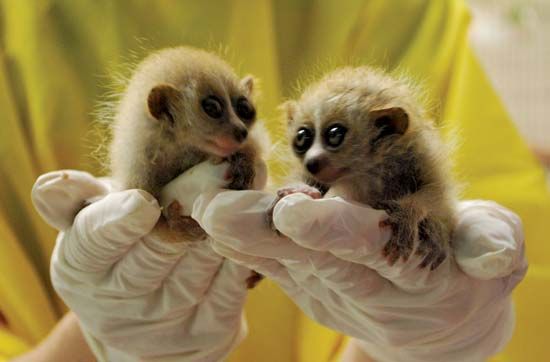
- Facial Structure: They are easily recognized by their large eyes encircled by dark patches. Compared to lemurs, lorises exhibit a greater degree of eye frontality, with the divergence of their bony orbits reduced to approximately 20°.12
- Limbs and Digits: They have short index fingers and move through trees with great deliberation. While slender lorises have long, thin limbs, slow lorises are more robust with shorter, stouter limbs.1
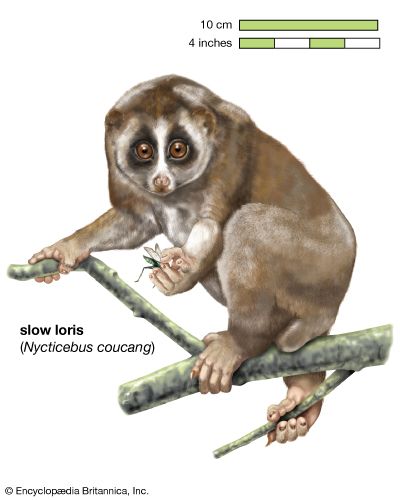
- Specialized Adaptations: The Javan slow loris is unique among primates for being venomous; it possesses specialized glands under its armpits that produce a toxin, which it mixes with saliva to deliver a necrotic bite.1
- General Appearance: They typically have soft gray or brown fur.1
What is the geographical distribution of lorises, and in which habitats are they typically found?
Lorises are arboreal primates native to forest environments across South and Southeast Asia. Their geographical distribution and habitat preferences vary by species:
- Slender Lorises: These are found in India and Sri Lanka.1
- Slow Lorises: Members of the genus Nycticebus are distributed throughout various parts of Southeast Asia. Specific examples include:
Across their range, these primates are strictly forest-dwelling, spending their lives in the trees where they move with great deliberation. Unfortunately, many species face significant threats due to habitat loss as their forest homes are converted into agricultural or grazing land.1
What are the main differences between the two genera of lorises: Nycticebus and Loris?
The two genera of the subfamily Lorisinae—Loris (slender lorises) and Nycticebus (slow lorises)—exhibit distinct physical and behavioral differences:
Feature
Loris
(Slender Lorises)
Nycticebus
(Slow Lorises)
Body Build
Long, slender limbs; small hands
Robust; shorter, stouter limbs
Head/Face
Rounded head; pointed muzzle
More-rounded snout; smaller eyes and ears
Size
20–25 cm (8–10 inches)
25–37 cm (10–15 inches)
Diet
Primarily insects (especially ants)
Insects, small animals, fruit, and vegetation
Sociality
Solitary
Generally solitary, though behavior varies
Unique Traits
N/A
Includes the only known
venomous
primate species
While both are nocturnal, arboreal primates that move with great deliberation, Nycticebus species are noted for moving even more slowly than their slender counterparts. Additionally, the Javan slow loris (N. javanicus) possesses specialized glands that produce a toxin, which it mixes with saliva to deliver a necrotic bite for defense1.
What unique adaptations do lorises have for their arboreal lifestyle?
Lorises have evolved several specialized adaptations that facilitate their arboreal lifestyle in the forests of South and Southeast Asia:
- Locomotion: Lorises move through the trees with great deliberation. A key feature of their movement is the ability to hang securely by their feet, which leaves their hands free to grasp branches or food.1
- Vision: Like many advanced primates, lorises exhibit an evolutionary trend toward frontality of the eyes. In the genus Loris, the divergence between the bony orbits is reduced to 20°, which supports depth perception necessary for navigating complex canopy environments. Their large eyes, often encircled by dark patches, are well-suited for their nocturnal activity.31
- Physical Morphology: They possess short index fingers, which assist in their specialized gripping capabilities.1
Additionally, some species, such as the Javan slow loris, have evolved unique chemical defenses, including specialized glands that produce venom to protect their territories and young.1
Sources
- loris — Encyclopædia Britannica
- lemur — Encyclopædia Britannica
- primate - Eyes and vision — Encyclopædia Britannica
Published on · 3 min read