Adapiform
Adapiforms primarily lived during the Eocene Epoch, which spanned from approximately 56 million to 33.9 million years ago. During this time, they flourished…
During which geological time period did adapiform primates primarily live?
Adapiforms primarily lived during the Eocene Epoch, which spanned from approximately 56 million to 33.9 million years ago. During this time, they flourished across Eurasia, North America, and Africa as some of the earliest and most primitive primates in the fossil record.12
While most adapiform lineages went extinct near the Eocene-Oligocene boundary due to global climate changes, the family Sivaladapidae persisted in southern Asia until the late Miocene Epoch, roughly 7 million years ago2.
How did climate changes during the Eocene epoch affect adapiform evolution and distribution?
During the Eocene Epoch, adapiforms thrived in forested environments across Eurasia, North America, and Africa, where they occupied the ecological niche of arboreal folivory (leaf-eating). Their evolution was marked by a significant increase in body mass—often exceeding 500 grams—which allowed them to subsist on diets of leaves and fruit, distinguishing them from smaller, often nocturnal, Eocene primates.2
The distribution of these primates was largely determined by geography, as different families inhabited distinct continents, which minimized competition between groups. However, this stability was disrupted near the Eocene-Oligocene boundary (approximately 34 million years ago) when the global climate shifted to become cooler and drier. This environmental transition led to the widespread extinction of most adapiform lineages.2
While the majority of these primates disappeared due to these climatic changes, the family Sivaladapidae managed to persist in southern Asia, surviving until the late Miocene Epoch, roughly 7 million years ago.2
How do adapiform primates fit into the broader picture of primate evolution?
Adapiforms occupy a significant place in the study of primate evolution as some of the earliest and most primitive members of the suborder Strepsirrhini, which includes modern lemurs, lorises, and galagos.2
Their evolutionary significance is highlighted by several key factors:
- Ancestral Links: The family Adapidae is widely considered to contain the probable ancestors of living lemurs and lorises. Morphological evidence, such as the structure of foot bones and the presence of a “toilet claw” in genera like Europolemur, supports their role as a stem group for these lineages.1
- Evolutionary Convergence: Some adapiforms, such as the African Afradapis and the European Darwinius masillae, exhibit physical traits—including fused mandibular symphyses and reduced premolars—that are also found in anthropoids (monkeys, apes, and humans). While these similarities are now largely attributed to evolutionary convergence rather than direct ancestry, they have historically led some researchers to view certain adapiforms as potential “missing links.”2
- Ecological Pioneers: Adapiforms were the first primates to evolve a body mass exceeding 500 grams, allowing them to exploit arboreal folivory (leaf-eating) earlier than most other mammals. This shift in body size and their diurnal activity patterns distinguish them from many other smaller, nocturnal Eocene primates.2
What are the key characteristics that define adapiform primates?
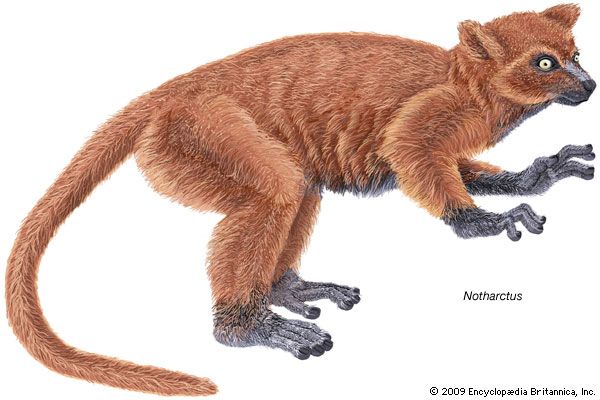
Adapiforms are a group of extinct primates belonging to the suborder Strepsirrhini that flourished during the Eocene Epoch. They are defined by several key characteristics that distinguish them from other early primates:
- Body Size and Diet: Adapiforms were the first primates to evolve an average body mass exceeding 500 grams. This larger size allowed them to occupy the ecological niche of arboreal folivory (leaf-eating), as their slower metabolic rates supported a diet of leaves and fruit.
- Diurnal Activity: Unlike many smaller, nocturnal Eocene primates, most adapiforms possessed small eye sockets (orbits), indicating they were active during the daytime.
- Morphological Traits: Many species exhibited specialized dental features for folivory, such as sharply crested teeth. Some forms, like Adapis and Leptadapis, featured large sagittal and nuchal crests, indicating powerful chewing muscles. Skeletal evidence suggests various modes of locomotion, including slow, deliberate climbing and vertical clinging and leaping.
- Evolutionary Convergence: Certain adapiforms, such as Afradapis and Darwinius masillae, developed traits similar to anthropoids, such as fused mandibular symphyses and reduced premolars, which are now recognized as examples of evolutionary convergence.
Sources
- primate - Eocene — Encyclopædia Britannica
- adapiform — Encyclopædia Britannica
- Tertiary Period - Primates — Encyclopædia Britannica
- human evolution - Hominin habitats — Encyclopædia Britannica
- primate - Pliocene — Encyclopædia Britannica
- primate — Encyclopædia Britannica
- lemur — Encyclopædia Britannica
Published on · 3 min read