Ida
The fossil known as Ida (Darwinius masillae) is distinguished primarily by its exceptional completeness, offering a rare, nearly two-dimensional skeleton…
How does Ida compare to other significant primate fossil discoveries?
The fossil known as Ida (Darwinius masillae) is distinguished primarily by its exceptional completeness, offering a rare, nearly two-dimensional skeleton from the middle Eocene Epoch. While early descriptions hailed it as a potential “missing link” between primitive primates and anthropoids, most scientists now classify it as a typical member of the adapiform radiation—a basal group distantly related to modern lemurs and lorises.12
In contrast, other significant discoveries have provided different insights into primate evolution:
- Proconsul: Known from nearly complete skeletons, this Miocene genus is considered a key early hominoid that diverged before the split of living apes and humans.3
- Sivapithecus: Famous for its facial skeleton, this genus provided crucial evidence linking it to the ancestry of the orangutan.3
- Oreopithecus: This “abominable coalman” is noted for its complex, debated features, including a pelvis suggesting partial bipedalism, placing it within the Hominidae.3
Unlike these later Miocene fossils, which are central to understanding the emergence of apes and humans, Ida remains a vital, albeit specialized, window into early Eocene arboreal primates.132
What controversy or debate surrounds the classification of Ida in the primate family tree?
The primary debate surrounding the classification of Ida (Darwinius masillae) concerns its position in the primate family tree and whether it represents a direct ancestor to anthropoids (the group including monkeys, apes, and humans).
When the specimen was first described, some members of the research team hailed it as a potential “missing link” between primitive primates and anthropoids. However, most of the scientific community classifies Darwinius as a typical member of the adapiform radiation—a group of basal primates more closely related to modern lemurs and lorises than to anthropoids.13
The debate is fueled by evolutionary convergence, where certain physical traits in adapiforms, such as those seen in Darwinius and the African adapiform Afradapis, appear similar to those of anthropoids despite having evolved independently. Furthermore, because the classification of Darwinius is based on a single juvenile specimen that retains its milk teeth, its precise taxonomic affinities remain difficult to determine with certainty.31
What physical characteristics of Ida make it unique among primate fossils?
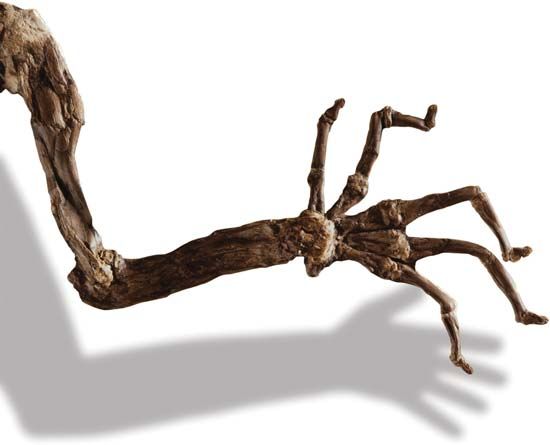
Ida (Darwinius masillae) is uniquely significant among primate fossils primarily due to its extraordinary preservation. Unlike many fossil finds that consist of fragmented remains, Ida is a nearly complete, articulated skeleton from the middle Eocene Epoch, approximately 47 million years ago.1
Several physical characteristics provide insight into its biology and lifestyle:
- Completeness: The specimen is virtually intact, allowing for a detailed analysis of its postcranial skeleton, which is rarely achieved in the fossil record.1
- Arboreal Adaptations: Ida possesses nails on all fingers and toes rather than claws, an opposable big toe (hallux) for grasping, and highly mobile limbs, indicating a specialized, generalized arboreal quadrupedal lifestyle.1
- Sensory Features: Its relatively large orbits suggest that the animal was likely nocturnal.1
- Sex Determination: The absence of a baculum (os penis) in the skeleton provides strong evidence that the specimen is female.1
While its juvenile status—retaining mostly milk teeth—makes taxonomic classification challenging, these physical traits offer a rare, high-resolution look at early primate morphology.1
What is the significance of the Ida fossil in the study of primate evolution?
The Ida fossil (Darwinius masillae) is significant primarily due to its exceptional state of preservation. As a nearly complete, articulated skeleton from the middle Eocene Epoch, it provides a rare, high-resolution look at the morphology of early primates.
Its scientific importance is defined by several factors:
- Morphological Insight: The specimen offers clear evidence of a generalized, arboreal lifestyle, featuring nails instead of claws, an opposable big toe for grasping, and highly mobile limbs.
- Evolutionary Context: While initially sensationalized as a potential “missing link” between primitive primates and anthropoids—the group including apes and humans—most researchers now classify it as a typical adapiform. This places it as a basal member of the lineage leading to modern lemurs and lorises.
- Taxonomic Challenges: Because the specimen is a juvenile retaining its milk teeth, it highlights the difficulties of using immature fossils to establish precise evolutionary relationships within the primate family tree.1
Sources
- Ida — Encyclopædia Britannica
- primate - Miocene — Encyclopædia Britannica
- adapiform — Encyclopædia Britannica
Published on · 3 min read