Macocha Gorge
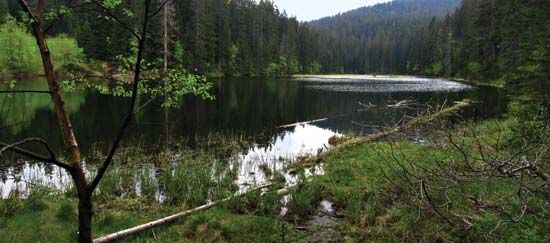
Macocha Gorge is a prominent natural landmark located in the Moravian Karst region of the Czech Republic. It is widely considered the most famous and…
What is Macocha Gorge?
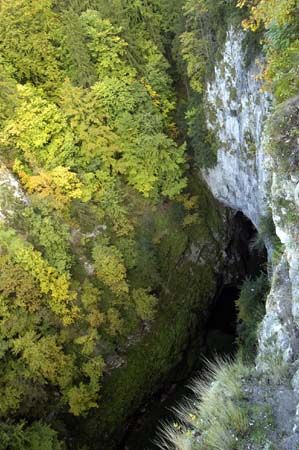
Macocha Gorge is a prominent natural landmark located in the Moravian Karst region of the Czech Republic. It is widely considered the most famous and frequently visited site in the area, characterized by a complex system of caves, galleries, and impressive stalactite and stalagmite formations.1
The gorge, which likely formed due to the collapse of an underground cave roof, reaches a maximum depth of 420 feet (128 meters), a length of approximately 900 feet (275 meters), and a maximum width of 390 feet (120 meters). Visitors can explore the site through a network of subterranean passages, including the Punkva water caves, which are accessible by boat. The surrounding region is a karst landscape defined by limestone formations, swallow holes, and underground rivers.12
How do stalactites and stalagmites form in caves?
Stalactites and stalagmites are types of speleothems—secondary mineral deposits formed by water in caves. Their formation begins when rainwater absorbs carbon dioxide from soil, creating a weak carbonic acid that dissolves calcium carbonate from limestone bedrock.3
When this mineral-rich water reaches a cave, the loss of carbon dioxide into the cave atmosphere causes the calcium carbonate to precipitate.34
- Stalactites: As water hangs from the ceiling, it deposits a ring of mineral matter. Over time, this builds an icicle-like stalactite with a central canal. These can range from thin “straws” to massive pendants.34
- Stalagmites: When the remaining water drips onto the cave floor, it deposits additional mineral matter, building a stalagmite upward. Unlike stalactites, stalagmites do not have a central canal and are typically thicker in proportion.34
If a stalactite and stalagmite continue to grow toward one another, they may eventually join to form a column.4
What exactly is a karst landscape?
A karst landscape is a distinct type of terrain characterized by barren, rocky ground, caves, sinkholes, and underground rivers, typically featuring an absence of surface streams and lakes.5
This topography is primarily formed by the chemical dissolution of massive, soluble bedrock—most commonly limestone or dolomite—by slightly acidic groundwater. As rainwater percolates through cracks and joints in the rock, it dissolves the material and carries it away, gradually widening these fissures into complex underground drainage systems and cave networks.56
Key characteristics of karst terrain include:
- Internal Drainage: Much of the water flow occurs underground rather than through surface streams.6
- Surface Features: The landscape often exhibits jagged bedrock, lapiés, and depressions such as sinkholes, which form when the roofs of underground caves collapse.5
- Variability: Karst regions vary significantly; some feature dramatic surface landforms with few caves, while others possess extensive cave systems with minimal surface expression.6
While the term originated from the Karst region in Slovenia, such landscapes are found globally, covering approximately 15 percent of the Earth’s land surface.57
How are underground rivers like the Punkva created?
Underground rivers, such as the Punkva in the Moravian Karst, are formed through the chemical dissolution of soluble bedrock, typically limestone or dolomite.67
The process begins when surface streams encounter these soluble rocks and begin to lose water through joints and fractures. Over thousands of years, this water—often slightly acidic from absorbed carbon dioxide—slowly widens these cracks. This “initiation phase” eventually creates continuous, pencil-sized conduits.5672
As these passages enlarge, they transition from slow, percolating flow to turbulent, pipe-like flow, allowing them to transport sediment and accommodate larger volumes of water. Eventually, these conduits become large enough to capture the entire flow of a surface stream, causing the surface channel to run dry while the water is diverted into an integrated underground drainage system. These rivers continue to carve out caves and passages as they flow toward their outlets, which often emerge as large springs.2657
Sources
- Macocha Gorge — Encyclopædia Britannica
- Moravian Karst — Encyclopædia Britannica
- cave - Depositional materials and features — Encyclopædia Britannica
- stalactite and stalagmite — Encyclopædia Britannica
- karst — Encyclopædia Britannica
- cave — Encyclopædia Britannica
- cave - Fluviokarst — Encyclopædia Britannica
- cave - Geographic distribution of karst terrain — Encyclopædia Britannica
- cave - Initiation phase — Encyclopædia Britannica
Published on · 3 min read