Maddalena Pass
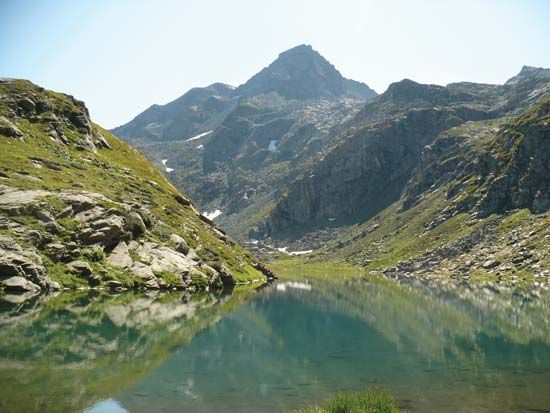
The Maddalena Pass is a mountain gap situated at an elevation of 6,548 feet (1,996 meters) on the border between France and Italy. It serves as a geographic…
What is Maddalena Pass?
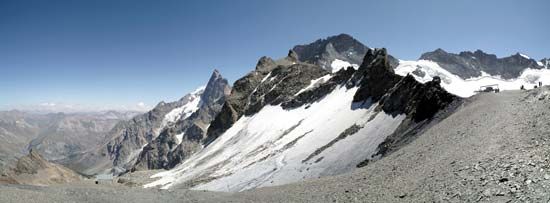
The Maddalena Pass is a mountain gap situated at an elevation of 6,548 feet (1,996 meters) on the border between France and Italy. It serves as a geographic divide between the Cottian Alps to the north and the Maritime Alps to the south.1
Located 12 miles (19 km) east-northeast of Barcelonnette, France, the pass is traversed by a road constructed in 1870 that links the Italian city of Cuneo with Barcelonnette. Historically, the route has been significant for military movements; it is famously associated with the passage of Hannibal’s Carthaginian army during his march toward Rome in 218 BCE, and it was later utilized by King Francis I of France in 1515 to enter Italy and conquer Milan.1
What are the differences between the Cottian and Maritime Alps?
The Cottian Alps and the Maritime Alps are distinct segments of the Western Alps that share a border but differ in their geographic positioning and elevation.
Geographic Positioning
- Cottian Alps: This range extends along the French-Italian border between the Maddalena Pass to the south and Mont Cenis and the Graian Alps to the north.2
- Maritime Alps: These mountains form an arc along the French-Italian border stretching 120 miles (190 km) between the Colle di Cadibona in the east and the Maddalena Pass in the west. They are bounded by the Cottian Alps to the north.3
Elevation and Features
- Highest Points: The Cottian Alps reach a higher elevation, with Mount Viso standing at 12,602 feet (3,841 meters). The Maritime Alps reach their peak at Punta Argentera, which is 10,817 feet (3,297 meters) high.23
- Spurs: The Cottian Alps include the Dauphiné Alps as western spurs, while the Maritime Alps include the Ligurian Alps and the Provence Alps.23
How did Hannibal cross the Alps with his army?
Hannibal’s crossing of the Alps in 218 BCE was a monumental military feat that took 15 days to complete. Departing from Cartagena, Hannibal led a diverse force of 25,000 infantry, 6,000 cavalry, and 37 elephants into northern Italy to challenge Rome.4
The journey was fraught with extreme challenges:
- Hostile Encounters: Hannibal’s column faced repeated ambushes by local tribes, such as the Allobroges, who attacked from high ridges and rolled boulders down onto the troops and baggage animals.4
- Treacherous Terrain: The army navigated narrow, precipitous paths. In one instance, Hannibal had to bivouac on a bare rock to protect his horses and pack animals as they moved through a gorge at night.4
- Environmental Hazards: The expedition faced harsh weather, including snow at the summit and on the descent. Rockslides frequently blocked the path, requiring the army to clear the way for the elephants and pack animals.4
After reaching the summit and camping for several days, the army successfully descended into Italy, having overcome significant geographical and tactical obstacles.4
Why was the region of Milan historically important to French kings?
The region of Milan held significant strategic and dynastic importance for French kings during the Italian Wars of the 15th and 16th centuries. Its value was driven by two primary factors:
Dynastic Claims
French monarchs, including Louis XII and Francis I, asserted legal rights to the duchy of Milan based on their ancestry. Louis XII, for instance, claimed the territory as a distant descendant of the Visconti family, who had previously ruled the city as dukes. These claims provided a formal justification for repeated military campaigns to seize control from the Sforza family.6
Strategic Significance
Beyond dynastic ambition, Milan served as a vital gateway to the Italian peninsula. Its location made it a keystone for imperial power, acting as a critical staging area for military forces and supplies. Control over Milan allowed French kings to project power into Italy, leading to major confrontations such as the Battle of Marignano in 1515, where Francis I secured a temporary but significant victory to maintain French influence in the region.789
Sources
- Maddalena Pass — Encyclopædia Britannica
- Cottian Alps — Encyclopædia Britannica
- Maritime Alps — Encyclopædia Britannica
- Hannibal - The Alpine crossing of Hannibal — Encyclopædia Britannica
- ancient Rome - Second Punic War (218–201 bc ) — Encyclopædia Britannica
- Milan - Feudal and dynastic conflicts — Encyclopædia Britannica
- Battle of Marignano — Encyclopædia Britannica
- Italy - The duchy of Milan — Encyclopædia Britannica
- Italian Wars — Encyclopædia Britannica
- Sforza Family — Encyclopædia Britannica
- Milan - Foundation and early growth — Encyclopædia Britannica
Published on · 3 min read