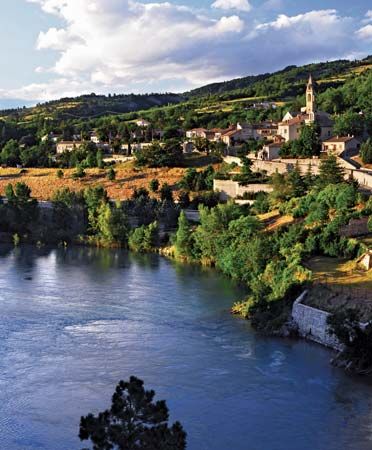
Dauphiné Alps
The Dauphiné Alps are a western spur of the Cottian Alps located in southeastern France. Geographically, they are situated between the Arc and Isère river…
What is Dauphiné Alps?
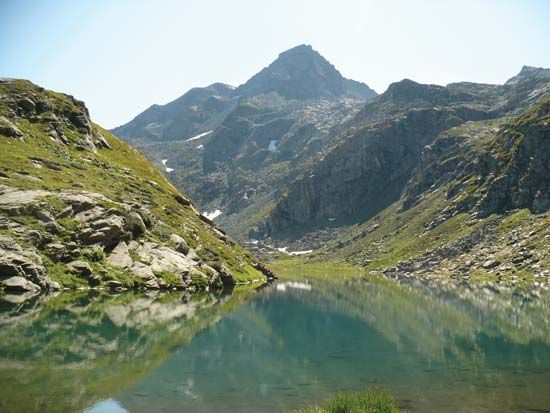
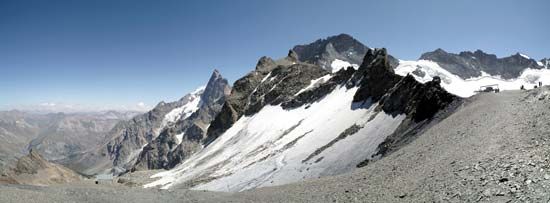
The Dauphiné Alps are a western spur of the Cottian Alps located in southeastern France. Geographically, they are situated between the Arc and Isère river valleys to the north and the upper Durance River valley to the south.1
The region is characterized by high-altitude terrain, with many peaks exceeding 10,000 feet (3,050 meters). The highest point is the Barre des Écrins, which reaches an elevation of 13,459 feet (4,102 meters). The mountain system encompasses several notable ranges, including the Massif du Pelvoux (also known as the Massif des Écrins), the Belledonne, and the Grandes Rousses. Due to their rugged topography, these mountains are a popular destination for mountain climbing and skiing.1
The name of the range is derived from the historic Dauphiné region, a former province that played a significant role in French history and political culture.2
What is the significance of the title ‘Dauphin’ in French history?
The title Dauphin served as the official designation for the eldest son of a king of France and the heir apparent to the French throne from 1350 to 1830.34
Origins and Establishment
The title originated from the Dauphiné, a region in southeastern France. The name “Dauphin” was initially a personal name used by the rulers of Viennois, such as Guigues IV Dauphin in the 12th century. Over time, it became a hereditary title for the lords of that territory.4
In 1349, the future Charles V purchased the Dauphiné and subsequently granted it to his son, the future Charles VI, in 1368. This established the precedent that the French king’s eldest son would hold the title and the associated lands.34
Historical Significance
- Political Status: The Dauphiné maintained a quasi-independent status until its formal annexation to France in 1457.3
- Royal Succession: The title became synonymous with the heir to the throne. For example, Charles VII was known as the Dauphin before his coronation, a period during which he navigated complex political rivalries, including the Hundred Years’ War.5
- Distinctions: To avoid confusion with other titles, such as the Dauphin of Auvergne, the heir to the French crown was occasionally referred to as le roi dauphin (“king dauphin”).4
How do the Alps influence the climate and agriculture of the Dauphiné region?
The Dauphiné region is defined by its varied topography, ranging from the rugged, high-altitude peaks of the Alps to the lower-lying valleys of the Rhône River. While the provided search results do not explicitly detail the specific climatic mechanisms of the Dauphiné, the region’s geography dictates its agricultural output.
Agricultural Production
The influence of the mountainous terrain and valley systems supports a diverse agricultural economy:
- Crops: The region produces cereals, fruits, and wines.2
- Livestock: Cattle and sheep are raised, reflecting the traditional pastoral history of the Alpine valleys.2
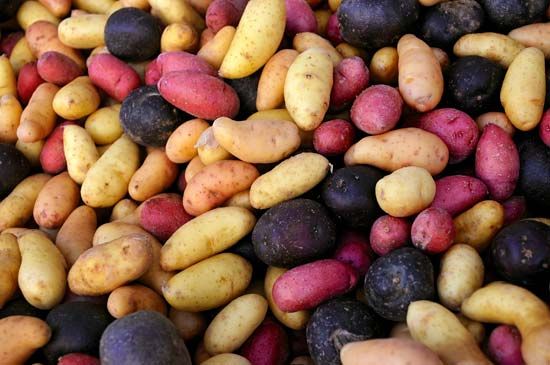
- Specialized Products: The regional diet and economy are supported by local resources, including freshwater fish, mushrooms, and potatoes. Notably, the production of cheese (such as the variety from Saint-Marcellin) and the distillation of Chartreuse liqueur—made from over 130 plants—are significant cultural and economic activities.2
Regional Adaptation
Agriculture in the Alps has historically shifted from a primary economic driver to a more specialized or secondary income source in many high-altitude areas. In the Dauphiné, traditional architecture reflects the environmental demands of the region, with stone-built structures designed to house both living quarters and livestock under one roof to withstand the mountain climate.62
What are some other major mountain ranges found within the French Alps?
The French Alps are composed of several distinct mountain ranges and massifs, each contributing to the region’s diverse topography. Beyond the well-known Mont Blanc massif, other major ranges include:
- Dauphiné Alps: Located in southeastern France, this range includes the Massif des Écrins, as well as the Belledonne and Grandes Rousses ranges.1
- Graian Alps: Situated along the French-Italian border, this northern segment of the Western Alps features glacier-covered peaks and serves as a primary destination for mountaineering and skiing.7
- Savoy Alps: These northwestern spurs of the Graian Alps include subranges such as the Beaufortin, Bauges, Bornes, and Chablais. The Massif de la Vanoise, which is protected within a national park, is also located here.8
- Cottian Alps: This range lies to the southwest of the Graian Alps and serves as a significant geographical feature in the region.17
These mountains are characterized by their dramatic relief, ranging from high-altitude peaks exceeding 10,000 feet to narrow, winding gorges in the southern sections.19
Sources
- Dauphiné Alps — Encyclopædia Britannica
- Dauphiné — Encyclopædia Britannica
- Did you know? — Merriam-Webster
- dauphin — Encyclopædia Britannica
- Charles VII — Encyclopædia Britannica
- Alps - Agriculture — Encyclopædia Britannica
- France - Pyrenees , Jura, and Alps — Encyclopædia Britannica
- Rhône-Alpes — Encyclopædia Britannica
- Mont Blanc — Encyclopædia Britannica
- Savoy Alps — Encyclopædia Britannica
- Graian Alps — Encyclopædia Britannica
Published on · 3 min read