Madeira Islands
The economy of the Madeira Islands is diverse, rooted in traditional agriculture and bolstered by modern service industries.
What are the main economic activities and industries in Madeira?
The economy of the Madeira Islands is diverse, rooted in traditional agriculture and bolstered by modern service industries.
Agriculture and Exports
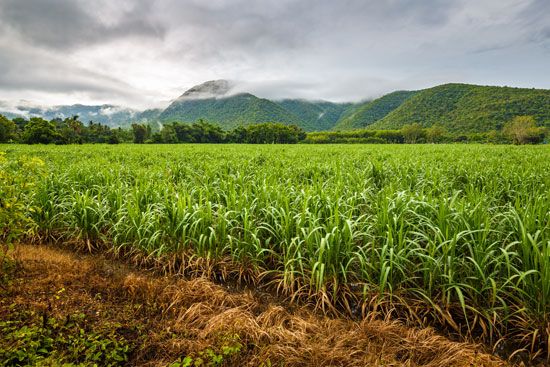
Agriculture has historically been a dominant activity. Today, banana plantations and vineyards are the most prominent features of the landscape. Key agricultural exports include:
- Madeira wine: A globally recognized product supported by investment in modern vinification techniques.12
- Bananas: A primary export crop.1
- Fruits and Produce: Including various tropical and European fruits.13
Industry and Handicrafts
Manufacturing and processing industries are centered largely in the capital, Funchal. Significant activities include:
- Processing: Sugar milling and distilling.3
- Handicrafts: Traditional production of embroidery, wickerwork, and woodworking.13
- Fishing: The local industry includes the catch of scabbard fish, which contributes to both local food supplies and exports.23
Services and Tourism
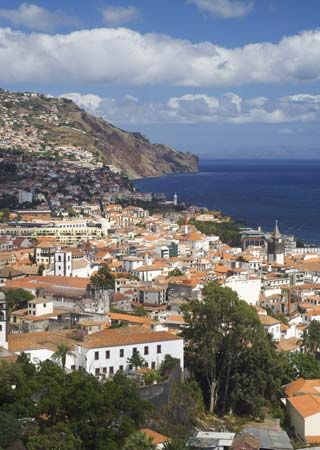
By the early 21st century, tourism became a major economic pillar, driven by the archipelago’s mild climate and scenic landscape. Funchal serves as the regional hub for commerce, communications, and maritime logistics, featuring a modernized port and an international airport.13
What is the geographical location and composition of the Madeira Islands?
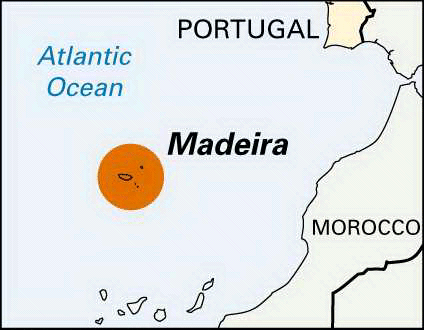
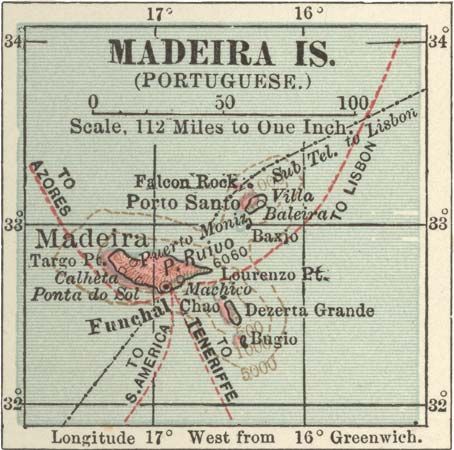
The Madeira Islands are an archipelago of volcanic origin situated in the North Atlantic Ocean, approximately 600 miles (1,000 km) southwest of the Portuguese mainland. Administratively, they constitute an autonomous region of Portugal.14
The archipelago is composed of the following groups:
- Inhabited Islands: Madeira, the largest island, and Porto Santo, located about 26 miles (42 km) to the northeast.1
- Uninhabited Groups: The Desertas (comprising Chão, Bugio, and Deserta Grande) and the Selvagens (Salvage Islands), which lie 156 miles (251 km) south of Madeira.1
Geologically, these islands are the summits of mountains rising from the abyssal ocean floor. Madeira itself is characterized by a mountainous, asymmetrical relief featuring thick layers of basalt, ash, and scoriae, which have been carved into deep gorges and canyons. While Madeira reaches an elevation of 6,106 feet (1,861 metres) at Ruivo Peak, Porto Santo is notably lower and flatter.14
What is the historical significance of the Madeira Islands in Portuguese exploration?
The Madeira Islands played a pivotal role in the early stages of the Portuguese Age of Discovery. Discovered by Portuguese navigators around 1419, the uninhabited archipelago became one of the first major successes of the maritime expansion efforts championed by Prince Henry the Navigator.15
The islands served as a critical testing ground for Portuguese colonization strategies, which began in earnest around 1445. The successful settlement of Madeira provided a model for later colonial ventures, and the introduction of sugarcane cultivation transformed the islands into a vital economic asset, exporting sugar to Europe and generating significant wealth for the Portuguese crown.15
Beyond their economic value, the islands functioned as a strategic port-of-call on the burgeoning trade routes between Europe, Africa, and the New World. This position not only facilitated the logistics of exploration but also led to the development of Madeira wine, a durable commodity that became globally renowned due to its ability to withstand long tropical voyages.6
What are some of the most popular tourist attractions and activities in Madeira?
Madeira has become a premier destination for travelers, largely due to its stunning natural scenery and mild, year-round climate. While the provided search results do not list specific “tourist attractions” by name, they highlight several key areas and activities that define the visitor experience:1
- Exploring Funchal: As the regional capital, Funchal is a central hub for tourism. Visitors often explore the older sections of the city, characterized by steep, narrow cobblestone streets, whitewashed buildings, and the historic Sé Cathedral, which dates back to the early 16th century.1
- Nature and Landscapes: The islands are defined by their dramatic volcanic topography. Travelers can visit the mountainous interior of Madeira Island, which features deep gorges, canyons, and high-altitude areas like the Ruivo Peak or the bleak plateau of Paul da Serra.34
- Cultural and Culinary Experiences: Tourism is closely tied to local production. Visitors frequently engage with the island’s heritage by sampling Madeira wine and shopping for traditional handicrafts, such as intricate embroidery, wickerwork, and woodwork.31
- Island Hopping: While Madeira is the primary focus, the nearby island of Porto Santo offers a different landscape, being notably lower and flatter than its mountainous neighbor.34
Sources
- Madeira Islands — Encyclopædia Britannica
- Portugal - Agriculture, forestry, and fishing — Encyclopædia Britannica
- Funchal — Encyclopædia Britannica
- Portugal - The Madeira Islands — Encyclopædia Britannica
- Portugal - Conquest and exploration — Encyclopædia Britannica
- history of Portugal - Conquest and exploration — Encyclopædia Britannica
- Madeira — Encyclopædia Britannica
Published on · 3 min read