Sugarcane
While traditional plant breeding for sugarcane has long relied on sexual hybridization to improve disease resistance and sugar content, genetic engineering…
How is genetic engineering being used to improve sugarcane crops?
While traditional plant breeding for sugarcane has long relied on sexual hybridization to improve disease resistance and sugar content, genetic engineering offers more precise methods to introduce or enhance specific traits.12
Although the provided search results do not detail specific, current commercial applications of genetic engineering exclusively for sugarcane, the technology is broadly applied to crops to achieve several improvements:32
- Disease and Pest Resistance: Scientists can insert genes into a plant’s genome to confer resistance to pathogens such as viruses, fungi, and insects.2
- Stress Tolerance: Genetic techniques allow for the modification of genes to improve a crop’s tolerance to environmental stressors, such as drought.3
- Nutrient and Growth Efficiency: By replacing or modifying dysfunctional genes, researchers can improve nutrient use efficiency and correct factors that limit growth or yield.3
- Herbicide Tolerance: Engineering plants to be tolerant to herbicides assists in more effective weed control.32
These advancements aim to increase productivity while supporting sustainable agricultural practices by reducing the need for synthetic inputs.3
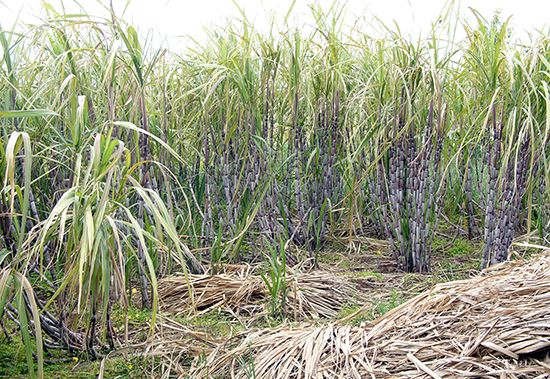
How has mechanization changed sugarcane farming over the years?
Mechanization has significantly transformed sugarcane farming since the 1940s, though its adoption remains complex and varies by region.45
Planting and Cultivation
Modern sugarcane cultivation utilizes mechanical planters that streamline the process by opening furrows, applying fertilizer, depositing seed cane, and covering it with soil in a single operation. While weeding is still largely manual, mechanical weeders equipped with rakes have been developed to assist in maintaining fields until the cane canopy closes.6
Harvesting and Transport
Harvesting has seen the most dramatic shift. While approximately two-thirds of the global crop is still harvested by hand using machetes, mechanical harvesters have become increasingly common. Advanced cane combines can top, cut, chop, and load stalks into transport vehicles, increasing labor productivity by as much as sixfold.45
Challenges to Adoption
Despite these gains, full mechanization faces significant hurdles, including:
- Environmental and Soil Conditions: Tropical soils, stones, and irregular terrain often impede machine performance.5
- Economic Factors: High costs for machinery, maintenance, and replacement parts, alongside the need for efficient transport systems, limit widespread use.5
- Social Impact: The displacement of manual labor remains a critical concern, often requiring a measured approach to introducing new technology.5
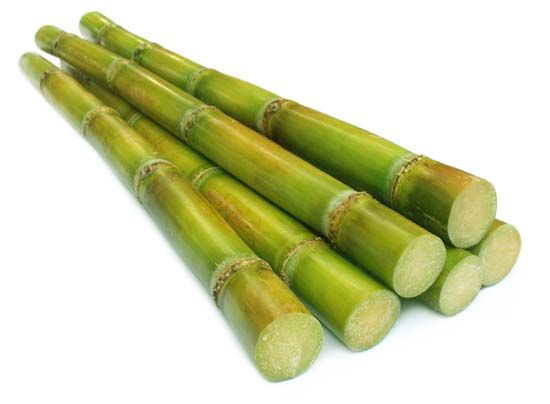
What are some traditional uses of sugarcane besides sugar production?
Beyond sugar production, sugarcane is a versatile crop with numerous industrial and agricultural applications. Its primary by-products, bagasse and molasses, are central to these uses.78
Industrial and Energy Uses
- Biofuel: Sugarcane is a significant source of biofuel, with both the cane juice and bagasse used to produce ethanol and cellulosic ethanol.78
- Fuel Source: Bagasse is widely burned as fuel in sugar factories, providing an energy-efficient alternative to fuel oil7.8
- Manufacturing: Bagasse serves as a raw material for paper, fibreboard, and particleboard. It is also used to synthesize furfural, which is essential for producing nylons, solvents, and medicines.98
- Chemical Production: Low-grade molasses is utilized in the industrial synthesis of vinegar and citric acid.10
Agricultural and Cultural Uses
- Livestock Feed: Both molasses and bagasse are common components in animal feed.811
- Beverages: Sugarcane is the base for rum and cachaça.710
- Construction: The plant itself is sometimes used for thatch.7
How is sugarcane cultivated and harvested?
Sugarcane cultivation and harvesting are specialized processes that vary by region and technology level.
Cultivation
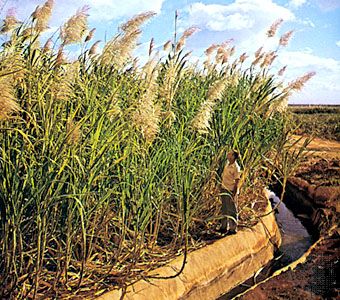
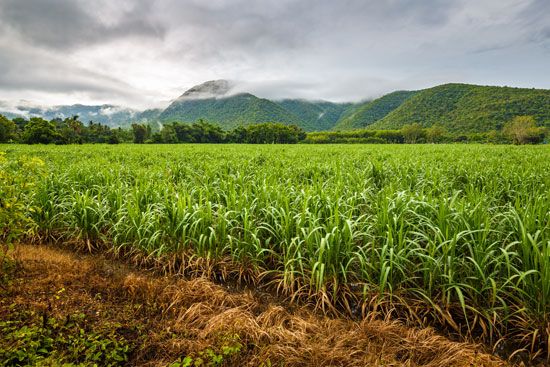
Sugarcane is primarily propagated using cuttings known as seed cane, which contain at least two or three buds. These are planted in well-worked fields, often using mechanical planters that furrow, fertilize, and cover the stalks in one pass. Once established, the plant forms a “stool” from which multiple canes grow. Farmers also utilize a process called ratooning, where a portion of the stalk is left underground after harvest to sprout a new crop. This cycle is typically repeated three times before the field is replanted.4
The crop requires significant water and well-drained soil, with fertilizers applied throughout the growth cycle. Because weeds can hinder development, they are managed through manual hoeing, mechanical weeders, or herbicides.4
Harvesting
Harvesting occurs during the dry, cooler season. While two-thirds of the global crop is still harvested by hand using machetes, mechanical harvesters are increasingly used to cut and load stalks. Fields are sometimes burned before or after harvest to remove leaves and pests, though environmental concerns are driving a shift toward harvesting unburned cane. Once cut, the cane must be transported to the mill quickly to minimize deterioration and maximize sucrose yield.45
Sources
- genetic engineering - Applications — Encyclopædia Britannica
- Sugarcane - Breeding — Encyclopædia Britannica
- Plant disease - The use of genetic engineering in developing disease-resistant plants — Encyclopædia Britannica
- Sugarcane - Culture and cultivation — Encyclopædia Britannica
- sugar - Cane harvesting and delivery — Encyclopædia Britannica
- Agricultural technology - Mechanical problems — Encyclopædia Britannica
- sugar - Bagasse — Encyclopædia Britannica
- Sugarcane — Encyclopædia Britannica
- Bagasse — Encyclopædia Britannica
- sugar - Molasses — Encyclopædia Britannica
- molasses — Encyclopædia Britannica
Published on · 4 min read