Mandara Mountains
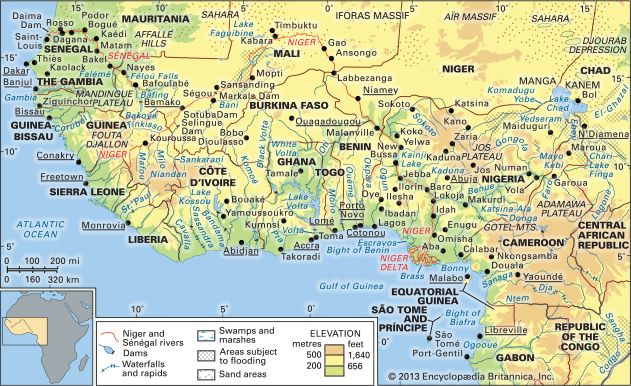
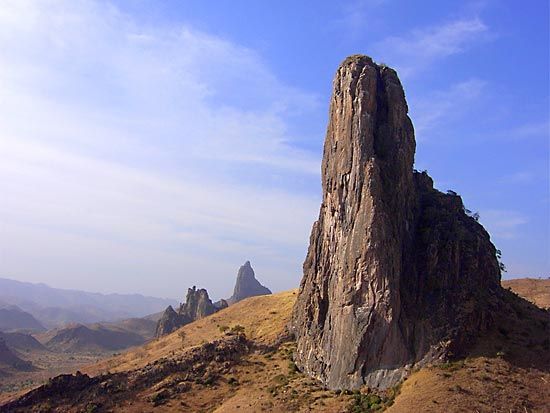
The Mandara Mountains are a volcanic range stretching approximately 120 miles (193 km) along the border between Nigeria and Cameroon. Extending from the…
What is Mandara Mountains?
The Mandara Mountains are a volcanic range stretching approximately 120 miles (193 km) along the border between Nigeria and Cameroon. Extending from the Benue River in the south to Mora in the north, these mountains reach elevations exceeding 3,500 feet (1,100 m) above sea level.1
Historically, the range served as the boundary between the British and French Cameroons during the colonial era. Today, the region is densely populated, primarily by people of the Chad language group who reside in dispersed homesteads or villages characterized by small, circular huts. The local economy is largely agricultural, with sorghum serving as the principal crop. Key urban centers in the area include Mokolo and Maroua in Cameroon, as well as Mubi in Nigeria.1
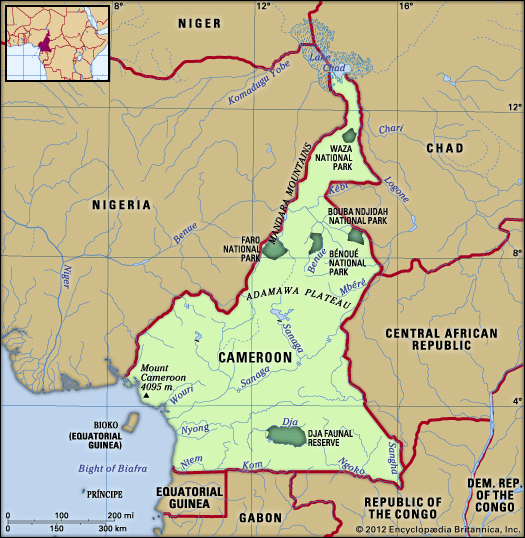
What is the significance of the Benue River in this region?
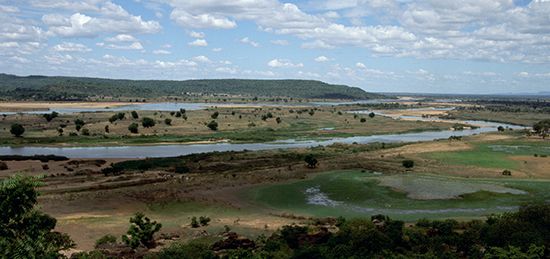
The Benue River is a vital geographical and economic artery in western Africa, serving as the longest tributary of the Niger River. Its significance to the region is multifaceted:2
- Transportation and Trade: The river is a key navigable waterway used to transport imports, such as petroleum, and exports, including cotton and peanuts (groundnuts), from the Chad region. Makurdi serves as its chief port.23
- Agriculture and Economy: The river basin supports extensive agricultural activity. In Benue state, the river facilitates the cultivation of various cash crops and staple foods, including yams, soybeans, and rice.3
- Hydrology and Ecology: The river system is a major drainage area for Nigeria. During flood periods, it links with the Logone River, connecting to Lake Chad. It also supports specialized fishing communities, such as the Wurbo and the Jukun people.425
- Natural Resources: The valley contains significant mineral deposits, including lead, limestone, tin, and marble, as well as saline springs.3
How do the people of the Mandara Mountains farm in a volcanic landscape?
The people of the Mandara Mountains utilize terrace cultivation to farm effectively within their rugged, volcanic landscape. This method involves constructing graduated, flat ridges into the slopes of the mountains, which allows for the maximization of arable land in an otherwise challenging, variable terrain.
By building these terraces, farmers are able to significantly reduce soil erosion and minimize water loss, which is essential for maintaining productivity on steep inclines. In many systems, these terraces are designed with channels that manage runoff water, ensuring it moves slowly toward an outlet to prevent damage to the crops. While this practice is highly labor-intensive, it has been a vital agricultural strategy in various parts of Africa and across the globe for centuries, enabling communities to thrive in mountainous environments.
What are the characteristics of the Chad language group?
The Chadic languages comprise a superfamily within the Afro-Asiatic phylum, consisting of over 140 languages spoken primarily in Niger, Nigeria, Cameroon, and Chad. The family is divided into four main branches: West Chadic, Central Chadic (Biu-Mandara), Masa, and East Chadic.7
Phonetics and Phonology
Chadic languages typically feature up to four sets of consonants: voiced, voiceless, glottalized, and prenasalized. Vowel systems vary significantly, ranging from two to seven vowels, with vowel length often serving as a critical feature. While consonant clusters are generally avoided, they are managed through the insertion of vowels. Additionally, all Chadic languages utilize tonal systems to distinguish meaning, sometimes employing “tonal downstep” to lower the pitch of specific syllable groups.7
Morphology and Grammar
The family exhibits traces of a “root and pattern” system, where consonants provide the core meaning and vowel patterns modify it. Verbs are frequently modified through internal derivation (such as reduplication) or external derivation (adding extensions to indicate direction or location). While the predominant word order is subject-verb-object (SVO), some Central Chadic languages retain a verb-subject-object (VSO) order, which is considered by many scholars to be the original structure of the family.7
Sources
- Mandara Mountains — Encyclopædia Britannica
- Benue River — Encyclopædia Britannica
- Nigeria: Top Questions — Encyclopædia Britannica
- Niger River - People and economy — Encyclopædia Britannica
- Benue — Encyclopædia Britannica
- Terrace cultivation — Encyclopædia Britannica
- Chadic languages — Encyclopædia Britannica
- Chad - Ethnic groups — Encyclopædia Britannica
Published on · 3 min read