Manta Ray
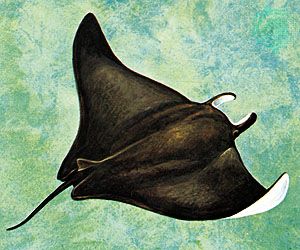
Manta rays are members of the family Mobulidae and are characterized by a flattened body shape that is wider than it is long. Their most distinctive physical…
What are the distinctive physical characteristics of manta rays?
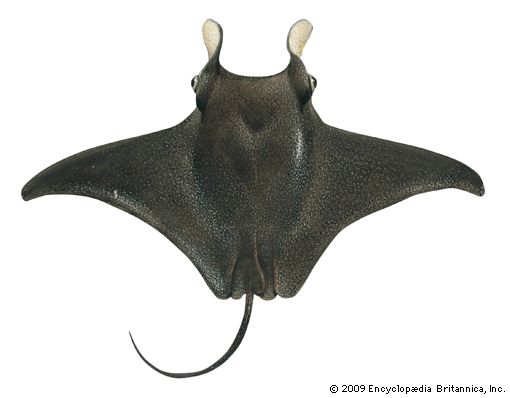
Manta rays are members of the family Mobulidae and are characterized by a flattened body shape that is wider than it is long. Their most distinctive physical features include:12
- Pectoral Fins: They possess large, fleshy pectoral fins that resemble wings, which they use to propel themselves through the water.12
- Cephalic Fins: Extensions of the pectoral fins project from the front of the head, appearing like a devil’s horns. These are used to sweep plankton and small fishes into their mouths1.2
- Tail: They have a short, whiplike tail, which in some species may feature one or more stinging spines.12
- Size: There is significant variation in size; while the smallest species, Mobula diabolis, reaches only about 60 cm (2 feet) across, the Atlantic manta can grow to over 7 meters (23 feet) wide.12
Unlike many other rays that rely on spiracles for respiration, manta rays primarily breathe through their mouths due to their surface-dwelling lifestyle.3
Where are manta rays typically found in the ocean, and what is their habitat like?
Manta rays are primarily found in warm waters across the globe, typically inhabiting areas along continents and islands. Unlike many other species of rays that are bottom dwellers, manta rays are pelagic, meaning they spend the majority of their time swimming at or near the ocean surface.124
Their habitat is characterized by open-water environments where they can move freely, often propelling themselves by flapping their large, winglike pectoral fins. They are frequently observed in regions rich in food sources, such as areas with high concentrations of plankton or schools of small fish, which they funnel into their mouths using their specialized cephalic fins. Their active lifestyle also includes behaviors such as leaping or somersaulting out of the water, a trait they share with some other members of the order Myliobatiformes.14
How do manta rays feed, and what is their primary diet?
Manta rays are specialized filter feeders that consume a diet consisting primarily of plankton and small fishes.14
To capture their prey, these rays utilize a unique feeding mechanism while swimming through the water column. They possess prominent, fleshy extensions known as cephalic fins that project forward from either side of their mouths. As a manta ray moves through masses of macroplankton or schools of small fish, it turns slowly from side to side, using these cephalic fins to funnel the prey directly into its broad mouth.12
Unlike many other bottom-dwelling rays that forage on the seafloor, manta rays remain near the surface to feed, often employing a graceful, flapping motion of their winglike pectoral fins to navigate toward their food sources.124
How are manta rays related to other types of rays and sharks?
Manta rays are members of the family Mobulidae and are closely related to sharks and skates. Together, these creatures are classified within the class Chondrichthyes, a group of cartilaginous fishes distinguished by skeletons made of cartilage rather than true bone.1564
While manta rays share a common ancestry with sharks, they are distinguished by several key physical traits:
- Body Shape: Rays possess a flattened, disklike body, whereas sharks typically have a more cylindrical form.64
- Fin Structure: In rays, the pectoral fins are greatly enlarged and attached to the sides of the head in front of the gill openings, creating a winglike appearance.64
- Gill Placement: A ray’s gill openings are located on the underside of its body, while a shark’s are generally on the sides.64
- Respiration: Many rays, including manta rays, take in water for breathing through spiracles—openings on the upper surface of the head—rather than through the mouth.64
Sources
- manta ray — Encyclopædia Britannica
- 10 of the World’s Most Dangerous Fish - Atlantic Manta — Encyclopædia Britannica
- chondrichthyan - Respiration — Encyclopædia Britannica
- chondrichthyan - Rays — Encyclopædia Britannica
- ray — Encyclopædia Britannica
- chondrichthyan - Distinguishing features — Encyclopædia Britannica
Published on · 3 min read