Eagle Ray
An eagle ray is any of about two dozen species of exclusively marine rays belonging to the family Myliobatidae. These large, active fish are found in major…
What is eagle ray?
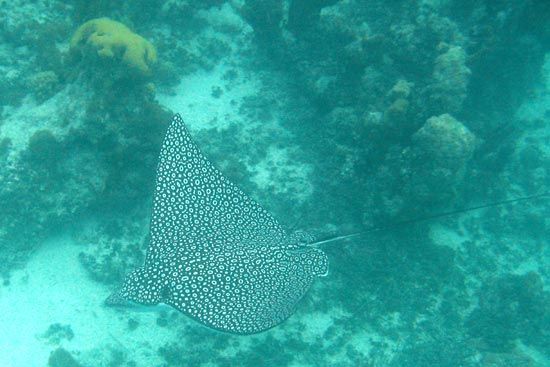
An eagle ray is any of about two dozen species of exclusively marine rays belonging to the family Myliobatidae. These large, active fish are found in major oceans and are characterized by broad, winglike pectoral fins and heads that project beyond their body disks.123
Unlike many other bottom-dwelling rays, eagle rays frequently swim near the ocean’s surface and are known for spectacular displays where they jump high out of the water. They possess flat teeth designed for crushing and grinding mollusks and crustaceans. While they are generally bottom feeders, some species are armed with a sharp-edged, serrated spine at the base of their long, whiplike tails, which can inflict serious wounds. A notable member of this family is the spotted eagle ray, which can reach a wingspan of up to 2.1 meters (7 feet).143
How do eagle rays differ from manta rays?
Eagle rays and manta rays belong to the same suborder, Myliobatoidei, but they differ significantly in their biological families, feeding habits, and physical adaptations.
Key Differences
- Family Classification: Eagle rays belong to the family Myliobatidae, whereas manta rays (also known as devil rays) belong to the family Mobulidae.15
- Diet and Feeding: Eagle rays are primarily bottom feeders that use flat teeth to crush and grind mollusks and crustaceans.) and crustaceans. In contrast, manta rays are filter feeders that consume plankton and small fish. They use prominent cephalic fins projecting from the sides of their mouths to funnel prey into their broad mouths while swimming.15
- Swimming Mechanics: While both swim using their winglike pectoral fins, manta rays progress primarily through flapping motions. Eagle rays typically swim with graceful undulations of their fins.5
- Physical Features: Many eagle rays possess a sharp, serrated, venomous spine at the base of their long, whiplike tails. Manta rays are generally distinguished by their large size and the specialized cephalic fins used for feeding.415
What do eagle rays eat in the ocean?
Eagle rays are specialized bottom feeders that primarily consume invertebrates found on or near the seafloor. Their diet consists mainly of:
- Mollusks: These include various types of shellfish that the rays locate in sand or mud.14
- Crustaceans: A staple of their diet, these are easily processed by the rays’ unique dental structure.14
To facilitate this diet, eagle rays possess flat, specialized teeth that are perfectly adapted for crushing and grinding the hard shells of their prey. While they are classified as bottom dwellers, they are highly active and frequently swim near the ocean’s surface, distinct from other bottom-dwelling rays that remain buried in the substrate.14
Why do eagle rays jump out of the water?
Eagle rays are known for their spectacular habit of leaping high out of the water, though the exact biological purpose of this behavior remains a subject of study among marine biologists. While these eagle rays are primarily bottom feeders that hunt for mollusks and crustaceans, they frequently travel near the ocean’s surface.
These leaps are often observed as impressive displays, and researchers suggest they may serve several functions, including:
- Parasite Removal: The impact of hitting the water surface may help dislodge parasites from the ray’s skin.
- Communication: Jumping may act as a form of signaling to other members of their species.
- Courtship: In some instances, leaping is believed to be related to mating rituals or social interaction.
- Predator Avoidance: The sudden movement could potentially startle or evade predators.
Despite these theories, the behavior remains one of the most captivating sights for observers of these marine animals.1
Sources
- eagle ray — Encyclopædia Britannica
- eagle ray — Merriam-Webster
- stingray — Encyclopædia Britannica
- chondrichthyan - Rays — Encyclopædia Britannica
- ray — Encyclopædia Britannica
Published on · 3 min read