Ray
Rays are a diverse group of cartilaginous fishes found in all of the world's oceans. While they share a flattened, disklike body and enlarged pectoral fins…
What are some common species of rays, and where can they be found in the world’s oceans?
Rays are a diverse group of cartilaginous fishes found in all of the world’s oceans. While they share a flattened, disklike body and enlarged pectoral fins, they are categorized into several distinct groups based on their physical characteristics and habitats.1
Common Groups and Species
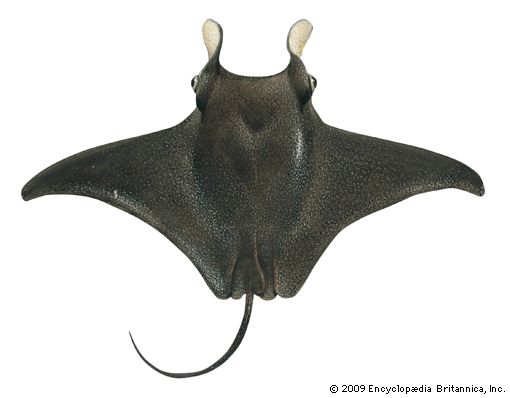
- Manta Rays: These large, plankton-feeding rays are found in warm waters near continents and islands. The Atlantic manta (Manta birostris) is the largest, reaching widths of over 7 meters.123
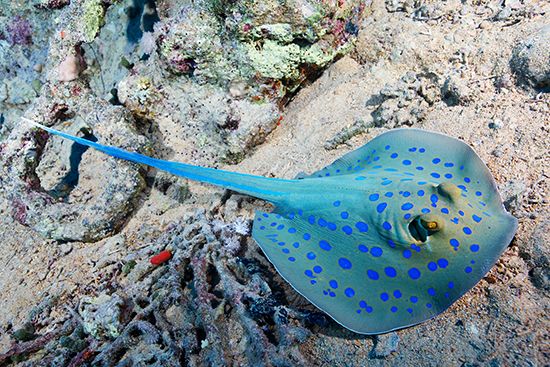
- Stingrays: Known for their venomous, barbed tail spines, these bottom-dwellers inhabit warm temperate and tropical coastal waters. Species include the small Dasyatis sabina of the western North Atlantic and the larger Australian D. brevicaudata.14
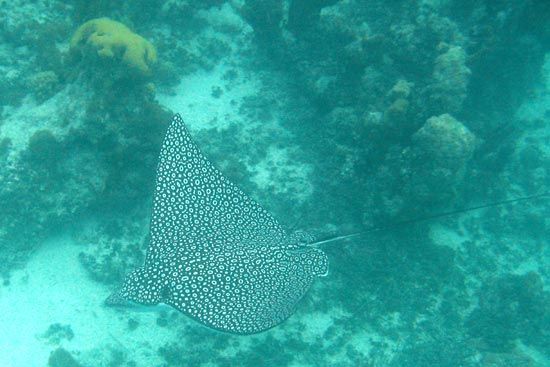
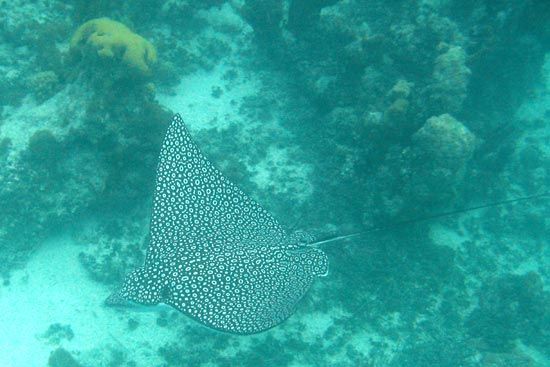
- Eagle Rays: These active, marine rays are widely distributed in major oceans. The spotted eagle ray is a notable species found in both the Atlantic and Pacific.564
- Electric Rays: Found in warm and temperate waters worldwide, these rays use specialized organs to produce powerful electrical shocks for defense and hunting.17
- Sawfishes: These rays are characterized by a long, tooth-lined snout and are typically found in warm seas, sandy shores, and estuaries.1
How are rays related to sharks, and what features do they share?
Rays and sharks are closely related, both belonging to the class Chondrichthyes, a diverse group of cartilaginous fishes. Within this class, they are further grouped together in the subclass Elasmobranchii.89
Shared Features
Because they share a common ancestry, rays and sharks possess several fundamental biological characteristics:
- Cartilaginous Skeleton: Their skeletons are composed of cartilage rather than true bone.10
- Dermal Denticles: Their skin is covered in minute, tooth-like scales called dermal denticles, which are structurally similar to teeth.10
- Respiratory Openings: Most sharks and all rays possess a spiracle—a modified first gill cleft located behind each eye—that aids in respiration.10
- Internal Anatomy: Both groups feature a spiral valve, a specialized membranous fold that extends through the intestine.10
- Reproduction: Male sharks and rays utilize specialized copulatory organs known as claspers to transfer sperm to the female during internal fertilization.109
- Teeth Replacement: Their teeth are not firmly attached to the jaws but are embedded in a fibrous membrane; they are continuously replaced by new rows of teeth moving forward as older ones are lost or worn down.10
While they share these traits, rays are distinguished by their flattened, disklike bodies, pectoral fins attached to the sides of the head, and gill openings located on the underside of the body.109
How do rays use electroreception to detect prey and navigate their environment?
Rays utilize a highly refined sensory system known as electroreception to navigate their environment and locate prey, even in conditions where vision is limited, such as in murky water or when prey is buried under sand or mud.1213
The Ampullae of Lorenzini
The primary organs responsible for this ability are the ampullae of Lorenzini. These are specialized sensory structures arranged in an extensive network, primarily across the ray’s head. Each ampulla consists of:1213
- Gel-filled canals: Pores on the skin surface lead to bulb-shaped chambers beneath the skin, connected by canals filled with a conductive, gelatinous matrix.1213
- Electroreceptor cells: Located within the chambers, these cells are extremely sensitive to voltage changes in the surrounding water.12
- Nerve fibers: These transmit signals from the receptor cells to the central nervous system, allowing the ray to process the information.12
Detecting Prey and Navigation
Rays use these organs for passive electrolocation. All living organisms produce weak bioelectric fields—often generated by muscle contractions, gill movements, or skin wounds—that rays can detect.141213
Because rays are remarkably sensitive to potential differences as low as 0.01 to 0.02 microvolts per centimeter, they can pinpoint the exact location of hidden prey. Additionally, these organs help rays orient themselves and navigate by sensing variations in water temperature and salinity, providing a sophisticated way to perceive their surroundings beyond what is visible.141312
What are the main characteristics that distinguish rays from other fish?
Rays are distinguished from other fish, particularly bony fishes and sharks, by several unique anatomical features:
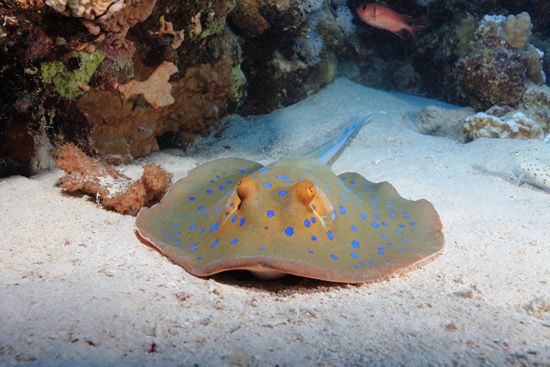
- Body Shape: Rays possess flattened, disklike bodies with greatly enlarged, winglike pectoral fins that attach to the sides of the head in front of the gill openings.168
- Gill Placement: Unlike sharks, which have gill openings on the sides of the head, rays have their gill openings confined to the underside of the body.168
- Respiratory Openings: Rays take in water for respiration through spiracles—large openings located on the upper surface of the head behind the eyes—rather than pulling water primarily through the mouth as many sharks do.168
- Dorsal Features: The eyes of a ray are positioned on the dorsal (upper) surface of the body.8
- Skeletal Composition: Like sharks, rays belong to the class Chondrichthyes and have a skeleton composed of cartilage rather than true bone.8
- Skin and Protection: While some rays have skin covered in tooth-like dermal denticles, others may be smooth or armed with modified scales such as thorns, tubercles, or venomous, saw-toothed spines on their tails.8
Sources
- ray — Encyclopædia Britannica
- stingray — Encyclopædia Britannica
- eagle ray — Encyclopædia Britannica
- 10 of the World’s Most Dangerous Fish - Atlantic Manta — Encyclopædia Britannica
- eagle ray — Merriam-Webster
- manta ray — Encyclopædia Britannica
- electric ray — Encyclopædia Britannica
- chondrichthyan - Distinguishing features — Encyclopædia Britannica
- fish - Chondrichthyes : sharks and rays — Encyclopædia Britannica
- list of sharks, skates, and rays — Encyclopædia Britannica
- muscle - Jawed fishes — Encyclopædia Britannica
- Animal communication - Signal reception — Encyclopædia Britannica
- Electroreception — Encyclopædia Britannica
- ampulla of Lorenzini — Encyclopædia Britannica
- Mechanoreception - Ampullary lateral-line organs ( electroreceptors ) — Encyclopædia Britannica
- ray: Top Questions — Encyclopædia Britannica
- rays — Merriam-Webster
- ostariophysan - Fin spines and adipose fin — Encyclopædia Britannica
Published on · 4 min read