Mayenne River
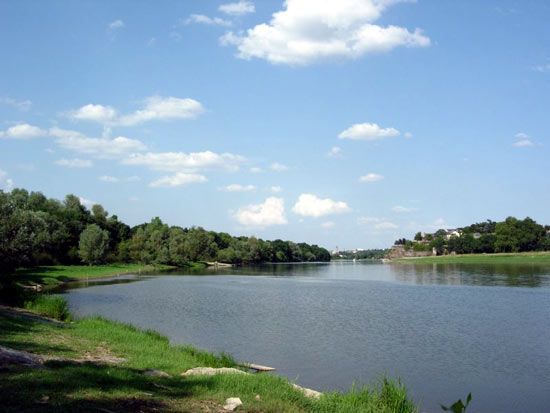
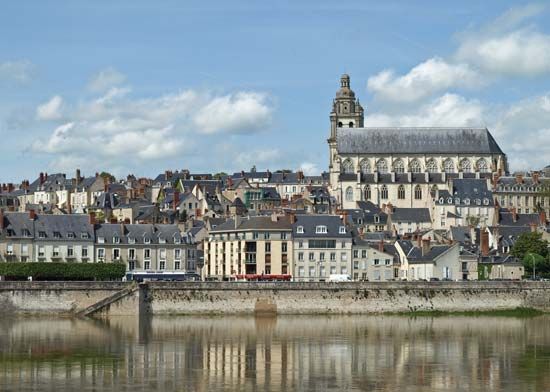
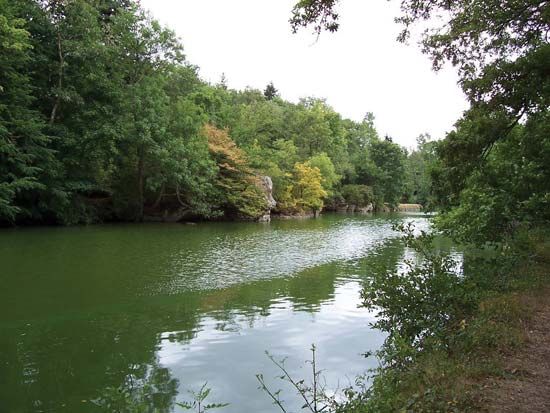
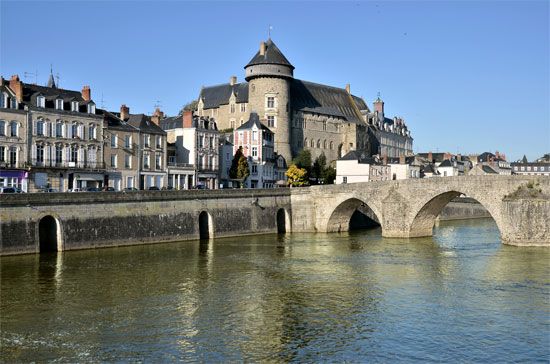
The Mayenne River is a river located in northwestern France. Its headwaters originate in the Forêt de Multonne, situated west-northwest of Alençon in the…
What is Mayenne River?
The Mayenne River is a river located in northwestern France. Its headwaters originate in the Forêt de Multonne, situated west-northwest of Alençon in the Orne département.1
The river flows southward for 121 miles (195 km) before reaching its confluence with the Sarthe River just above Angers. Together, these rivers form the Maine River, which eventually flows into the Loire. To facilitate navigation, the Mayenne is canalized for 73 miles and features 45 dams and locks.12
What is the Maine River and how is it formed?
The Maine River is a short river in the Maine-et-Loire département of western France, spanning approximately 7 miles (12 km) in length.2
It is formed through the confluence of the Sarthe River and the Mayenne River. North of Angers, the Sarthe and Mayenne rivers meet at the lower point of the island of Saint-Aubin to create the Maine. The river then flows in a southwesterly direction across Angers before joining the Loire about 5 miles downstream from the city.2
How do dams and locks help with river navigation?
Dams and locks are essential engineering structures used to transform natural rivers into reliable, navigable waterways.
The Role of Locks
A lock is an enclosure with gates at both ends that allows vessels to move between stretches of water at different elevations. By filling or emptying the chamber, the water level is adjusted to match the level of the upstream or downstream “pound,” enabling boats to safely ascend or descend river gradients.3
The Role of Dams and Canalization
On canalized rivers, navigation is facilitated by creating a series of steps. Dams and weirs are used to regulate water flow and maintain the necessary depth for vessels, while locks allow them to pass these barriers. These structures help mitigate the hazards of natural rivers, such as seasonal droughts or floods, by retaining the channel in a predetermined course and ensuring a more uniform depth.4
In modern engineering, these systems often incorporate sluices to manage surplus water and, in many cases, integrate hydroelectric power generation.4
What are some other major rivers in France?
France features several major river systems that play significant roles in the country’s geography, economy, and history. These rivers generally originate from major divides in the eastern part of the country, including the Massif Central, the Alps, and the Pyrenees.9
Key major rivers include:
- Loire River: The longest river in France, stretching 634 miles (1,020 km). It is known for its irregular flow and picturesque valley, which is a UNESCO World Heritage site.1011
- Seine River: At 485 miles (780 km) long, it is the second-longest river. It is highly significant for inland navigation, linking Paris to the sea at Le Havre.12
- Rhône River: A powerful river in southeastern France that flows through the Alpine furrow. It is vital for hydroelectric power and irrigation.13
- Garonne River: Located in the southwest, it is the shortest of the main rivers at 357 miles (575 km). It flows through the Aquitaine Basin and joins the Dordogne to form the Gironde estuary.14
- Rhine River: Another major river originating in the Alps that forms part of the drainage system in eastern France.9
Sources
- Mayenne River — Encyclopædia Britannica
- Maine River — Encyclopædia Britannica
- lock — Encyclopædia Britannica
- canals and inland waterways - Ancient works — Encyclopædia Britannica
- dam - Fish passes — Encyclopædia Britannica
- canals and inland waterways - Characteristics of basic types — Encyclopædia Britannica
- canals and inland waterways - Channel design — Encyclopædia Britannica
- dam - Reservoirs — Encyclopædia Britannica
- France - Drainage of France — Encyclopædia Britannica
- Loire River — Encyclopædia Britannica
- France - The Rhône system — Encyclopædia Britannica
- Seine River — Encyclopædia Britannica
- France - The Loire system — Encyclopædia Britannica
- France - The Garonne system — Encyclopædia Britannica
Published on · 3 min read