Dordogne River
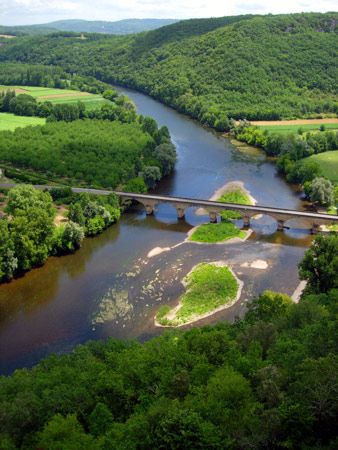
The Dordogne River is located in southwestern France. It rises in the Massif Central at the Puy de Sancy and flows westward for approximately 293 miles (472…
What is the geographical location and length of the Dordogne River?
The Dordogne River is located in southwestern France. It rises in the Massif Central at the Puy de Sancy and flows westward for approximately 293 miles (472 km).1
The river originates from the confluence of the Dore and Dognon rivers and travels through various departments, including Puy-de-Dôme, Corrèze, Lot, and Dordogne, before entering the Gironde department. It eventually reaches Bec d’Ambès, north of Bordeaux, where it unites with the Garonne River to form the Gironde Estuary.12
What are some of the major towns and historical sites along the Dordogne River?
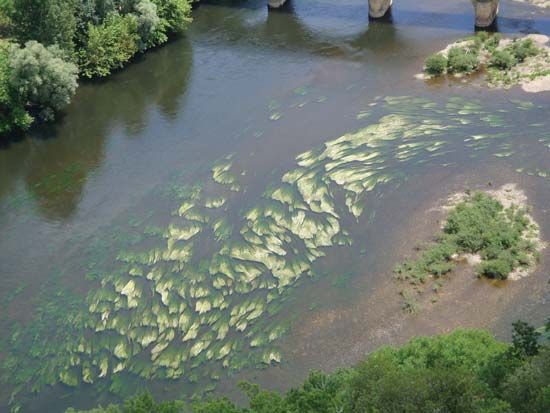
The Dordogne River flows through a region rich in history and culture, passing several notable towns and significant archaeological sites.
Major Towns and Locations
- Le Mont-Dore and La Bourboule: Located in the Puy-de-Dôme department, these towns are well-known spa resorts near the river’s headwaters.1
- Argentat: Situated in the Corrèze department, this town marks the end of the river’s passage through the scenic Dordogne gorges.1
- Souillac: A town in the Lot department that the river skirts on its westward journey.1
- Libourne: Located in the Gironde department, this town sits at the confluence of the Dordogne and the Isle rivers.1
- Périgueux: While situated on the Isle River (a tributary), this historic town is the capital of the Dordogne department and is famous for its Roman ruins, such as the 3rd-century arena, and the 12th-century Cathedral of Saint-Front.4
Historical and Prehistoric Sites
The Vézère Valley, a tributary of the Dordogne, is world-renowned for its concentration of Paleolithic sites, many of which are designated as a UNESCO World Heritage site. Key locations include:13
- Lascaux: Famous for its extensive and significant prehistoric wall paintings.13
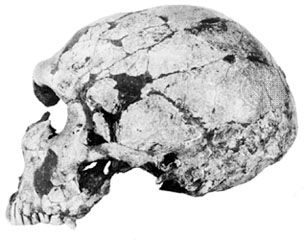
- Les Eyzies-de-Tayac: A primary center for the study of Paleolithic man, featuring numerous caves and rock shelters, including the site where the first Cro-Magnon skeleton was discovered.13
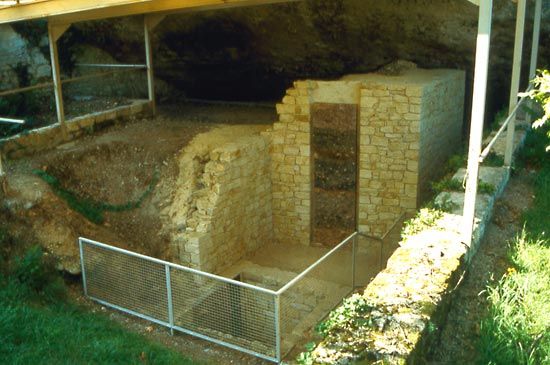
- Le Moustier: The type site for the Mousterian industry, associated with Neanderthal culture.3
What is the source of the Dordogne River and where does it flow into?
The Dordogne River originates in the Massif Central of southwestern France. Its headwaters rise at an elevation exceeding 5,600 feet (1,700 meters) on the Puy de Sancy, formed by the confluence of the Dore and Dognon rivers.1
The river flows westward for approximately 293 miles (472 km) until it reaches Bec d’Ambès, located north of Bordeaux. At this point, it unites with the Garonne River to form the Gironde Estuary.1
What is the significance of the prehistoric caves found near the Dordogne River?
The prehistoric caves near the Dordogne River, particularly within the Vézère valley, are of immense archaeological significance, offering a window into human development during the Middle Paleolithic Period and Upper Paleolithic Period. Collectively designated as a UNESCO World Heritage site, these sites provide critical evidence of early human culture, art, and burial practices.46
Key Archaeological Contributions
- Artistic Achievement: Lascaux contains one of the most outstanding displays of prehistoric art, featuring hundreds of animal figures and symbols created with sophisticated techniques. Other sites, such as Font-de-Gaume, are noted for their intricate, multicolored animal drawings.64
- Human Evolution: The region is central to the study of early humans. The discovery of the first Cro-Magnon skeleton in a local rock shelter established the area as a primary site for understanding early modern humans.4
- Cultural and Ritual Evidence: Sites like Le Moustier and La Ferrassie provide vital insights into Neanderthal life. Evidence from La Ferrassie, including intentional burials of adults and children, suggests that Neanderthals practiced complex ritual behaviors. Additionally, the site of La Madeleine serves as the type site for the Magdalenian culture, known for its advanced bone and antler tools.47
Preserving these fragile sites is a moral imperative, as human activity—such as the introduction of artificial light and pedestrian traffic—has historically caused significant damage to the paintings and archaeological integrity of the caves.46
Sources
- Dordogne River — Encyclopædia Britannica
- Dordogne — Merriam-Webster
- Périgord — Encyclopædia Britannica
- Eyzies-de-Tayac caves — Encyclopædia Britannica
- Périgueux — Encyclopædia Britannica
- Lascaux — Encyclopædia Britannica
- La Ferrassie — Encyclopædia Britannica
Published on · 3 min read