Meander
A meander is an extreme U-bend in the course of a stream, typically occurring in a series. Named after the Menderes River in Turkey, these features are most…
What is a meander in a river system and how does it form?
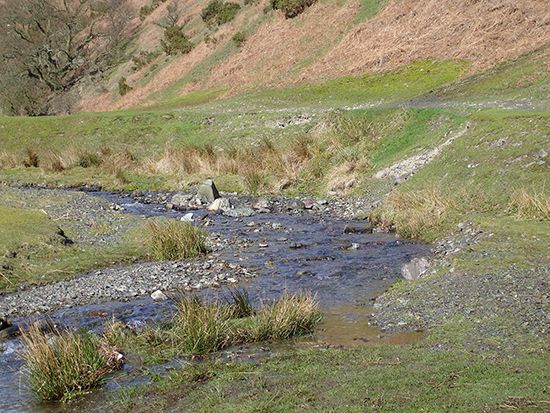
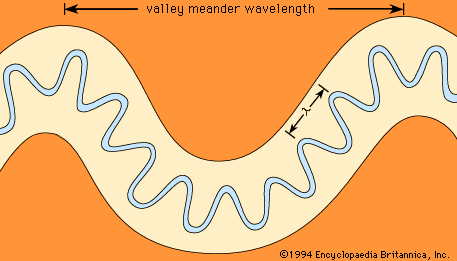
A meander is an extreme U-bend in the course of a stream, typically occurring in a series. Named after the Menderes River in Turkey, these features are most commonly found in alluvial materials, where the river can freely adjust its shape and shift downstream based on the valley’s slope.1
Meanders are considered a form of wave phenomenon and are viewed as the most probable channel shape because they represent a “least-work” system. By meandering, a river minimizes variables such as the angle of current deflection, the water-surface slope, and the total energy expended in turning.12
The formation of these bends is closely linked to the river’s flow dynamics. As a stream flows, it naturally develops a sequence of pools (at the bends) and riffles (in the reaches between bends). While the exact mechanics are complex, the process involves the river adjusting its path to maintain equilibrium. Over time, irregularities in the terrain or uneven resistance to erosion can cause meanders to constrict, potentially leading to a cutoff that creates an oxbow lake.12
What are some famous rivers known for their meandering patterns?
Several rivers are renowned for their distinct meandering patterns, where the channel loops and curls across the landscape. Notable examples include:
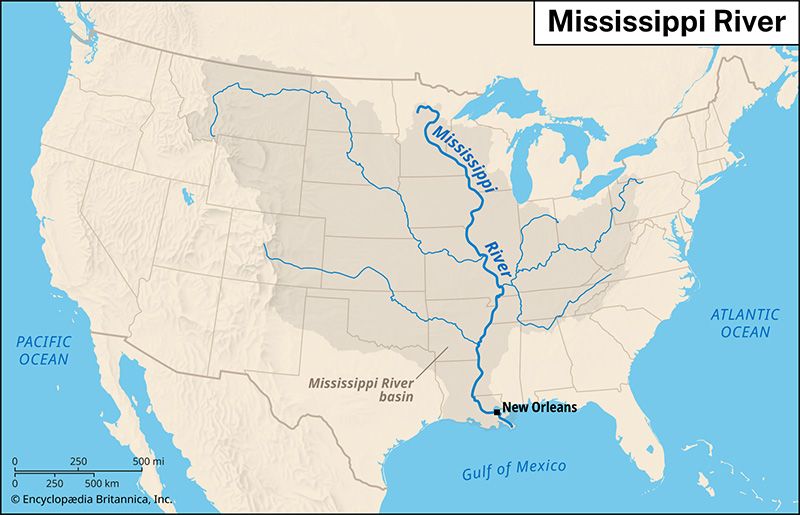
- Mississippi River: The lower reach of the Mississippi is a classic example of a meandering alluvial river. Its channel loops extravagantly across its floodplain, creating a landscape defined by oxbow lakes, meander scars, and swampy backwaters.1
- Menderes River: Historically known as the Maeander River in Turkey, this river is the namesake for the term “meander” due to its characteristic U-bend patterns.4
Meandering is a common feature in rivers flowing through alluvial materials, as these sediments allow the river to adjust its shape and shift its course over time. While these rivers are often modified by human intervention—such as the levees and dams used to control the Mississippi—they remain iconic for their natural, winding geometry.41
How does the slope of the land affect the formation of meanders?
The slope of the land plays a critical role in the development and evolution of meandering channels. Because rivers function as “least-work” systems, they naturally seek to minimize energy expenditure, which includes balancing their water-surface slope and the total work performed while turning.101
The relationship between slope and meander formation is characterized by the following dynamics:
- Adjustment of Sinuosity: Variations in total sinuosity—the degree to which a river winds—are primarily driven by adjustments to the channel slope. As a river flows through alluvial materials, it can freely shift its course to accommodate changes in the valley’s slope.110
- Slope Reduction: Increases in sinuosity often accompany a reduction in slope. By increasing the length of its path through meandering, a river effectively decreases its gradient, allowing it to maintain an equilibrium state.110
- Energy Equilibrium: A river’s power is derived from its rate of elevation loss, which is directly tied to its slope. To minimize variations in power as discharge increases downstream, a river must decrease its slope, which contributes to the characteristic concave upward profile of river valleys.2
What are oxbow lakes and how are they related to meanders?
An oxbow lake is a crescent-shaped or serpentine body of water formed when a river abandons a loop of its meander channel.67
These lakes are intrinsically linked to the evolution of meandering rivers through a process known as a cutoff:
- Formation: As a river meanders, it often develops tight, U-shaped bends. Over time, the river may erode the narrow neck of land between two adjacent bends. When the river eventually breaches this neck, it creates a shorter, more direct path for the water to flow, effectively “short-circuiting” the original loop.61
- Isolation: Once the new, straighter channel is established, the ends of the old meander loop become blocked by sediment, isolating the water and creating an oxbow lake.67
- Evolution: Over time, these lakes typically fill with fine sediment and organic matter, eventually transitioning into marshes and finally into meander scars—depressions on the landscape that mark the former path of the river.61
Sources
- meander — Encyclopædia Britannica
- river - Meandering channels — Encyclopædia Britannica
- river - Straight channels — Encyclopædia Britannica
- Mississippi River — Encyclopædia Britannica
- river - Floodplain deposits, origins, and features — Encyclopædia Britannica
- oxbow lake — Encyclopædia Britannica
- oxbow lake — Merriam-Webster
- Amazon River - Hydrology of the Amazon River — Encyclopædia Britannica
- river - Morphology of deltas — Encyclopædia Britannica
- river - Valleys and canyons — Encyclopædia Britannica
- valley - Valley longitudinal profiles — Encyclopædia Britannica
Published on · 4 min read