Pool and Riffle
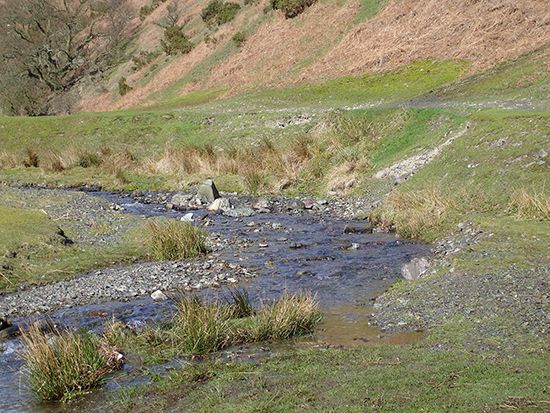
Pools and riffles are the deep and shallow sections, respectively, that create an undulating pattern along a stream bed.
What is pool and riffle?
Pools and riffles are the deep and shallow sections, respectively, that create an undulating pattern along a stream bed.1
- Pools are deeper areas where water currents are reduced, allowing silt and debris to collect on the bottom. In meandering streams, they often form along the outer edges of meander loops.12
- Riffles are shallow, wider reaches of a stream where water flows over the bed, often creating broken or “white” water at low stages.13
These features typically appear in sequences spaced at intervals of about five to seven channel widths. They are present in most perennial channels containing bed material larger than coarse sand and are relatively stable in their positioning. While they share some characteristics with rapids—which are typically found in bedrock channels and feature turbulent water at all flow stages—pools and riffles are distinct, recurring geomorphic features that support diverse riverine ecosystems by providing varied habitats for specialized life forms.12
How do different fish species use pools and riffles?
While the provided information defines the physical characteristics of pools and riffles, it does not contain specific details regarding how different fish species utilize these habitats.
The pool and riffle structure creates an undulating stream bed that provides varied environments, but the specific ecological interactions between these features and fish species are not addressed in the available data.
What causes a stream to meander?
A meander is an extreme U-bend in a stream’s course, typically occurring in a series. While the exact causes are not yet fully understood, meanders are considered a form of wave phenomenon and represent the most probable channel shape for a river.4
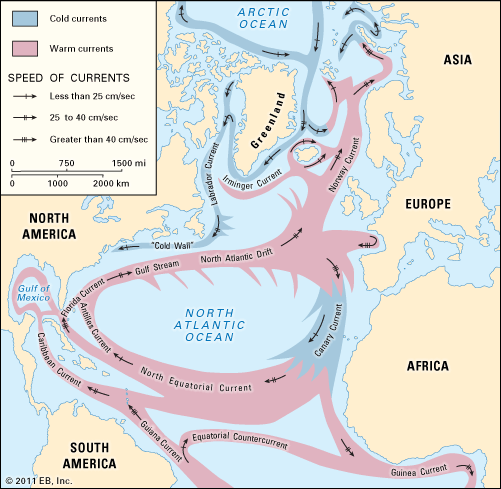
The formation of meanders is driven by the principle of “least work.” By following a meandering path, a river minimizes variables such as the angle of current deflection, the water-surface slope, and the total work required to turn. This behavior is so fundamental that similar patterns appear in other natural systems, including the Gulf Stream and atmospheric jet streams.54
Specific factors influencing meandering include:
- Efficiency: The meandering form is the most efficient way for a single channel to deviate from straightness while maintaining equilibrium.4
- Channel Dynamics: In alluvial materials, rivers adjust their shape by eroding the outside of bends while simultaneously depositing sediment on the inside, allowing the channel to shift laterally.56
- Resistance: Irregularities in the riverbed, such as non-homogeneous material or varying grain sizes, can cause the stream to deviate and stack meanders.54
How does water flow affect sediment transport in rivers?
The transport of sediment in rivers is a fundamental fluvial process driven by the interaction between flowing water and the channel. The capacity of a river to move material depends largely on its velocity, which is influenced by the channel’s slope and roughness.8
Sediment load is categorized into three types based on particle size and the river’s competence:
- Bed load: Consists of larger particles like boulders, cobbles, and sand. These materials move along the stream bed by rolling, pushing, or “jumping” (saltation) when the flow velocity is sufficiently high.89
- Suspended load: Composed of finer particles, such as silts and clays. Once lifted by the turbulent flow of the water, these particles remain in suspension and can be transported over long distances at the speed of the current.89
- Dissolved load: Includes chemical compounds that have been taken into solution by water moving through the soils of the drainage basin.9
As velocity decreases, the river’s transporting power diminishes, causing larger materials to be deposited first, while finer sediments are carried further downstream.8
Sources
- pool and riffle — Encyclopædia Britannica
- riverine ecosystem — Encyclopædia Britannica
- riffle — Merriam-Webster
- meander — Encyclopædia Britannica
- river - Floodplain deposits, origins, and features — Encyclopædia Britannica
- river - Morphology of deltas — Encyclopædia Britannica
- river - Meandering channels — Encyclopædia Britannica
- fluvial process — Encyclopædia Britannica
- river - Sediment yield and sediment load — Encyclopædia Britannica
- river - Peak discharge and flooding — Encyclopædia Britannica
Published on · 3 min read