Moeritherium
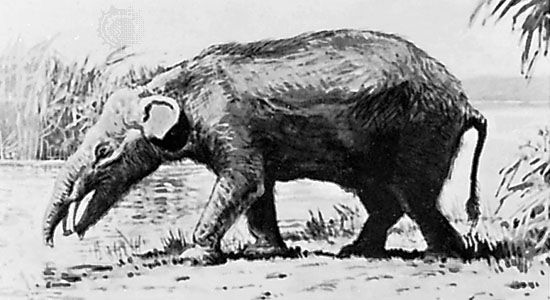
Moeritherium was a primitive, tapir-sized mammal that inhabited marshy regions and is considered to have been at least partly aquatic. Its physical…
What adaptations did Moeritherium have for its aquatic or semi-aquatic lifestyle?
Moeritherium was a primitive, tapir-sized mammal that inhabited marshy regions and is considered to have been at least partly aquatic. Its physical adaptations for this lifestyle included:1
- Body Structure: It possessed a relatively long body with short, strong legs, which likely aided in navigating marshy environments.1
- Feet: Its feet were broad and terminated in flat-hoofed toes, providing stability in soft, wet terrain.1
- Skull and Sensory Placement: The eyes were set very far forward on the skull, and the nasal openings were located on the upper side of the skull, which may have allowed the animal to breathe while keeping much of its head submerged.1
- Musculature: Strong neck muscles were attached to the broad back end of the skull, likely supporting the animal as it fed on aquatic vegetation.1
While it possessed a short, flexible proboscis similar to that of a tapir, it lacked the specialized trunk of modern elephants.1
What is Moeritherium and when did it live?
Moeritherium is an extinct genus of primitive mammals that represents a very early stage in the evolution of elephants. Belonging to the order Proboscidea, these animals were roughly the size of a tapir and inhabited marshy regions, where they were at least partly aquatic.12
Regarding their timeline, fossils of Moeritherium have been found in northern Africa in deposits dating to the Eocene Epoch (approximately 55.8 to 33.9 million years ago) and the early part of the Oligocene Epoch (33.9 to 23 million years ago).12
Unlike modern elephants, Moeritherium did not possess a trunk; instead, it likely had a short, flexible proboscis. Its physical characteristics included short, strong legs, a long body, and broad feet with flat-hoofed toes. Its strongly developed upper and lower incisors are considered precursors to the tusks seen in later related forms.12
How was Moeritherium first discovered and by whom?
Moeritherium was first discovered in the Faiyum province of northern Upper Egypt, a region known for its rich fossil deposits. The genus derives its name from Lake Moeris, an ancient lake located in that same province where the remains were originally unearthed.2
While the provided search results identify the geographic origin and etymology of the genus, they do not specify the individual researcher or the exact date of the initial discovery.
What were the key physical characteristics of Moeritherium?
Moeritherium was a primitive, tapir-sized mammal that served as an early ancestor to modern elephants. Unlike its descendants, it did not possess a trunk; instead, it likely featured a short, flexible proboscis similar to that of a tapir.13
Key physical characteristics of Moeritherium included:
- Body Structure: It had a relatively long body, a short tail, and short, strong legs.1
- Feet: Its feet were broad and terminated in flat-hoofed toes, supporting its life in marshy, semi-aquatic environments.1
- Skull and Head: The skull and cheekbones were elongated, with eyes positioned far forward. Strong neck muscles attached to the broad back of the skull.1
- Nasal Openings: The nasal openings were located on the upper side of the skull, rather than the forehead position seen in modern elephants.1
- Dentition: It featured strongly developed upper and lower incisors, which represent an early evolutionary stage in the development of tusks.13
Sources
- Moeritherium — Encyclopædia Britannica
- Moeritherium — Merriam-Webster
- proboscidean — Encyclopædia Britannica
Published on · 2 min read