Monongahela River
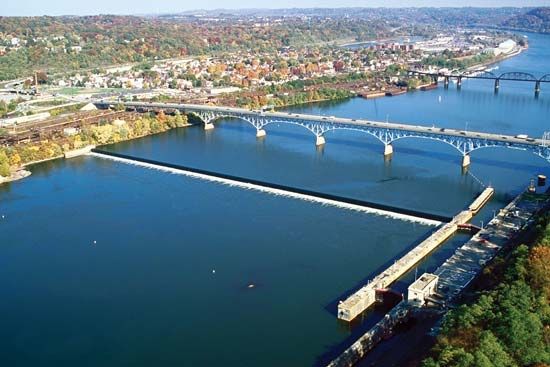
The Monongahela River is a 128-mile (206 km) waterway in the United States, formed by the confluence of the Tygart and West Fork rivers in Marion County…
What is Monongahela River?
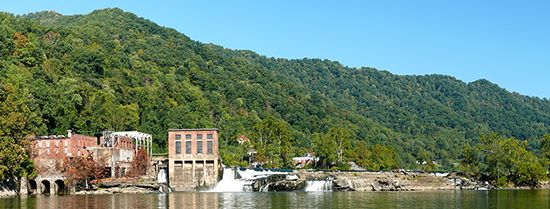
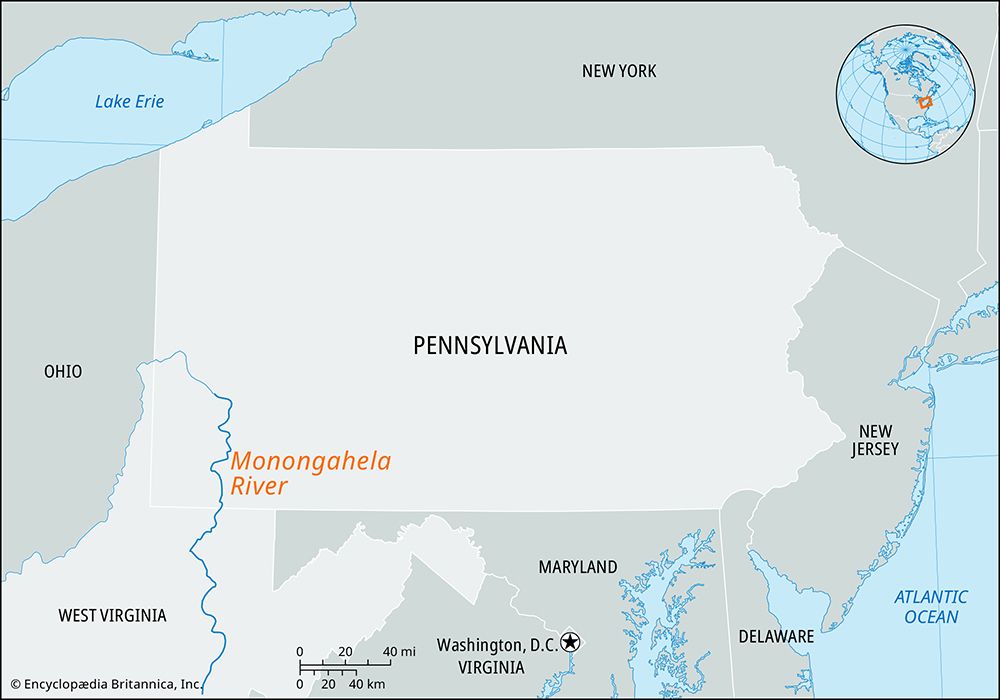
The Monongahela River is a 128-mile (206 km) waterway in the United States, formed by the confluence of the Tygart and West Fork rivers in Marion County, West Virginia. It flows in a northerly direction through West Virginia and Pennsylvania, passing cities such as Morgantown, Brownsville, and Charleroi.12
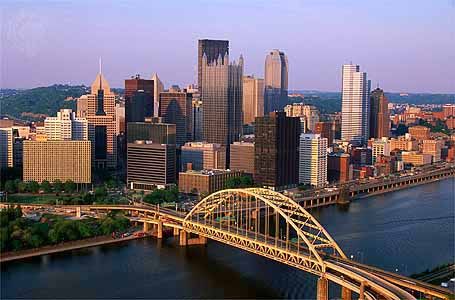
At Pittsburgh, the Monongahela joins the Allegheny River to form the Ohio River, serving as one of its major headwaters. The river is a vital commercial artery; it is made navigable through a system of locks and functions as a significant barge route for the transport of coal, coke, iron, and steel. Additionally, the river’s upper reaches provide hydroelectric power to several municipalities.13
How do locks and dams help make rivers navigable for large barges?
Locks and dams work together to transform a river into a series of level steps, allowing large barges to navigate sections that would otherwise be too shallow, turbulent, or steep.
The Role of Dams
Dams act as impounding barriers that raise the water level of a river, creating a deep, calm pool known as an “upper pound.” This process, often called canalization, ensures that the river has sufficient depth to support heavy commercial traffic.5
The Function of Locks
A lock is a specialized chamber that allows vessels to move between these different water levels:
- Entering: A barge enters the lock chamber, and the gates are closed behind it.65
- Equalizing: If the vessel is moving downstream, water is drained from the chamber through sluices until the level matches the lower section of the river. If moving upstream, water is pumped in until the level matches the upper pool.65
- Exiting: Once the water levels are equalized, the gates at the destination end open, allowing the barge to proceed.65
This system enables navigation through significant elevation changes while maintaining a controlled, low-turbulence environment for safe passage.65
What is the historical significance of the confluence at Pittsburgh?
The confluence of the Allegheny River and the Monongahela River at Pittsburgh, which forms the Ohio River, has long been a site of immense strategic and commercial importance.27
Strategic Military Significance
During the 18th century, this location—often referred to as the “Forks of the Ohio”—became a focal point of the struggle between the French and the British for control of the North American interior. The French established Fort Duquesne in 1754 to secure their territorial claims, but they were expelled by British forces in 1758. The British subsequently constructed Fort Pitt in 1761 to solidify their dominance over the region.27
Commercial and Industrial Growth
Following the American Revolution, the site served as a vital outfitting point for settlers traveling westward. Its strategic position and access to natural resources fueled Pittsburgh’s rise as a major industrial center, particularly in the iron and steel industries. The confluence remains a critical transportation hub, supporting Pittsburgh’s status as one of the nation’s largest inland ports.7
How does the Allegheny River differ from the Monongahela River?
The Allegheny River and the Monongahela River differ primarily in their origins, flow directions, and primary economic roles:
- Origins and Flow: The Allegheny rises in the hilly plateau of Potter County, Pennsylvania, and flows in a generally northward direction into New York before turning southwest to reach Pittsburgh. In contrast, the Monongahela is formed by the confluence of the Tygart and West Fork rivers in West Virginia and flows northward into Pennsylvania.41
- Length and Drainage: The Allegheny is longer, stretching 321 miles (516 km) and draining an area of 11,700 square miles. The Monongahela flows for 128 miles (206 km).41
- Economic Function: While both rivers are essential to the Ohio River system, the Monongahela is a heavily utilized barge route for transporting coal, coke, iron, and steel, and it provides hydroelectric power in its upper reaches. The Allegheny was historically significant for keelboat navigation and features several dams built for flood control and navigation.14
Sources
- Monongahela River — Encyclopædia Britannica
- Ohio River — Encyclopædia Britannica
- Monongahela — Merriam-Webster
- Allegheny River — Encyclopædia Britannica
- lock — Encyclopædia Britannica
- canals and inland waterways - Locks — Encyclopædia Britannica
- Pittsburgh — Encyclopædia Britannica
- Canada - The growth of Anglo-French rivalry — Encyclopædia Britannica
Published on · 3 min read