Mont-Saint-Michel
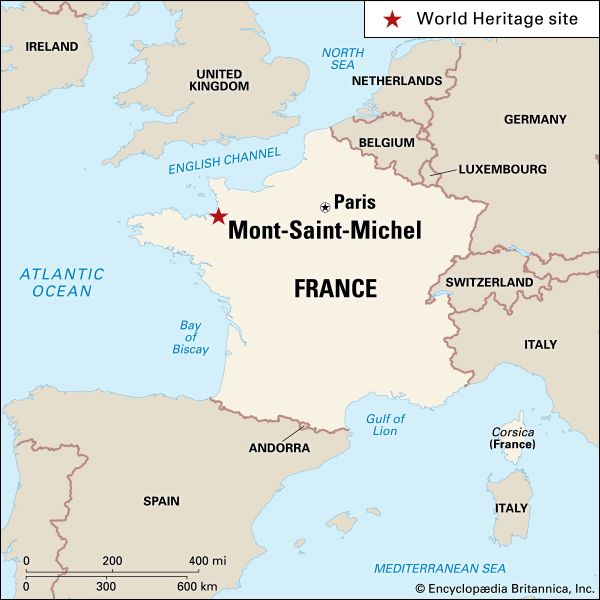
Mont-Saint-Michel is a granite outcrop that rises sharply to 256 feet (78 meters) out of Mont-Saint-Michel Bay. Rather than forming as an island through…
How did Mont-Saint-Michel form as an island, and what are its unique geographical features?
Mont-Saint-Michel is a granite outcrop that rises sharply to 256 feet (78 meters) out of Mont-Saint-Michel Bay. Rather than forming as an island through traditional geological processes, it is a rocky islet situated within a bay characterized by extreme tidal variations.12
Its unique geographical features include:
- Tidal Dynamics: The site is surrounded by vast sandbanks for much of the day. It only becomes a true island during very high tides. The region experiences some of the most dramatic tidal shifts in the world, with water levels rising significantly during spring and autumn.12
- Hazardous Terrain: Historically, the area surrounding the mount was known for quicksand and exceptionally fast-rising tides, which made the site notoriously difficult to reach.1
- Human-Altered Landscape: A 3,000-foot causeway was constructed to connect the islet to the mainland. This structure has acted as a barrier to natural tidal currents, leading to the accumulation of higher sandbanks between the mount and the coast.1
How has Mont-Saint-Michel been depicted in art and literature throughout history?
Sorry, the Britannica knowledge base does not contain information regarding the depiction of Mont-Saint-Michel in art and literature.
What are some of the most notable buildings and structures on Mont-Saint-Michel?
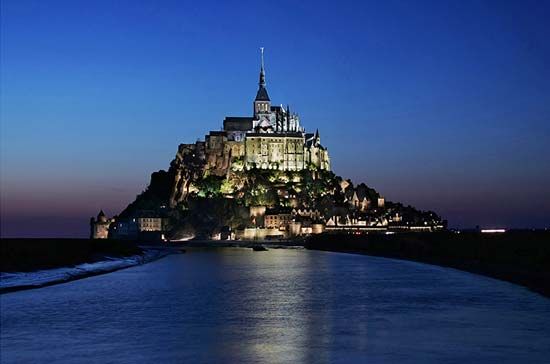
Mont-Saint-Michel features a variety of historic structures that reflect its evolution from a religious sanctuary to a fortified site. Notable buildings and features include:
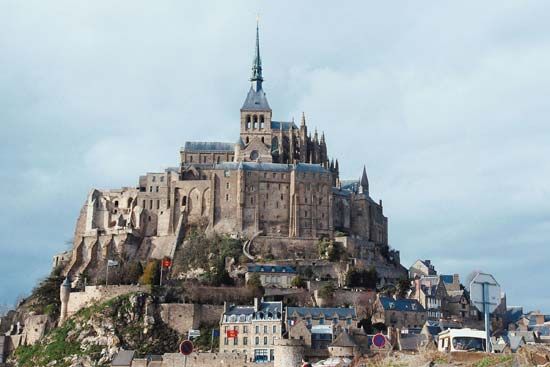
- The Abbey: Crowning the mount, this complex includes an 11th- and 12th-century Romanesque nave and an elegant choir built in the Flamboyant Gothic style between 1450 and 1521. The church is supported by three crypts, the oldest of which dates back to the 8th–10th century.1
- La Merveille: This splendid Gothic monastery, completed by 1228, is renowned for its dual nature as a religious building and a military fortress. Its most striking elements include a refectory with high, narrow windows and a magnificent cloister featuring fine sculptures.1
- Medieval Walls and Towers: Dating from the 13th to the 15th century, these fortifications line the southern and eastern sides of the mount and offer panoramic views of the bay.1
- Village Houses: The narrow street winding up toward the abbey is lined with historic houses, some dating to the 15th century, which now primarily serve as shops and hotels for visitors.1
- St. Aubert’s Oratory: The original site of the mount’s religious foundation, established in the 8th century.1
What role did Mont-Saint-Michel play during times of conflict, such as the Hundred Years’ War?
Mont-Saint-Michel served as a critical strategic stronghold during times of conflict, most notably throughout the Hundred Years’ War (1337–1453) between England and France. Due to its unique geography—a rocky islet surrounded by treacherous tides and quicksand—the site was naturally defensible, a feature further enhanced by the construction of fortifications in 1256.1
During the Hundred Years’ War, the mount successfully resisted multiple English sieges, serving as a symbol of French resilience. Its defensive capabilities were bolstered by the integration of military architecture into its monastic structures; for instance, the Gothic monastery known as La Merveille was designed to combine the simplicity of a religious building with the powerful characteristics of a military fortress.1
The site’s role as a fortified position continued into the 16th century, when it again resisted sieges during the French Wars of Religion (1562–1598).1
Sources
- Mont-Saint-Michel — Encyclopædia Britannica
- Mont-Saint-Michel — Merriam-Webster
- Gulf of Saint-Malo — Encyclopædia Britannica
- Saint Michael’s Mount — Encyclopædia Britannica
- Great Wall of China - Walls — Encyclopædia Britannica
- Fontevrault-l’Abbaye — Encyclopædia Britannica
- Abbey — Encyclopædia Britannica
Published on · 3 min read