Monteregian Hills
The Monteregian Hills are a series of eight butte-type mountains located in the St. Lawrence River valley in southeastern Quebec, Canada. Stretching…
What is Monteregian Hills?
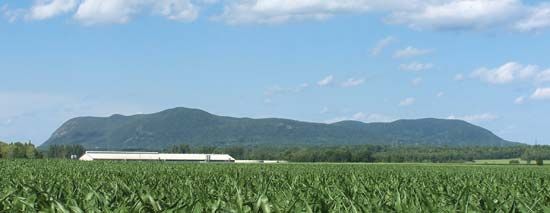
The Monteregian Hills are a series of eight butte-type mountains located in the St. Lawrence River valley in southeastern Quebec, Canada. Stretching approximately 50 miles (80 km) from the Île de Montréal toward the Appalachian Highlands, these formations are composed of igneous rock1.1
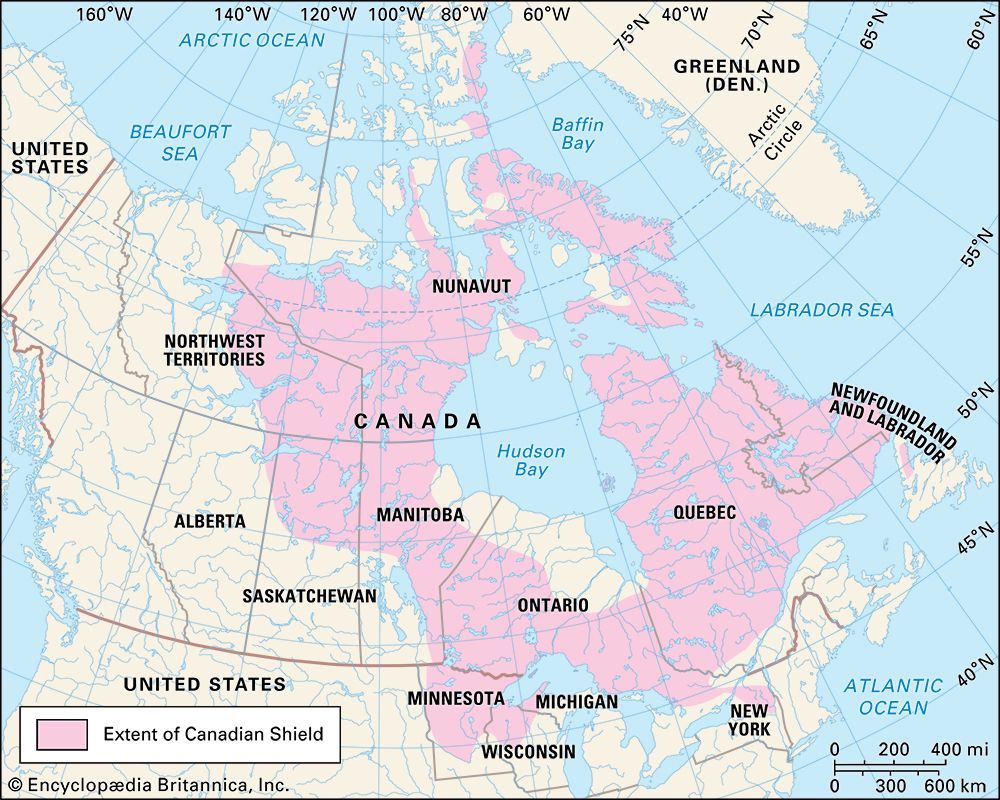
The name, which translates to “Royal Mountain,” was coined by the explorer Jacques Cartier in 1535. The most prominent of these is Mont-Royal, which features three distinct peaks: Mont-Royal, Westmount, and Côte-des-Neiges. The remaining seven mountains in the series are Saint-Bruno, Saint-Hilaire (Beloeil), Saint-Grégoire (Johnson), Brome, Rougemont, Yamaska, and Shefford. Geographically, these hills are distinct from the much older Laurentian Mountains, which are part of the Canadian Shield2.1
How are igneous rocks formed?
Igneous rocks are formed through the cooling and solidification of molten earth material, known as magma or lava. Magma is generated deep within the Earth, typically at depths below 60 kilometers, and rises toward the surface because it is less dense than the surrounding solid rock.34
The formation process is categorized based on where the cooling occurs:
- Intrusive (Plutonic) Rocks: These form when magma cools slowly deep within the Earth’s crust. This slow cooling allows for the growth of large, visible mineral crystals, resulting in a phaneritic texture.4
- Extrusive (Volcanic) Rocks: These form when magma erupts at the surface as lava or pyroclastic material. Because the material is chilled rapidly, minerals have little time to grow, often resulting in an aphanitic (fine-grained) or glassy texture.4
The texture of these rocks—defined by the size, shape, and arrangement of their crystals—is primarily determined by the rate of cooling, though diffusion and nucleation rates also play significant roles.5
What is the history of Mount Royal in Montreal?
Mount Royal is a prominent feature of the Montreal landscape, rising to 763 feet (233 meters) and serving as the focal point around which the city was built. The mountain’s name, derived from the Latin Mons Regius (“Royal Mountain”), was first applied by the French explorer Jacques Cartier in 1535.16
Geologically, the mountain is part of the Monteregian Hills, a series of eight igneous butte-type mountains in the St. Lawrence River valley. It consists of three distinct peaks: Mont-Royal, Westmount, and Côte-des-Neiges.1
The mountain has long held cultural and architectural significance for the city:
- Mount Royal Park: The city’s famous park on the mountain was designed by the renowned American landscape architect Frederick Law Olmsted, who is also known for designing New York City’s Central Park.7
- Religious Landmarks: The mountain is home to St. Joseph’s Oratory, a monumental Renaissance-style basilica featuring a large white dome that marks the highest point in the city at 856 feet (260 meters) above sea level.8
- Residential Development: The flanks of the mountain are home to some of the city’s most affluent neighborhoods, including Westmount and Outremont.8
What are the main differences between the Monteregian Hills and the Laurentian Mountains?
The Monteregian Hills and the Laurentian Mountains are distinct geological features in Quebec, differing significantly in their formation, age, and physical structure.
Geological Origins and Age
- Monteregian Hills: These are a series of eight igneous rock formations that appear as buttes in the St. Lawrence River valley.1
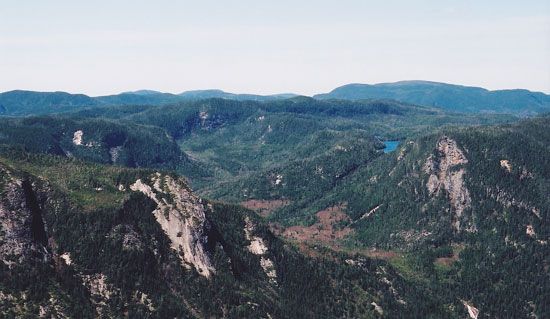
- Laurentian Mountains: This range forms the Quebec portion of the Canadian Shield. It is among the oldest mountain regions globally, composed of Precambrian rocks that are more than 540 million years old.10
Physical Characteristics
- Structure: The Monteregian Hills extend about 50 miles (80 km) from the island of Montreal toward the Appalachian Highlands, characterized by steep northeast crests and gradual southwest slopes. In contrast, the Laurentian Mountains have been worn down over time into a rocky peneplain—a vast erosional plain—featuring relatively uniform crests.110
- Elevation: The Laurentian Mountains are significantly higher, with average crests of 3,000 feet (900 meters) and a maximum elevation of 3,905 feet (1,190 meters). The Monteregian Hills are much smaller; for example, Mont-Royal reaches only 763 feet (233 meters).101
Sources
- Monteregian Hills — Encyclopædia Britannica
- Laurentian Mountains — Encyclopædia Britannica
- rock: Top Questions — Encyclopædia Britannica
- igneous rock — Encyclopædia Britannica
- texture — Encyclopædia Britannica
- Frederick Law Olmsted — Encyclopædia Britannica
- Mont-Royal — Merriam-Webster
- Montreal - City site — Encyclopædia Britannica
- Montreal - City layout — Encyclopædia Britannica
- Laurentian Mountains — Merriam-Webster
Published on · 3 min read